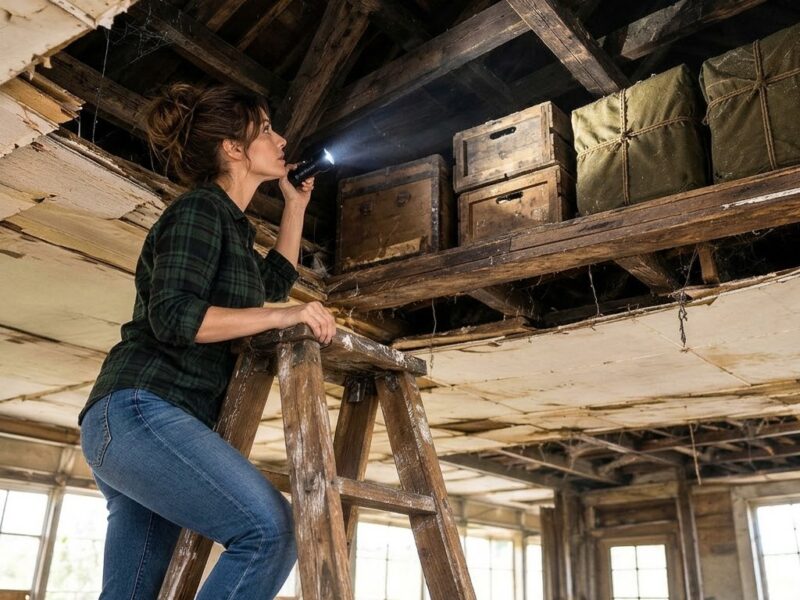
She Bought a Deserted General Store for $5—What Was Hidden in the Rafters Was Untouched for Years
The Return to Oak Haven
The black SUV left Oak Haven quietly, carrying away the ghosts of the 1930s.
Three days later, the funds cleared into a newly opened commercial bank account. Cora sat in her rusted Subaru in the bank parking lot, staring at the mobile app on her phone. The string of zeros felt like a strange digital illusion.
She turned off the engine, stepped out of the car, and walked two blocks down Main Street.
The bell above the door of Oak Haven Feed and Seed jingled loudly. The store smelled of fertilizer, cut pine, and oiled leather. Gibson was behind the counter reading a newspaper. He looked up, his sharp eyes narrowing as he recognized her.
“Thought you’d be gone by now,” he grunted, folding the paper. “Haven’t seen you dragging trash to the alley in a few days. Figure that roof finally caved in on you.”
Cora walked up to the counter. She reached into her pocket and pulled out the heavy forged-steel pry bar he had lent her. She placed it carefully on the glass counter.
“I came to return this,” Cora said, “and to place an order.”
Gibson looked at the pry bar, then at her. “An order?”
“I need lumber. A lot of it. I need twenty squares of architectural shingles, three rolls of roofing underlayment, and enough drywall to cover 3,000 square feet. I also need plumbing fixtures, commercial-grade electrical wiring, and a dozen gallons of copper ceiling paint.”
Gibson stared at her, motionless. The silence in the hardware store was absolute.
“You’re out of your mind, girl,” Gibson finally said, his voice dropping an octave. “You can’t afford that. And even if you could, it’s throwing good money after bad. The Hayes place is dead.”
“It’s not dead,” Cora said. Her voice was even, grounded, stripped of the cynical armor she had worn for years. “It just needed someone to clear out the rot. I have the money, Mr. Gibson. All of it.”
She slid a piece of paper across the counter. It was a printed bank statement, the account numbers blacked out. The bottom line was clearly visible.
Gibson adjusted his glasses, leaning over the counter to look at the paper. He froze. He looked at the number, looked up at Cora, and looked back at the number. He didn’t ask where it came from. In a town like Oak Haven, you learned not to ask questions when a miracle walked through the door. You just nodded and got to work.
“You’re staying,” he said quietly.
“I’m staying,” Cora agreed. “I also need a crew. I know half the contractors in this town are out of work. I want to hire local—prevailing wage plus 20%. I want a new roof on that building by the end of the month.”
Gibson slowly slid the paper back to her. A faint, begrudging smile touched the corners of his mouth. It was the first time she had seen his expression soften.
“All right, kid,” he said. “Let’s build a hardware order.”









