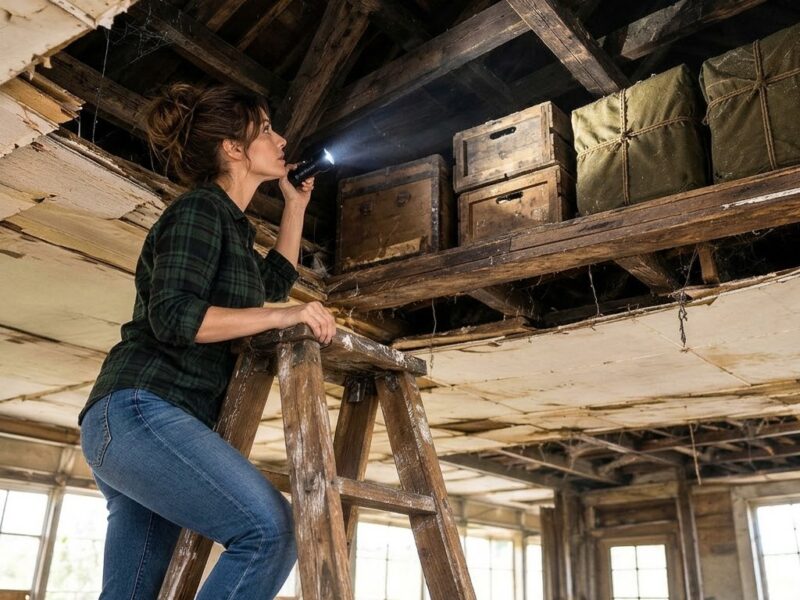
She Bought a Deserted General Store for $5—What Was Hidden in the Rafters Was Untouched for Years
The Valuation
The next twenty-four hours were a masterclass in agonizing restraint.
Cora drove back to the store and sat inside the darkened, stifling space with her crowbar across her lap. She listened to the floorboards groan as the temperature shifted. She listened to the distant hum of pickup trucks rolling down Main Street.
Arthur arrived at 10:00 the next morning in a rented black SUV. He was a wiry man in his late forties, wearing thick-rimmed glasses and a tailored linen jacket that looked entirely out of place in Oak Haven. He carried a heavy aluminum Halliburton briefcase.
Cora let him in through a side door and quickly locked it behind him.
Arthur didn’t look at the peeling wallpaper. He didn’t look at the collapsed plaster or the water stains. His eyes locked onto the five wooden crates sitting in the center of the room. He walked toward them slowly, like a man approaching a wild animal.
He opened his briefcase and pulled out a pair of white cotton archival gloves. He slipped them on, knelt in the dust in his expensive trousers, and reached into the first crate.
He lifted a denim jacket. He checked the pleats, the single pocket, the shape of the metal buttons. He turned it over, tracing the stitching with a trembling, gloved finger.
“My God,” Arthur whispered.
The cynicism and slickness of a big-city dealer evaporated completely. He was just a man looking at a miracle. “The stitching is flawless. The dye hasn’t oxidized. It’s a time capsule.”
He moved from crate to crate, counting, inspecting, documenting with a high-end camera. He worked in absolute silence for two hours.
Finally, Arthur sat back on his heels. He pulled off his gloves, his hands shaking slightly. He looked up at Cora.
“You found the motherlode,” he said, his voice quiet in the vast, empty space. “During the Depression, dry goods were better than cash. A merchant out here must have hoarded his best stock, wrapping it in waterproof canvas to keep the damp out, hiding it from creditors, or maybe just from desperation. He basically created a vacuum seal.”
“What are they worth?” Cora asked. The question felt heavy in her mouth.
Arthur adjusted his glasses. “The market for dead-stock denim is highly specialized. If we flood the market with 120 pieces, the individual value drops. But I represent a consortium of private collectors and two textile museums in Japan and London. I can buy the entire lot from you in a single private transaction. No auctions, no public spectacle.”
He pulled a checkbook from his breast pocket and a silver pen. “I will write you a cashier’s check right now, drawn on a corporate escrow account, for $2.4 million. We will load the crates into my vehicle, and you will never have to worry about this building or this town ever again.”
Cora stared at him. The number didn’t seem real. It sounded like monopoly money.
2.4 million.
It was enough to move back to Chicago. It was enough to buy a condo overlooking the lake, to never worry about an eviction notice, to never haul bags of rotted garbage again.
She looked at the checkbook. Then she looked at the heavy iron pry bar resting on the floorboards nearby. She looked up at the gaping hole in the drop ceiling, exposing the beautiful original wooden joists of the old building.
“2.4,” Cora repeated.
“Cash in hand,” Arthur said.
Cora stood up. She walked over to the crates and gently closed the lid of the one containing the jackets. She fastened the rusted latches.
“I’ll take the deal,” she said, “on one condition.”









