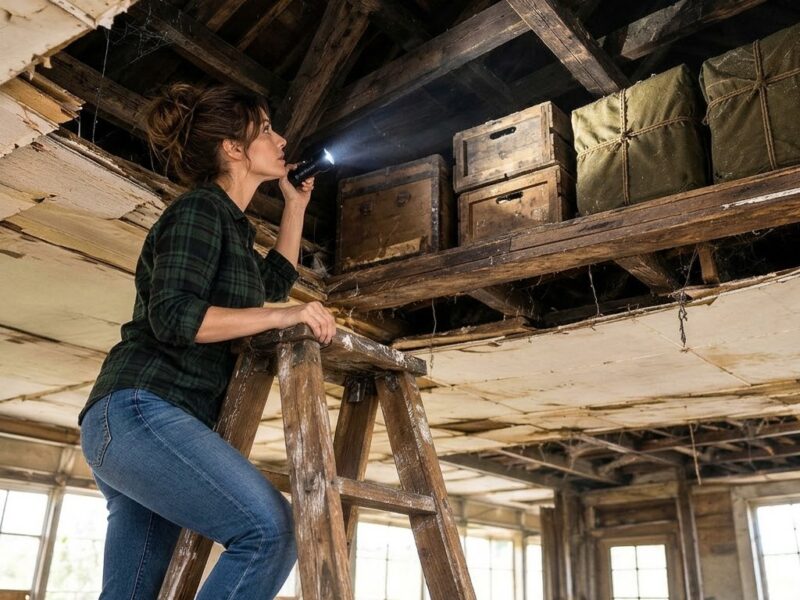
She Bought a Deserted General Store for $5—What Was Hidden in the Rafters Was Untouched for Years
The Monoliths
Getting them down took three hours.
It wasn’t a matter of simply pulling. The crates were heavy—impossibly heavy. Cora guessed the smallest one weighed at least sixty pounds, the largest closer to one hundred. The beadboard ceiling was groaning, threatening to collapse entirely if she shifted the weight wrong. She had to tear away an entire eight-foot section of the drop ceiling, piece by agonizing piece, dodging showers of debris, dead insects, and decades of filth.
By the time she had a clear opening, her arms were trembling with exhaustion. Her shirt was soaked through with sweat, and her knuckles were bleeding freely into her leather gloves.
She dragged an old wooden A-frame ladder from the basement to replace the crate. It was rickety, wobbling dangerously with every step she took. Cora stood on the second-to-highest rung, her head and shoulders up inside the rafter space. The air up here was dead. It felt untouched by time.
She grabbed the thick hemp rope wrapping the nearest crate. The rope was dry and brittle, cutting into her gloves. She pulled. The crate scraped against the wooden joist with a terrible, low groan.
“Come on,” she grunted, her teeth gritted.
She braced her boots against the rungs of the ladder and hauled backward. The crate slid forward, clearing the joist. Suddenly, the entire weight of it dropped into her arms.
Cora gasped, her knees buckling. The ladder swayed violently. For a terrifying second, she thought she was going backward, taking the crate and the ladder with her to the floor. She slammed her shoulder against the wall, pinning the heavy bundle against her chest, gasping for air.
Slowly, agonizingly, she backed down the ladder, step by step, clutching the canvas-wrapped block like a lifeline. When she reached the floor, she let it drop.
Thump!
The sound resonated through the floorboards, kicking up a fresh cloud of dust.
She did this four more times. Each descent was a battle of endurance. By the fifth crate, her muscles had stopped burning and gone entirely numb. Her hands shook so badly she could barely grip the rungs of the ladder.
When it was over, Cora sat on the floor, her back resting against a support pillar, her chest heaving. Before her sat five heavy rectangular blocks. They were arranged in a rough semicircle on the floorboards. In the dim light filtering through the cracked front windows, they looked like primitive monoliths.
Cora took off her respirator and let it hang around her neck. She wiped her bleeding hands on her jeans, ignoring the sting. She stared at the bundles.
Fear. That was the first clear emotion that cut through her exhaustion.
When you find something hidden in the walls of a forgotten building, the rational mind jumps to the worst conclusions. Drugs? Money from a bank robbery? Something illegal, something dangerous, something that people might come looking for? The town of Oak Haven didn’t seem like the setting for a cartel stash, but desperation makes people do strange things.
She reached for the pry bar lying on the floor beside her. She needed a knife. Cora pushed herself up, her joints popping, and walked to her tool bag. She pulled out a retractable utility knife, the bright orange plastic handle jarring against the muted grays and browns of the store.
She knelt beside the smallest crate. The hemp rope was tied in intricate, hardened knots. It wasn’t standard tying; it looked nautical, deliberate, and secure. She slid the razor blade under the rope. The blade snagged, then sliced cleanly through the brittle fibers.
The tension released with a sharp snap. Cora cut the remaining ropes, pulling them away. They crumbled into dry dust in her hands.
Now, the canvas.
It was thick, military-grade oiled canvas designed to keep moisture out. It felt stiff, almost like thin plywood. Cora dug her fingers under the overlapping folds at the top of the bundle. She pulled hard. The canvas was stuck to itself, bonded by years of pressure and temperature changes.
She gripped the fabric with both hands and wrenched it backward. The canvas peeled open with a sound like ripping velcro.
Underneath was a wooden crate. The wood was pale, clean, and surprisingly pristine, protected perfectly by the oiled canvas and the dry, dark environment of the rafters. It wasn’t cheap pine. It looked like solid oak or cedar, constructed with tight dovetail joints.
There were letters stencled on the top lid in faded black ink. Cora leaned in close, brushing away a fine layer of dust with her thumb.
The lettering was old-fashioned, the kind of typography you’d see on antique advertisements:
L. S. & CO. San Francisco, Cal. Lot 501X
Cora frowned. She read the words again. L.S. & Co.
She rocked back on her heels, her mind struggling to process the information. Denim jeans? Why would someone hide a crate of work pants in a false ceiling, wrapped in waterproof canvas like it was stolen gold?
She looked at the lid of the crate. It wasn’t nailed shut; it was secured by two heavy iron latches on either side. Cora reached out. Her fingers were trembling again, but not from fatigue this time.
She flipped the first latch. It resisted for a second, rusted shut, before giving way with a metallic clack. She moved to the other side and flipped the second latch. She placed her hands flat on the wooden lid, took a deep breath, and lifted.
The lid swung open.
A scent drifted up from the crate. It wasn’t the smell of rot or rat droppings. It was the sharp, distinct scent of raw indigo dye, dry cotton, and old paper.
Inside the crate, packed tightly in rows, were folded stacks of dark blue fabric. Cora reached out slowly. She touched the top item. The fabric was incredibly stiff, almost rigid. It felt nothing like modern clothing. She hooked her fingers under the fold and pulled the garment out.
It was a pair of jeans, but they looked strange. She stood up, holding them out by the waist.
The denim was a deep, inky, unwashed blue. There was a buckle strap on the back waist—a cinch-back—something she had only seen in historical photographs of gold miners and cowboys. The rivets were made of dull copper, protruding heavily from the corners of the pockets. There was a leather patch sewn onto the back right waist, perfectly intact, untarnished by time.
Cora squinted at the patch. Two horses pulling a pair of jeans in opposite directions.
She looked down at the crate. There were twenty-three more pairs in there. She looked at the other four crates resting on the floor, if they were all filled with the same thing.
Cora wasn’t a historian, and she certainly wasn’t a fashion expert, but she lived in the modern world. She had seen the articles online, the strange, esoteric auction news that pops up on social media feeds. She remembered reading about vintage denim collectors, Japanese buyers, and American archivists who paid exorbitant sums for authentic, unworn workwear from the early 20th century. Dead stock, they called it.
She looked closer at a small paper tag still stapled to the back pocket of the jeans in her hands. The typography was distinctly 1920s or 1930s.
“No,” Cora whispered to the empty room. “It can’t be.”
She dropped the jeans back into the crate and ran to the second bundle. She didn’t bother cutting the ropes this time; she grabbed her utility knife and slashed violently through the canvas, tearing away strips.
Another cedar crate, stencled letters: L.S. & Co. Lot 500. Denim Jackets. Qty: 24.
Cora fell to her knees. Her breath was coming in short, panicked gasps. She looked around the cavernous, rotting store she had bought for $5, the peeling wallpaper, the sagging floors, the broken glass.
Someone hadn’t just abandoned inventory. Someone in the 1930s had hoarded the most durable, valuable dry goods they possessed, packed them in waterproof canvas, and hidden them away in the rafters. Maybe the bank was foreclosing. Maybe the Great Depression had driven them to paranoia. They had hidden them, and then, for whatever reason, they had never come back to claim them.
Cora stared at the piles of blue gold sitting in the dust. The cynical armor she had worn for years—the heavy protective shell that kept her from hoping for anything good—cracked right down the middle. She was sitting on a fortune, and her life was never going to be the same.









