She Found 20-Inch Limestone Walls From an Old Relay Station — Added a Sod Roof and Forgot the Cold
The Ruins on the Rise
Celia Horn came into the valley on a Thursday. Most people only remembered the specific day afterward because Dewey Larch, the owner of the local timber mill, had been unloading a massive order of fresh pine when her wagon rolled past his yard.
Dewey had leaned on his peavey hook, watching her from the gate, and concluded instantly that she was lost.
She drove a heavy freight wagon pulled by two exhausted draft horses and a reluctant, stubborn mule tied to the tailgate. Beside her on the high wooden seat sat two children: a boy of twelve named Nate, who had the watchful eyes of a much older man, and a girl of nine named Pearl, whose blonde hair was tucked fiercely beneath a woolen cap.
Celia herself drove with the rigid posture of someone who had been driving a very long time and intended to drive just a little further. Her face was weathered by the trail, her jaw set.
Instead of heading toward the center of the settlement, she pulled the reins, turned the heavy wagon at the fork above Milner Creek, and headed up the steep grade toward the old relay station ruins on the eastern rise. It was absolutely not the direction anyone expected a woman with two children to go.
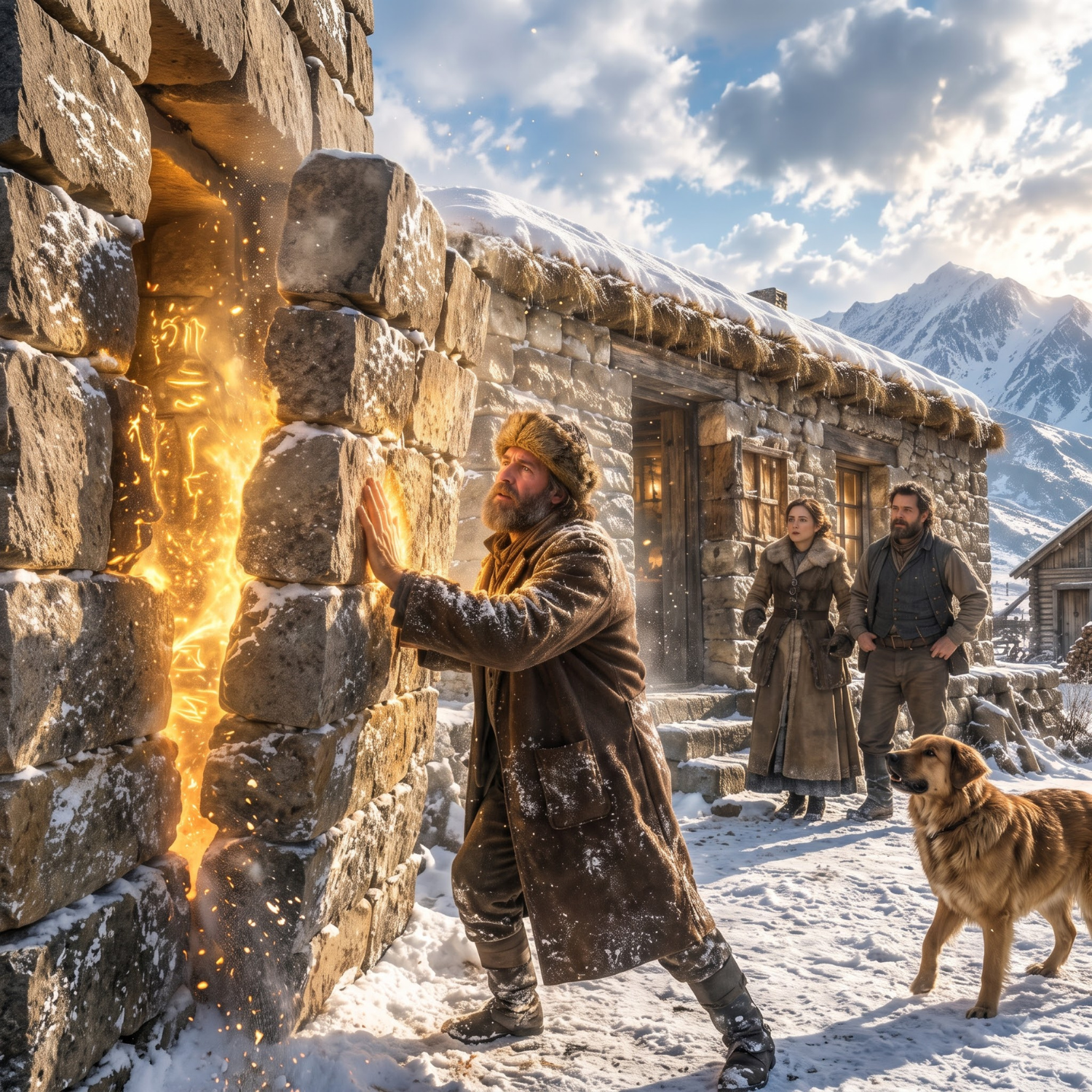
The relay station had served a stagecoach line that had folded back in 1879. The building itself had been constructed sometime in the brutal, chaotic 1860s out of massive blocks of cut limestone hauled up from a quarry several miles south. Whoever had built it had not been careless, nor had they been concerned with speed. The walls ran an astonishing twenty inches thick. They had survived a decade of utter abandonment without collapsing—which was a feat far beyond what most of the wooden structures down in the valley could have managed.
But to the eye of a pioneer, it was a graveyard. The roof had rotted and blown away years ago. The interior was choked with a decade of wind-collected debris, dead sagebrush, and animal bones. The mortar between the massive stones had crumbled into pale dust in places, and the entire northeast corner had settled crookedly after a wet spring pushed the earth beneath it.
Most settlers who looked up at the property saw a building that was already dead. A monument to failure.
Celia Horn saw it entirely differently. Though at the time, if pressed, she would have had no way to explain exactly why—at least not in words that would have satisfied the practical, timber-minded men of Harrow Flats.
Her reasons were born in the dark.
She had come from the eastern edge of the territory, where her husband, Thomas, had died of a sudden, violent fever the previous spring. The winter before his death had left scars on Celia that she rarely spoke about.
They had lived in a rented wooden cabin during those months. It was a typical frontier structure: poorly insulated, drafty, built quickly with green wood by a man who had moved further west before the first cold snap even arrived.
Celia had spent the entirety of that January sitting awake in a rocking chair, watching her children sleep in their heavy winter coats under piles of quilts. She had spent hours pressing torn rags and mud into the shrinking gaps between the wallboards, only to find them violently pushed out again by the howling wind the following morning. The iron stove in the center of the room consumed wood at a rate that terrified her, demanding to be fed every two hours. Yet, despite the roaring fire, the water in the bucket at the far corner of the single room was always frozen solid by dawn.
Nate had developed a deep, rattling cough that lingered like a ghost until the April thaw. Pearl had kept her wool hat pulled down over her ears inside the house for so many consecutive weeks that it had literally left a permanent impression in her fine hair.
But it wasn’t the physical cold itself that haunted Celia the most. What stayed with her, what kept her awake staring at the stars on the trail west, was the absolute helplessness of it. The helplessness of watching a fire burn furiously, consuming their precious fuel, and knowing the warmth was already leaving the building before it had a chance to settle anywhere useful. The heat was a temporary visitor in a house of wood.
She had made herself a promise somewhere in those long, shivering nights. It was not a dramatic, weeping promise. It was just a quiet, iron-clad resolution.
Whatever I build next, she had sworn, I will build it so the warmth can stay.
By the time she pulled the heavy wagon into Harrow Flats, that vague promise had grown highly specific.
Weeks earlier, during her grueling journey west, she had stopped the wagon one afternoon beside a ruined, old stone wall at an abandoned farm she was passing through. She had walked over to it to seek some shade. But when she accidentally pressed her hand against the surface of the stone, she had stopped breathing for a second.
The stone had been warm. Genuinely, deeply warm. Not just free of chill, though the afternoon sun had already begun to sink and the air was rapidly cooling. No fire had burned anywhere near the wall in years. Yet the rock held the heat of the afternoon sun like a living thing.
She stood there for several minutes, her palm flat against the masonry. She never entirely explained what she concluded on the side of that dusty road. But whatever revelation passed from the stone into her hand was enough to make her specifically look for land with standing stone walls when she finally arrived in Harrow Flats.
The relay station ruins were the only thing available within her meager widow’s means. She paid for the deed in hard currency at the assayer’s office on a Friday.
She began hauling the debris out of the interior on Saturday morning.