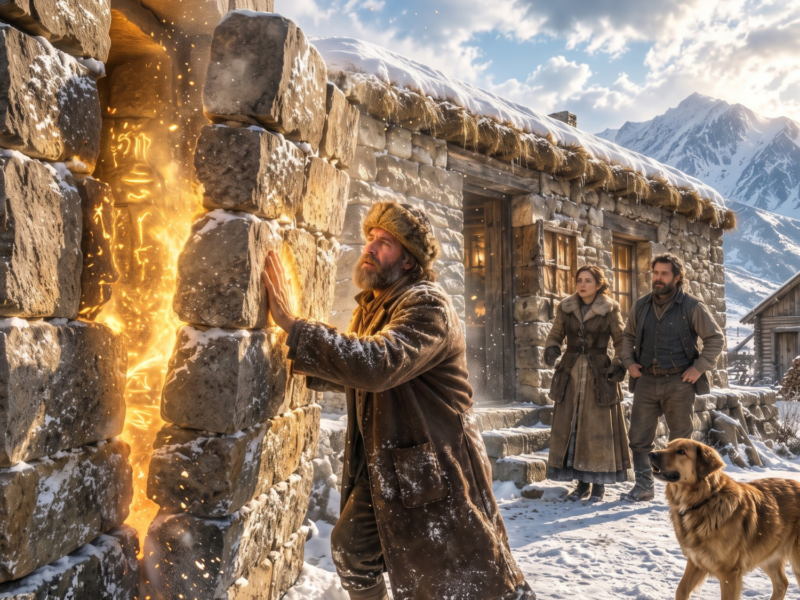
She Found 20-Inch Limestone Walls From an Old Relay Station — Added a Sod Roof and Forgot the Cold
The Thirty-One Below
December arrived hard, fast, and utterly merciless.
A week of cold that even the oldest, most hardened settlers called the worst they had ever seen crossed the valley between Christmas and New Year’s Day. The temperatures dropped past twenty below zero and simply kept dropping, as if the bottom had fallen out of the thermometer.
The wind came screaming down from the northwest without a single hour of interruption for three consecutive days. Fence posts disappeared entirely into massive, sculpted drifts. Livestock that hadn’t been brought into barns stood motionless in the fields, thick white frost building up in halos around their eyes and nostrils.
A scientific thermometer at the railway station near the ridge recorded thirty-one degrees below zero on the morning of the 28th.
Across Harrow Flats, familiar, terrifying trouble returned.
Inside the wooden cabins, cast-iron wood stoves ran through cordwood at a frightening, unsustainable pace. Families, desperate for survival, dragged their heavy iron beds across the rooms, positioning them as close to the hearths as they dared without catching the blankets on fire. Fathers woke every two hours in the pitch dark, their breath freezing in the air, to frantically feed fires that had fallen to embers.
Vernon Chalk, whose own cabin was widely considered to be among the tightest and best-built in the entire valley, woke three separate times during the night to find that the temperature inside his bedroom had dropped ten degrees while he slept. The wind was simply forcing the cold through the grain of the wood itself.
On the third morning of the deep freeze, when Vernon rose before dawn for the fourth time to stoke the stove, he sat beside the rekindled fire, wrapped in a buffalo robe. He looked at his perfectly joined corners and his impeccably milled floorboards. And he admitted a hard, bitter truth to himself: something he had built perfectly was still not enough to fight the sky.
That was the morning he went looking for his lost heifer.
The search carried Vernon through waist-deep drifts and across the frozen, howling lower fields. When the tracks he was following turned toward the eastern rise, he followed them, leaning his heavy body into the wind, trudging up the grade toward the old relay station.
He almost missed the structure entirely.
It sat incredibly low beneath its thick sod roof, dark, silent, and nearly invisible against the blinding white hillside. It didn’t look like a house; it looked like a snowdrift that had grown square edges.
If the tawny hound, Cinder, had not been lying outside in a shallow, wind-protected depression of packed snow near the entrance, Vernon might have walked right past it without looking twice.
He was stepping past the corner of the building when a sudden, violent gust of wind came screaming down from the ridge. Vernon lost his footing on a piece of buried ice. He stumbled hard, throwing out his right hand to catch himself against the wall of the house.
His bare palm landed flat, hard, against the exterior limestone.
He stopped. He froze in place.
In temperatures of thirty-one below zero, touching anything with exposed skin announced itself almost immediately. It is a sharp, gathering burn that turns to agonizing numbness within seconds. Touching freezing stone should have felt like grabbing a block of dry ice. It should have bitten him.
The stone wall did not bite him.
Vernon stood up straight, leaving his hand pressed against the surface. He waited for the agonizing pain. It did not come.
The stone was not warm. Not the way a roaring fire was warm. Not the way a cast-iron stove made the air feel in a heated, enclosed room.
But the murderous, lethal cold he expected to find in the rock was entirely absent.
Something was living inside the limestone. It wasn’t heat, exactly. It was a memory of heat. It was traces of warmth, gathered patiently over weeks of afternoon sun soaking into the south face, combined with the energy of evening fires pressing into the interior masonry. That energy had settled deep into the cellular structure of the thick stone, and it was releasing slowly, quietly, stubbornly fighting back against the ambient air without drawing any attention to itself.
Vernon Chalk took off his other glove. He pressed both of his large, bare hands against the wall. He stood there in the howling blizzard for longer than was sensible, his mind racing, tearing down everything he thought he knew about building and rebuilding it from the foundation up.
Then, he walked to the heavy wooden door and knocked.
Celia opened it.
Amos stood behind her at the rough-hewn table, a cup of coffee in his hand. Nate looked up from a leather harness he was mending by the light of a window. Pearl was still sound asleep on the platform beneath two thick wool blankets.
Cinder, the hound, had trotted inside when Celia opened the door. The dog immediately walked over and curled up near the south wall, a full fourteen feet away from the hearth.
Vernon stepped inside, closing the door against the storm. He stripped off his frozen hat.
He looked at the fire on the hearth. It was modest. It was a small, contained blaze. It was absolutely not the desperate, roaring inferno Vernon had been frantically maintaining in his own cabin for three days. A quiet, stable bed of red coals glowed beneath a layer of gray ash.
Vernon took a breath. The air inside the stone house did not move. There was no freezing draft slicing across the floorboards to bite his ankles. No corner of the room sat in cold ambush.
Vernon’s expert eyes moved slowly around the room, taking in the architecture.
A wooden water bucket sitting near the far wall caught his attention. He walked over to it, pulled off his glove, and tapped the surface of the water with his finger.
Liquid. Unfrozen.
He looked at the stacked wood supply beside the door. It was robust. There should have been vastly less of it remaining, given how many days the extreme cold had been running.
He turned and looked directly at Amos Trent.
Amos did not smile. He did not boast. He simply walked over to the shelf, picked up Celia’s leather-bound notebook, and handed it to the master carpenter without being asked.
Vernon Chalk opened the book. He read through it slowly, methodically. He read the temperature entries going back to October. He read the meticulous fuel consumption logs. He studied the comparison numbers—inside temperature versus outside temperature, morning after morning. And between the hard data, he read the short, seemingly ridiculous notations about where the dog chose to sleep.
He closed the notebook and lowered it to his side.
Celia quietly poured him a tin cup of hot coffee and handed it to him.
Vernon held the cup, letting the steam warm his face. He did not speak for a very long while. The only sound in the room was the soft crackle of the fire and Pearl’s steady breathing.
“How much wood have you burned since the deep cold started?” Vernon asked finally, his voice a low rumble.
Amos told him the number. It was less than half of what Vernon had burned in his own home.
Chalk absorbed the number quietly. He stayed in the house for about an hour. He didn’t ask about the weather. He asked highly technical questions. He asked Amos about the specific ratio of the inner mortar versus the outer mortar. He asked about the depth of the drainage trench. He asked about the integration of the hearth placement into the northern wall. He asked about the load-bearing weight of the sod roof.
He pointed to the bright white square above the fire. “What is the purpose of the chalk wash on the interior stone?”
Pearl, who had woken up during the intense, quiet conversation, sat up in her blankets. She explained the concept of thermal reflection to the most respected builder in the valley with the patient, unshakeable clarity of a child who has thought a problem through and is not particularly surprised that the adults in the room had missed it.
Vernon listened to the nine-year-old girl intently. He nodded.
He finished his coffee, handed the cup back to Celia, and left the house without making a single definitive statement about what he thought of the place.
That was typical of Vernon Chalk. He processed evidence slowly, turning it over in his mind like a piece of rough timber, and he announced his conclusions only when he was absolutely certain they could bear weight.









