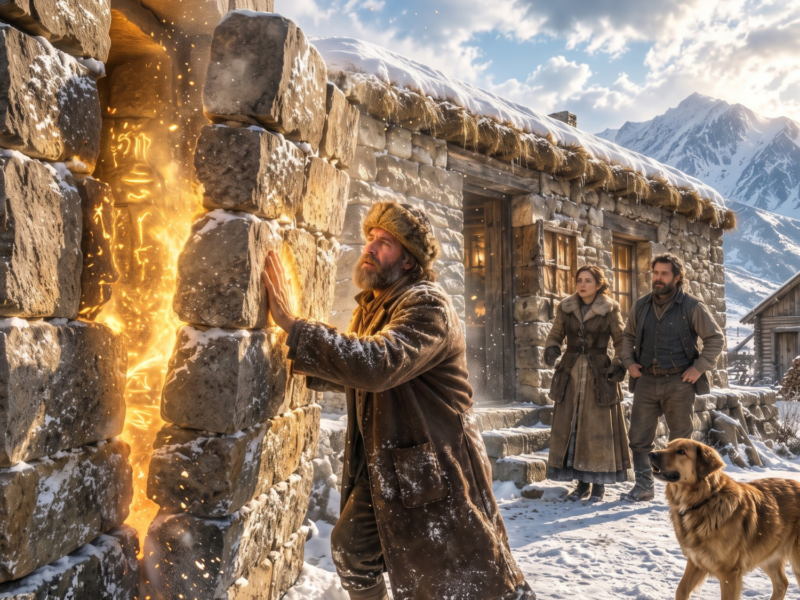
She Found 20-Inch Limestone Walls From an Old Relay Station — Added a Sod Roof and Forgot the Cold
The Adobe Mind
Amos Trent had been in Harrow Flats since May, quietly picking up whatever odd jobs and physical labor came available.
He was thirty-seven years old and possessed the thick, scarred hands and deliberate posture of a man who had spent the entirety of his life moving heavy things. He was wide across the shoulders, unhurried in his movements, with a permanent, deep-set squint that came from working outdoors at high elevation under a blinding sun.
Before drifting north to Colorado, Amos had spent eight years in the searing heat of New Mexico. He had worked doing adobe construction in and around the ancient settlements south of Santa Fe.
Working with earth and water taught a man lessons that most timber-obsessed builders in the Colorado foothills had never even encountered. It taught you that walls two feet thick and the precise mixture of mortar were not merely structural choices made to hold up a roof. They were thermal choices.
An adobe house stored heat the exact same way a heavy, seasoned cast-iron pan held it—absorbing the energy slowly, and deliberately releasing it long, long after the original heat source had gone cold. Amos had worked alongside indigenous and Mexican builders who could tell you, within a few degrees, exactly what the interior temperature of a room would be at midnight, simply based on how many hours of direct sun the south-facing wall had caught that afternoon.
He had never tried to explain this thermodynamic witchcraft to anyone in Harrow Flats. It was simply not the kind of knowledge people in a lumber-rich valley tended to ask about. They wanted to know how fast he could swing an axe or frame a stud wall.
Amos saw Celia working at the relay station ruins one crisp morning in early September.
He was riding his horse along the high ridge road. He stopped and watched her from a distance. She was carrying heavy, jagged stones from a collapsed section of the north wall, laboring under the weight, and restacking them beside the foundation.
He watched her for a full ten minutes before he understood what she was doing. She was not blindly clearing rubble to make way for a wooden cabin. She was sorting it. The larger, flatter, structural pieces went in one neat pile. The irregular, smaller stones—the rubble core—went in another.
She was preparing to rebuild the stone walls.
Intrigued, and possessing a free morning, Amos rode his horse down the grade.
Celia looked up at him as he approached, swiping a forearm across her sweating brow, but she did not stop working. She hoisted another heavy stone.
He touched the brim of his hat and introduced himself. She gave her name, nodded, and kept lifting stones.
“You planning to rebuild the walls, ma’am?” Amos asked, his voice a low, gravelly drawl. “Or just clear the foundation for timber?”
“I am planning to rebuild everything,” Celia said, dropping a stone onto the sorted pile with a heavy thud.
Amos leaned forward on his saddle horn. “You ever worked with limestone before, Mrs. Horn?”
“I have not,” she said truthfully, wiping her dusty hands on her apron. “But I am going to figure it out.”
Amos was quiet for a long moment. He looked at the determined set of her jaw, then at the massive, ruined walls surrounding her. Then, he swung his leg over the saddle and stepped down from the horse.
He walked over to the nearest section of standing wall on the shadowed, northern side of the ruin. He crouched down and pressed his bare palm firmly against the surface of the stone.
The morning air was quite cool, carrying the sharp bite of impending autumn. The stone had been in deep shadow since the sun went down the night before.
He held his hand there for a moment, then looked up at her. “Stand here,” he said quietly.
Celia hesitated, her eyes narrowing slightly in suspicion. Then, wiping her hands again, she walked over and placed her hand exactly where his had been. The stone was freezing to the touch, pulling the heat instantly from her skin.
“Now,” Amos said, standing up, “go around to the south side of the building.”
She looked at him, then walked around the ruined corner to the southern face. This wall had caught exactly two hours of the morning sun.
“Press your hand against it,” Amos called out.
She did. She pressed her palm flat against the pale, rough limestone.
She did not say anything for a long moment. Her eyes widened slightly.
“It’s warmer,” she whispered, looking back at him.
“It remembered,” Amos said, walking toward her. “That’s how it starts.”
Amos Trent began helping at the relay station the very next morning.
There was no formal arrangement made. No wages were discussed, no contract signed. They worked together the way practical, desperate people on the frontier often did. The monumental task was there, the specific skill was needed, and neither party saw the use in prolonging a negotiation when the threat of winter was already visible on the distant, snow-capped horizon.
Celia directed the overarching vision of the work. She knew what she wanted the house to be.
Amos brought the localized science. He immediately corrected her mortar mix, showing her how to balance the lime and sand so it wouldn’t turn to powder in the freeze. Nate, eager to work like a man, carried heavy wooden buckets of water from the creek and quickly learned the tactile skill of telling which stones seated flat against each other and which ones would eternally rock and destabilize a wall.
Pearl, tiny and energetic, was tasked with collecting dry prairie grass to use as the binding fiber for the mortar. She proved to be vastly better at it than anyone expected, pulling the grass with a thorough, meticulous obsession that most adults forgot how to employ.
The work progressed agonizingly slowly.
Walls that have stood for twenty years without a roof or maintenance do not repair quickly—especially when the repair is meant to last a lifetime rather than simply hold until the spring thaw.
Amos was a perfectionist. He insisted on digging deep down to the foundation corners, exposing the buried stone, before he would allow them to close any collapsed section.
“Water is the enemy of stone,” Amos told Nate, handing the boy a shovel. “We have to rebuild the drainage differently than the original builders did. They built it like a fort; we have to build it like a boat.”
They spent days creating gentle, sloping grades in the soil around the perimeter, encouraging rainwater and future snowmelt to move rapidly away from the limestone rather than collect and pool beside the foundation.
Amos also introduced a technique that baffled the locals. The mortar they mixed came in two distinct varieties. There was a harder, weather-resistant outer mix heavy with caustic lime for the exterior face of the wall. But for the interior core between the stones, Amos mixed a much softer, clay-heavy layer that could bond deeply and flexibly with the old, porous stone.
Neither recipe looked like anything Dewey Larch or Vernon Chalk had ever seen used on a building in Harrow Flats. And in a small valley, anomalies become currency. This became one of several specific details that circulated through the town gossip that autumn.









