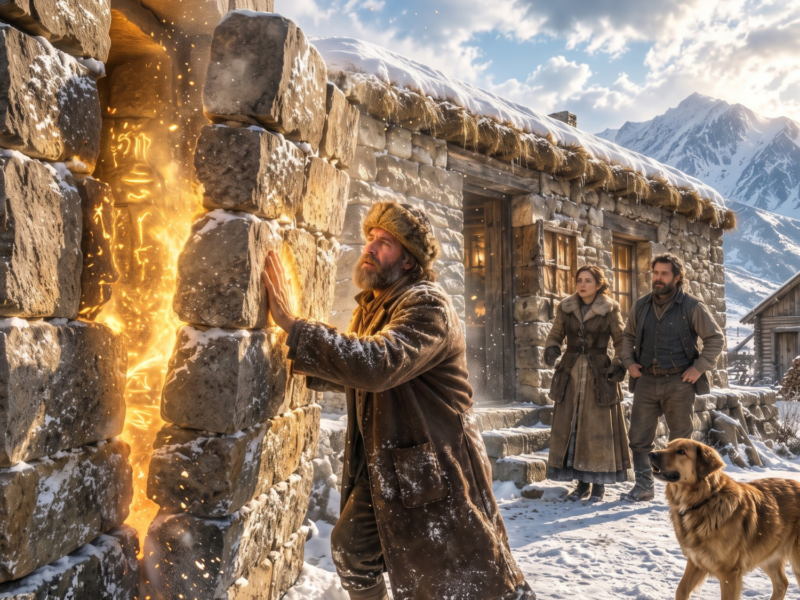
She Found 20-Inch Limestone Walls From an Old Relay Station — Added a Sod Roof and Forgot the Cold
The Chorus of Doubt
Dewey Larch visited the site first.
He rode up the ridge on a Tuesday, flanked by his lumber mill foreman. Dewey didn’t dismount. He spent about fifteen minutes watching Amos and Celia struggle to hoist a seventy-pound block of limestone into place before stating his expert opinion loudly from the saddle.
“I’ve got good timber available down at the mill, Mrs. Horn,” Dewey called out, his voice thick with condescending pity. “Properly milled pine. The exact right size for a solid, modern cabin. A sensible family could be under a dry wooden roof in three weeks with proper lumber and two strong men working steady.”
He pointed a gloved finger at the stone wall. “What you’re attempting here will take twice that long, break your backs, and end up colder than a springhouse in January. Stone holds the cold, ma’am. Everyone knows that.”
Celia wiped the sweat from her eyes, leaving a streak of gray mortar dust across her forehead. “I thank you for the information, Mr. Larch,” she said evenly. Then, she turned back to the trough and continued mixing mortar with a heavy hoe.
Dewey shook his head, spurred his horse, and rode away.
Vernon Chalk came separately, on a different day, and was somewhat less direct but infinitely more intimidating.
Chalk didn’t shout from a horse. He dismounted, walked right up to the wall, and studied the newly laid stones with the intense, critical attention of a man who genuinely understood the physics of construction. His prolonged silence was far more uncomfortable than Dewey’s arrogant speech had been.
Finally, Chalk turned to Amos, ignoring Celia entirely.
“Stone holds moisture,” Chalk said, his voice a low rumble of absolute authority. “That moisture seeps in. When the temperature drops, that moisture turns to ice. And ice expands. Ice is what breaks stone houses from the inside out. You’re building a tomb.”
He was not wrong about the basic physics of moisture. He was not describing a phenomenon Amos hadn’t already spent nights thinking about.
But Chalk’s ultimate conclusion was fundamentally flawed.
Amos did not try to correct the master carpenter. Partly because Amos had found, over his years drifting through the territories, that proud men rarely updated a conclusion they had already announced out loud in public. And partly because winter was coming fast, the light was fading, and finishing the walls was vastly more useful than winning an argument.
“Appreciate the advice, Vernon,” Amos said mildly, handing a stone to Nate.
The rain that changed everything—the rain that almost broke them—arrived at the end of September.
It was not a violent, crashing thunderstorm. It was the slow, relentless, creeping kind of rain. Two days of steady, freezing, gray water falling from a leaden sky without enough wind to even notice. It was just water falling, soaking the earth, until the ground simply could not absorb another drop of it.
On the morning after the second day of rain, they arrived at the site to find disaster.
A massive, ten-foot section of the newly rebuilt northern wall had moved.
The softer, clay-heavy inner mortar in that specific stretch had not been given enough time to fully cure and harden before the relentless rain reached it. Furthermore, they had not yet finished properly grading the drainage trench on that side. Water had stood in a deep pool against the base of the limestone long enough to turn the earth to pudding and shift three heavy courses of stone ominously outward, creating a terrifying, bulging bow in the wall.
Celia stood in the freezing mud and looked at the ruined wall for a very long time. Her shoulders slumped. The exhaustion of the past month seemed to crash down on her all at once.
Amos stood beside her, rainwater dripping from the brim of his hat, and said absolutely nothing.
Nate, looking between the two adults, his voice trembling slightly, asked, “Do we have to start over?”
Amos finally moved. He walked to the wall and ran his hand over the bulging stones.
“Not start over,” Amos said, his voice hard and determined. “Start correct.”
He grabbed a crowbar. He began tearing the failed section apart, stone by heavy stone, dropping them back into the mud. Celia didn’t weep. She didn’t complain. She simply picked up her heavy leather gloves, walked over, and began working beside him without having to be asked.
They dug the drainage trench significantly deeper on the north side, their boots sinking in the muck. They hauled wheelbarrows of crushed gravel, extending the drainage bed much further from the base of the wall to ensure water could never pool there again.
Amos mixed the mortar again. This time, he altered the chemistry, using significantly less clay and more lime near the exterior face to ensure it would cure harder and faster, even in damp conditions.
The failed stones went back into the wall in a completely different order than they had come out. Amos taught them to read the rock. The flattest, most uniform surfaces were turned inward to face the living space. The rougher, more jagged faces were turned outward, specifically to accept and grip the harder outer lime mortar.
The mistake and the rebuild cost them nine agonizing days of labor.
Dewey Larch happened to ride past during that period. He noted with smug satisfaction from the high road that the widow’s “cold box” had started falling in on itself before the first freeze had even arrived.
The joke was not entirely original, but Dewey delivered it with enough venomous satisfaction that several exaggerated versions of it traveled through the taverns and stores of Harrow Flats before the week was done.
Celia heard at least one version of the joke from a gossiping woman at the dry goods store when she went to buy flour. She paid for her goods, carried the heavy sack home, and did not mention the insult to anyone.
But that evening, as the sun went down and the chill set in, she sat by the fire pit and asked Amos a single, pointed question.
“Do you still believe this will work?”
Amos was at the water barrel, aggressively scrubbing the gray mortar dust from his cracked hands. He dried them on his trousers, turned, and looked up at the newly rebuilt northern wall. It stood perfectly plumb, still pale and glowing slightly with fresh lime in the twilight.
“I believe it more than I did before the rain,” Amos said quietly. “The wall showed us what it needed. We listened.”









