She Found 20-Inch Limestone Walls From an Old Relay Station — Added a Sod Roof and Forgot the Cold
The Stone That Remembered
Spring came to the Colorado foothills when it was good and ready, not a day sooner.
The snow retreated from the south-facing slopes first, revealing the bruised, flattened grass beneath. The creek ran loud, fast, and violent with meltwater for a few chaotic weeks, and then slowly quieted back into its usual, babbling voice. Wagon traffic returned to the muddy valley roads.
But the idea that spread through Harrow Flats that spring was not just a new building technique. It was a fundamental paradigm shift. It was an entirely different way of thinking about what a wall was actually supposed to do. A wall was not just a barrier to keep the wind out; a wall was a battery meant to keep the life in.
Not every settler had the money or the means to quarry limestone. Not every property possessed standing ruins to build upon.
What moved from neighbor to neighbor, what was debated over fences and shared over coffee, was the understanding that thick, massive walls and a properly placed, integrated hearth could work together in a symphony of survival that a thin-walled, drafty timber cabin with a freestanding iron stove simply could never achieve.
Vernon Chalk, a man willing to learn even in his later years, began heavily incorporating stone and earth features into his new timber builds. He designed massive stone hearth surrounds built directly against the exterior walls rather than in the center of the room. He integrated thick, load-bearing fieldstone piers at the vulnerable north corners. He utilized earthen banking against the foundations wherever the slope of the land allowed it.
Vernon simply called the combined approach “Practical Building.”
It was a name that stuck in the valley because it made no arrogant claim about being smarter or more educated than anyone else. It simply described what kept a family alive.
A few seasons later, the families living in the homes Vernon built using those hybrid methods were burning noticeably, drastically less wood. In some cases, the difference in fuel consumption approached a full third of their previous winter’s labor.
Dewey Larch adjusted his business model, because practical, profit-driven men usually do. He sold fewer thin, cheap boards for oversized, useless interior partition walls, and sold vastly more massive, proper roof timbers and heavy floor joists where good, strong lumber genuinely mattered to bear the weight of earth and stone.
Celia Horn expanded the relay station during her second summer on the rise. She added a small, sturdy addition on the eastern side, built to the exact same exacting standards as the original repair. Amos Trent stayed on, working beside her, his hands shaping the stone. Nate, having grown tall and broad-shouldered over the year, was now capable enough to mix the mortar and set the heavy stones entirely on his own.
Pearl kept the leather-bound notebook current. She took to adding meticulous, beautiful small sketches in charcoal beside her daily temperature entries—diagrams of the hearth flues, the pitch of the roof profile, the precise arrangement of the drainage stones along the northern foundation.
Nobody told her to do it. She simply understood, with the innate wisdom of someone who had survived the cold, that the record of how they lived was a thing worth keeping carefully.
A thin wooden wall lives entirely in the present tense. It warms rapidly while the fire burns, and it cools instantly when the fire dies. By morning, whatever warmth had been frantically gathered is mostly gone, stolen by the sky, and the family inside must begin the whole exhausting, desperate effort over from the very beginning.
The heavy limestone walls of the old relay station worked on a completely different clock.
They collected the long, golden afternoon light that angled across the eastern rise each day, drinking it in. They absorbed the steady, radiant warmth of the evening fires, storing away the energy that most people never noticed was worth saving. They held that warmth like a secret through the darkest, most terrifying hours of the night. And they returned it quietly, gently, without any grand announcement, while the family slept, and the fire shrank to white ash, and the valley outside dropped toward whatever murderous cold the night intended to bring.
That was the absolute verdict that Winter had delivered.
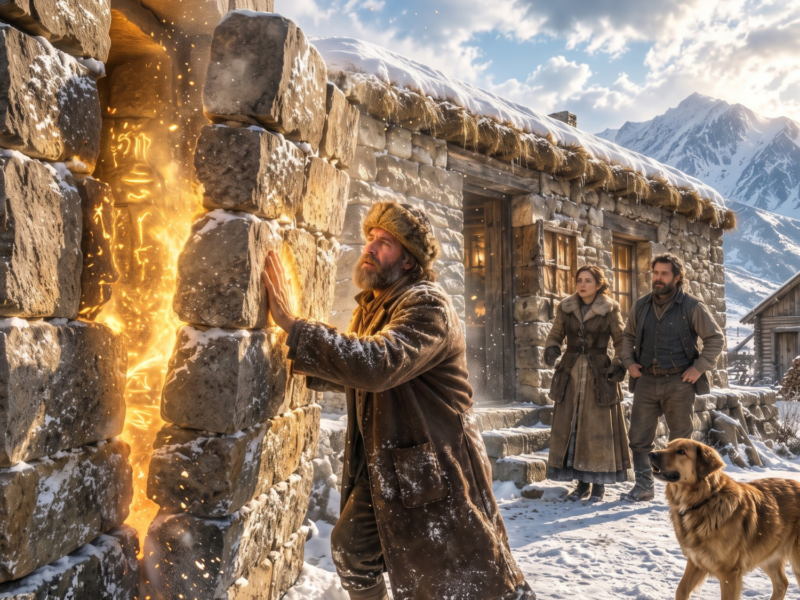
It was not handed down in any courtroom, printed in any newspaper, or voted upon in any town meeting. It was delivered in the palm of a master carpenter’s hand, pressed against freezing limestone at thirty-one degrees below zero. It was delivered in the form of a tawny hound sleeping contentedly fourteen feet away from a dying hearth. It was delivered in a wooden water bucket that never once froze beside the south wall.
Celia Horn had not come to Harrow Flats to prove anything to anyone. She had not come to revolutionize architecture or humiliate the men of the valley.
She had come because she had made a desperate, silent promise to her children during a long, freezing night in a drafty wooden cabin where her husband had died. And that promise had simply taken the physical shape of twenty-inch stone walls, a massive sod roof, and a hearth that fed its life-saving warmth directly into the heaviest masonry in the house.
She had come because she had once pressed her own bare hand against a warm, ruined wall at the side of a dusty road, and she had understood—in the way that only quiet, absolute certainty can teach a person.
She had understood that stone remembered what wood forgot.
What she had not expected to find in the valley was the man who had pressed his hand against a different wall first. The man who had recognized, from the very first moment he rode down that ridge road and saw her sorting the rubble, exactly what she was looking for.









