She Inherited a “Worthless” Mountain Fortress—Then She Opened the Heavy Iron Door
The Fortress in the Snow
The transition from the mild, damp, gray coast to the high, brutal elevations of the Rockies was jarring.
By the time Clare turned off the main interstate highway in Montana, the snowbanks plowed onto the sides of the road were three feet high and frozen solid. The black pavement gave way to graded gravel, and the gravel eventually dissolved into a narrow, rutted dirt track that wound sharply upward through dense, claustrophobic stands of lodgepole pine.
Her GPS lost its satellite signal an hour before she reached the coordinates.
She drove on, relying on blind instinct and a printed topographical map resting on her passenger seat. Her Civic’s all-season tires slipped and spun dangerously on the packed ice of the incline.
When the trees finally broke, opening into a small, sloping valley facing directly south, Clare slammed on the brakes. The car skidded to a halt.
She stared through the frosty windshield.
There was no house.
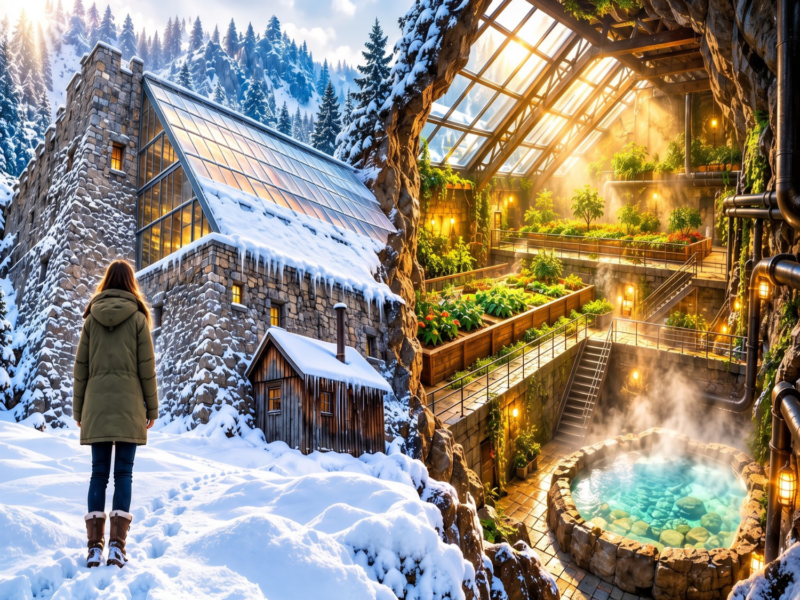
There was only a massive, heavy structure built directly into the side of the mountain. From the front, it looked like a medieval fortress constructed of rough, local fieldstone and thick, weathered timber. It didn’t stand proudly on the land; it was aggressively embedded in it. The back wall of the structure was the mountain itself.
Attached to the side of this imposing stone monolith was a tiny wooden cabin, no larger than a single room. Its thin iron chimney rose like a dark, accusing finger against the bruised gray sky.
Clare parked, her breath pluming in the freezing air as she stepped out of the car.
The silence of the place was absolute, and terrifying. It wasn’t the quiet of a quiet room in the city, where you can still hear the hum of a refrigerator or traffic miles away. It was the heavy, ancient, crushing silence of a dormant earth.
The wind bit through her wool coat immediately. The temperature was well below freezing—the specific kind of violent cold that made the moisture inside her nose instantly crystallize.
She walked to the small wooden cabin, her boots crunching loudly in the snow, and unlocked the door with the heavy brass key the county clerk had mailed her.
The interior was austere, bordering on monastic. A small, black cast-iron wood stove. A narrow cot with a thin mattress. A tiny kitchenette featuring a hand-pump sink. Rough wooden shelves lined with hundreds of empty mason jars and worn, cloth-bound books. It was impeccably clean, but it held the deep, settled, dangerous cold of a space that hadn’t seen a fire in weeks.
Clare’s analytical brain immediately categorized the situation. Asset is uninhabitable. Value is purely in the land. Liquidate immediately.
She spent the first hour hauling in split firewood from a neatly stacked, covered cord on the porch. She struggled to get the stove lit, her city-soft fingers stiff and clumsy with matches and kindling. When the fire finally caught, casting a flickering, desperate orange glow over the raw wood walls, she sat on the hard floor, exhausted, shivering uncontrollably, pulling her coat tight around her knees.
It wasn’t until the small cabin warmed slightly, thawing the numbness in her face, that she noticed the door on the far, flush wall.
It was an interior door, but it looked like it belonged on a castle. It was made of incredibly thick, vertical oak planks, bound tightly in wrought iron. It clearly led directly into the main, massive stone structure buried in the hill.
Curiosity overrode her profound fatigue. She picked up her heavy Maglite flashlight, unlatched the heavy iron hook that held the door shut, and pulled it open with a groan of heavy hinges.
She braced herself. She fully expected the biting, damp chill of a derelict barn, the smell of rotting wood and frozen earth.
Instead, she was hit by a physical wall of air that utterly defied logic.
It was warm. Not exactly hot, but distinctly, impossibly mild. And the smell—it smelled of rich, damp loam, crushed green leaves, and something faintly mineral and alive.
Clare stepped cautiously through the doorway and played the bright beam of her flashlight over the space.
She was standing on a stone landing. Below her, the structure dropped away deep into the earth.
It was not a barn. It was a massive, subterranean, terraced cavern.
The floor descended in three deep, wide steps carved directly into the hillside. At the very bottom, perhaps fifteen feet below where she stood, the ground leveled out. Looking up, Clare realized that the steeply pitched roof she had seen from the outside—the one currently blanketed by thick snow—was entirely made of thick, double-paned industrial glass.
It was a walipini. An underground greenhouse.
But the sheer scale and the sophisticated engineering were far beyond a simple pioneer dugout garden.
She descended the stone stairs slowly, her hand trailing along the masonry. The air grew warmer and more humid with every step down into the earth. At the bottom floor, the temperature had to be hovering around sixty-five degrees—a stark, mathematical impossibility considering the blizzard conditions raging just feet above the glass.
The space was meticulously, obsessively organized. Raised planting beds built from fitted stone and thick cedar lined the massive terraces, currently filled with dark, resting soil.
Along the massive rear retaining wall—the wall carved directly into the living rock of the mountain—ran a complex, intricate system of thick, black metal pipes.
At the center of the lowest floor sat a large, deep, circular stone basin filled with water.
Clare approached the basin, shining her light onto the surface. The water was perfectly clear, and a faint, ghostly ribbon of steam danced on its surface. She took off her glove, hesitated, and dipped her bare fingers into the pool.
It was hot.
She traced the black piping with her flashlight beam. The pipes drew water directly from the hot basin, snaked their way intricately along the stone walls, wove through the base of the soil beds to provide radiant heat to the root zones, and eventually cycled back to the pool.
It was a closed-loop geothermal heating system, powered entirely by a natural hot spring tapped deep within the mountain’s bedrock. The immense thermal mass of the stone walls absorbed the heat of the water, and the passive solar energy from the glass roof during the day, releasing it slowly at night to prevent the space from ever freezing.
Clare stood in the center of the underground cathedral, her heart beating a little faster.
This was absolutely not the haphazard work of a crazy recluse. This was a masterclass in thermodynamics, hydrology, and sustainable engineering. Her Aunt Helen hadn’t retreated from the world in defeat. She had built a vastly superior one right beneath its surface.









