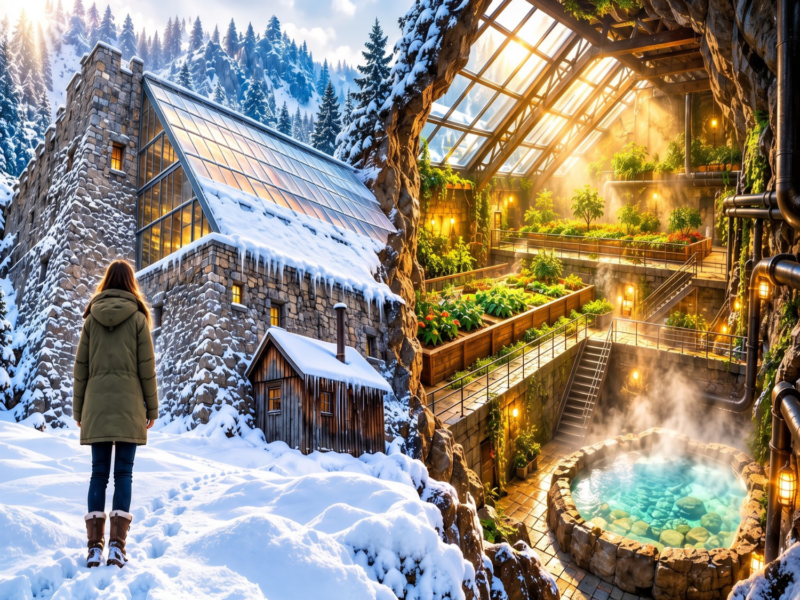
She Inherited a “Worthless” Mountain Fortress—Then She Opened the Heavy Iron Door
The Variables of Life
That night, Clare slept in the small, freezing cabin, but she left the heavy oak door open just a crack. It allowed the warm, deeply humid, earth-scented air from the greenhouse to seep into her room.
For the first time in six agonizing months, she did not dream of collapsing spreadsheets, red bank balances, or the pitying look on the HR rep’s face.
The next morning, the winter sky cleared, revealing a blindingly bright, sharp mountain sun.
Inside the greenhouse, the effect of the sun was instantaneous and dramatic. The heavy snow on the steeply pitched glass roof began to melt and slide free in massive, thudding sheets, allowing brilliant, golden shafts of sunlight to flood the subterranean space.
The temperature inside rose steadily, climbing from sixty-five and plateauing at a comfortable, balmy seventy-two degrees.
Clare explored the bottom terrace in the daylight. Tucked into a corner, bathed in sunlight, she found Helen’s desk. It was a sturdy oak drafting table, covered in thick, leather-bound logbooks.
Clare opened the first one, dated from the late 1980s. The handwriting was sharp, precise, and entirely lacking in sentimentality. There were absolutely no diary entries about feelings, or loneliness, or the family she had left behind.
It was purely, obsessively data.
Daily temperature variances. Solar angles calculated by the season. Geothermal water flow rates measured in gallons per minute. Soil pH levels. Complex planting schedules rotating crops for maximum nutrient retention.
Helen had spent three decades meticulously refining the variables of this closed system. She knew exactly how many gallons of thermal water it took to keep the soil at optimum germination temperatures during a minus-twenty-degree cold snap outside. She knew precisely which heirloom seeds required the lower, angled light of December, and which thrived in the increasing, direct sun of February.
Clare, a woman whose entire corporate career had been dedicated to identifying efficiencies, reducing friction, and optimizing complex global systems, read the worn notebooks with mounting, profound awe.
Her original, pragmatic plan had been to leave by the weekend, list the property, and take whatever cash she could get.
But as she sat at the desk in the warm, sunlit earth, listening to the gentle, rhythmic hum of the geothermal water cycling through the black pipes, the thought of returning to the gray, relentless rain of Seattle to beg for another cubicle job felt physically unbearable.
It’s an experiment, she told herself, the corporate analyst part of her brain trying to justify the decision. I’ll stay a few weeks. Just to see if I can run the system based on her data. If it fails, I’ll sell.
She found Helen’s seed bank in a cool, dark alcove near the stone stairs. It consisted of hundreds of meticulously labeled, airtight glass vials.
Following the precise instructions in the logbook marked January, Clare set to work.
She prepared the rich, dark soil in the middle terrace. She planted rows of winter-hardy greens: mâche, claytonia, specialized cold-weather spinach, and a fragile, incredibly rare variety of winter tomato Helen had selectively bred over twenty years specifically for low-light conditions.
The work was deeply, punishingly physical. It required moving heavy earth with a shovel, constantly monitoring the brass water valves, and manually adjusting the heavy, insulating thermal blankets on a pulley system that had to be drawn over the glass roof on the absolute coldest nights to trap the heat.
It was exhausting. But it was a clean, honest exhaustion.
There were no unread emails screaming for her attention. There were no office politics to navigate. There was no anxiety about quarterly earnings reports. There was only the brutal, beautiful simplicity of cause and effect: water, heat, light, and time.
Two weeks later, Clare was kneeling in the dirt, adjusting a drip line, when she saw it.
Tiny, vibrant green shoots had broken the surface of the dark soil.
She stopped breathing. In the city, “success” was an arbitrary number turning from red to black on a digital screen. Here, success was a living, breathing thing that pushed its way out of the earth solely because she had provided exactly what it needed to exist.
She gently touched a fragile green leaf with a dirt-stained finger, and felt a profound, quiet surge of pride she had never known in a boardroom.









