She Inherited a “Worthless” Mountain Fortress—Then She Opened the Heavy Iron Door
The Harvest
The next morning, Clare drove down the mountain to the county clerk’s office in town.
She didn’t hire a lawyer. She didn’t need one. She walked up to the counter and simply placed the original, state-sealed deeds and the continuous university data logs—which Helen had maintained meticulously right up until the week she died, and which Clare had seamlessly continued—flat on the clerk’s counter.
She pointed to the specific state statutes. She showed the undeniable proof of continuous agricultural use, augmented by her own recent, dated sales receipts to The Ironwood restaurant.
The flustered clerk called down the county attorney. The attorney read the documents, his face reddening. He made two hushed phone calls to the state capital. Then, he walked back out and looked at Clare with a mixture of intense annoyance and profound, grudging respect.
“The educational exemption holds,” the attorney confirmed grimly. “As long as you’re actively growing and recording data, nobody in this county can touch that water, or the structure. I’ll have the inspector remove the lock on the valve today.”
When David Sterling’s pristine black SUV rolled up the muddy driveway to the property a week later, Clare was waiting for him.
She was sitting on the wooden porch of the cabin, drinking a cup of hot tea made from mint and lemon balm grown twenty feet away under the earth.
Sterling stepped out, looking incredibly confident. He held a sleek leather folder, assuming she was ready to capitulate.
“Miss Vance,” Sterling smiled. “Have you had time to reconsider our offer? I understand the county has been making things quite difficult for you regarding your water access.”
Clare took a slow sip of her tea. The steam warmed her face.
“The county dropped their inquiry entirely yesterday, Mr. Sterling,” she said, her voice perfectly level. “The property is permanently protected under a state educational agricultural exemption. Your highly paid legal team missed it because it’s filed under a state university charter, not the local county tax rules. I have unrestricted rights to the aquifer.”
Sterling froze. His professional, polished mask slipped for a fraction of a second, revealing the cold, calculating, furious frustration beneath.
He stared at the impenetrable stone structure, then back at Clare.
“We can double the offer,” he said quietly, opening the folder. “Right now.”
Clare looked at him. She looked at the expensive suit, the luxury car, the constant, desperate, hollow hunger for more that radiated from him like a sickness. She knew that hunger intimately. She had lived inside it, fed it, and nearly been destroyed by it for eight years in Seattle.
“There isn’t a number, Mr. Sterling,” Clare said smoothly, setting her teacup down. “Because the currency you’re offering has absolutely no value here.”
She turned, walked back inside the cabin, and closed the heavy wooden door behind her, leaving him standing alone in the freezing mud.
Epilogue: Rooted
By the time her second winter on the mountain arrived, Clare had fully mastered the rhythm of the Walipini.
She did not expand. She did not try to maximize her yields, or hire staff, or supply every restaurant in a hundred-mile radius. She supplied her three loyal clients. It provided exactly enough money to cover her property taxes, buy necessary supplies, and live incredibly comfortably.
She learned to read the Montana sky, anticipating the angle of the sun before it even rose over the peaks. She knew the exact, groaning sound the water pipes made when the temperature outside dropped below zero. She understood the soil—not as inert dirt to be optimized, but as a living, breathing partner in her survival.
The frantic, desperate energy that had defined her entire life in the city was completely gone. It was replaced by a deep, grounded, unshakable resilience. She was no longer moving imaginary things on a glowing screen to make anonymous shareholders rich. She was anchored to the earth, a vital part of a system that actually made sense.
One evening, in the dead, frozen heart of deep January, a massive blizzard swept through the mountains.
The wind howled with demonic fury against the stone, and the temperature plummeted to a lethal twenty degrees below zero.
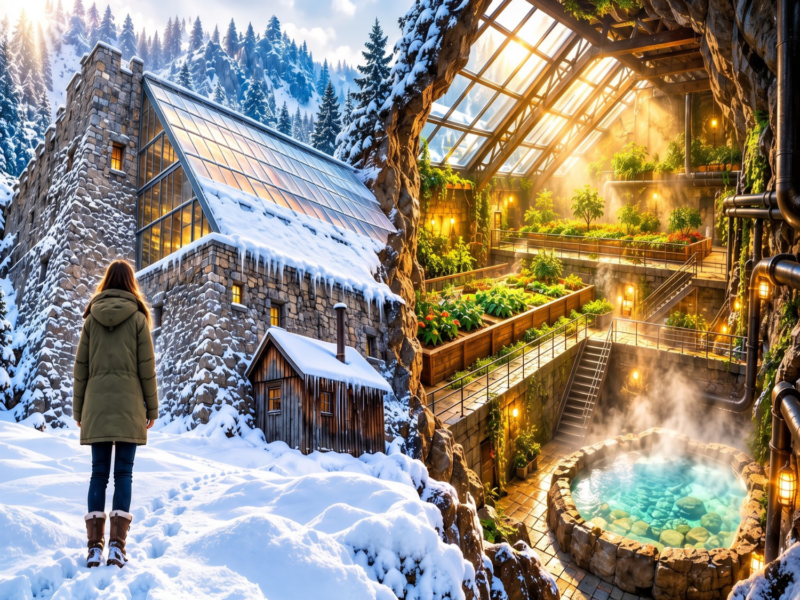
Clare sat at her aunt’s oak desk in the lowest terrace of the greenhouse. Above her, the thick glass roof was covered in a heavy, white blanket of snow, perfectly insulating the space below.
The air around her was a perfect, humid sixty-five degrees. The geothermal water murmured as it cascaded into the stone basin—a steady, ancient, comforting heartbeat.
She reached out and gently touched the thick, vibrant green leaf of a tomato plant. She felt its incredible vitality, its defiant, stubborn life flourishing in the face of the frozen world trying to kill it outside.
Her family had called this place useless. They had thought her Aunt Helen was crazy for leaving the system behind to live in the dirt.
But as Clare listened to the storm rage fruitlessly against the stone walls that protected her, she finally knew the absolute truth. This place wasn’t a retreat. It wasn’t a failure. It was the only place in the world that truly made sense.
The structure held. And for the very first time in her life, so did she.









