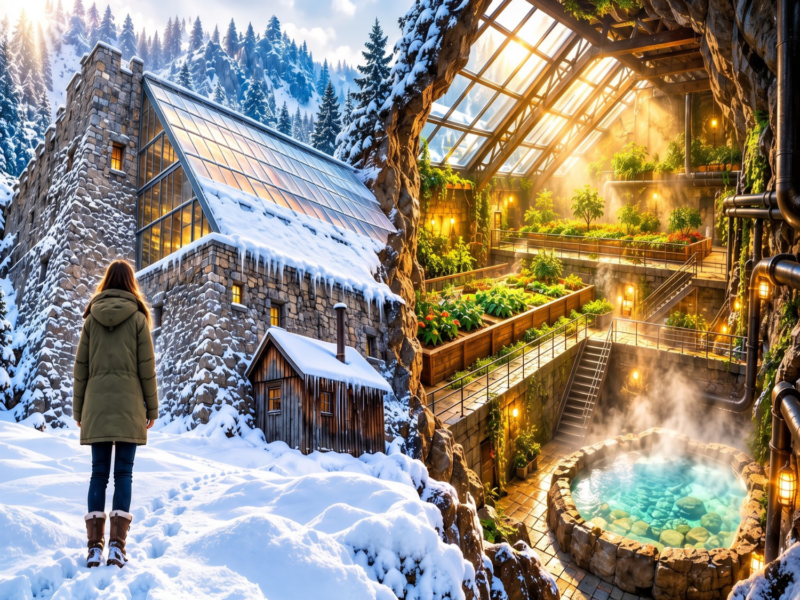
She Inherited a “Worthless” Mountain Fortress—Then She Opened the Heavy Iron Door
The Taste of Winter
By mid-February, the middle terrace of the Walipini was a lush, vibrant, chaotic sea of green.
The contrast was staggering, almost hallucinatory. Outside the thick glass roof, the world was locked in a brutal, killing freeze. The landscape was a dead, monochromatic expanse of blinding white and slate gray.
Inside, beneath the earth, it was spring.
Clare harvested her very first crop. She carefully packed the crisp, bright greens into insulated plastic coolers, loaded them into the back of her Honda, and drove the treacherous hour down the winding mountain road into the nearest town—a small, rugged valley community called Bitterroot Falls.
She didn’t know where to go, or who to talk to, so she parked on the main street and walked into the nicest-looking restaurant in town, a farm-to-table place called The Ironwood.
The lunch rush was over. She asked a waitress for the owner and was introduced to a man in his late forties named Marcus, who looked perpetually stressed, rubbing his temples and clutching a clipboard.
Clare introduced herself, explaining that she was Helen Vance’s niece and that she had brought fresh winter greens to sell.
Marcus looked at her with exhausted skepticism. “In February in Montana, unless they were trucked in from a hothouse in California three days ago, they’re frozen or wilted to mush, lady.”
Clare didn’t argue. She simply opened the cooler.
Marcus stopped talking mid-sentence. He stared at the vibrant green leaves. He reached in, pulled out a delicate leaf of claytonia, inspected it, and tasted it.
His eyes widened in shock. The flavor was sharp, deeply peppery, and incredibly fresh, completely devoid of the dull, watery, cardboard taste of industrial winter produce that had sat on a truck for a week.
“Helen’s sunpit,” Marcus said softly, looking up at Clare. “I heard rumors about that place for years from the old-timers. Nobody actually believed she was growing out there in the dead of winter. We all thought she was just crazy.”
He looked back down into the cooler. “How much do you have?”
“Enough for this week,” Clare said, her analyst brain automatically calculating supply. “And more maturing next week.”
Marcus bought the entire cooler on the spot. He walked to the register and paid her in crisp cash from the till.
Clare walked out of the restaurant, the cold wind hitting her face, her hand curled around the bills folded in her pocket. It wasn’t a fortune—a few hundred dollars. But the weight of that money in her hand felt fundamentally different than any direct-deposit paycheck she had ever received from Apex Logistics.
It was direct. It was undeniably real. She had produced tangible value from the earth, using her own hands and her aunt’s genius, and she had been fairly compensated for it.
Over the next month, Clare fell into a deep, satisfying rhythm. She expanded her plantings to the upper terrace, mastering the thermal flows. She supplied The Ironwood consistently, and Marcus quietly introduced her to two other local, high-end chefs in the valley who were absolutely desperate for fresh, vibrant local ingredients in the bleak off-season.
The money was modest, but her expenses were virtually zero. The property carried no mortgage. The heat was provided by the earth. The water was free.
For the very first time in her adult life, Clare stopped waking up at 3:00 AM, staring at the ceiling, calculating exactly how many months she had left until her bank account hit zero.
She had found her equilibrium. But stability, Clare was about to learn, rarely goes unnoticed by those who deal in greed.









