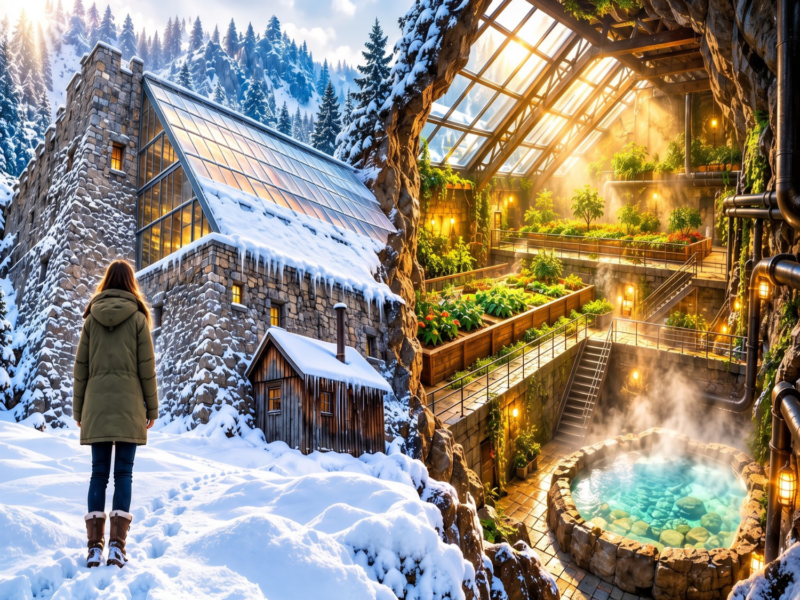
She Inherited a “Worthless” Mountain Fortress—Then She Opened the Heavy Iron Door
The Siege
The bureaucratic siege started exactly two weeks later.
First, it was an intimidating, registered notice from the county assessor’s office regarding an immediate re-evaluation of her property class, threatening a massive tax spike.
Then, an inspector from the Montana Department of Water Resources arrived unannounced in a white county truck. He claimed they had received an “anonymous complaint” about the illegal tapping and diversion of the geothermal aquifer.
The inspector, a tired-looking, middle-aged man holding a clipboard, walked through the lush, vibrant greenhouse. He took notes on the pipes, the basin, and the sheer commercial scale of the plantings.
“I’m sorry, miss,” he said, sounding genuinely apologetic as he wrote out a form. “But without modern, approved commercial permits, and a highly expensive, contemporary environmental impact survey for this level of geothermal extraction, I have no choice but to issue a formal cease and desist order.”
He handed her the pink slip. “You can’t use this water for commercial agriculture until this is cleared up. I have to shut the main intake valve.”
Clare felt the old, familiar panic—the dark, suffocating weight she thought she had left in Seattle—rising violently in her chest. The system was trying to crush her again. The developer, Sterling, knew exactly what he was doing. He knew she couldn’t afford the tens of thousands of dollars in legal fees, hydrologists, and surveys required to fight a modern permitting battle against a billion-dollar corporation.
They were squeezing her out. They would freeze her plants, bankrupt her, and wait until she had absolutely no choice but to sell the land for pennies on the dollar.
That night, the intake valve shut off, the temperature in the Walipini began to drop.
Clare sat at Helen’s desk in the lowest terrace, surrounded by the dark, quiet green of the plants that were slowly beginning to chill. The system her aunt had built was perfect. It was entirely harmless to the environment. It operated on a closed loop, returning the thermal water to the earth cleaner than it arrived.
But the law didn’t care about perfection, or harmony, or sustainability. It cared about paperwork, and who had the most expensive lawyers.
Clare lit a lantern and began tearing frantically through Helen’s logbooks. She wasn’t looking for planting schedules this time; she was looking for legal history.
Helen was a genius, Clare reminded herself, fighting down the panic. A genius who lived here undisturbed and completely self-sufficient for forty years. She wouldn’t have left a vulnerability like this wide open.
Helen wouldn’t have spent three decades building her entire life on a legal foundation that could be erased by a single inspector with a clipboard.
Around 2:00 AM, exhausted and covered in dust, Clare found it.
It was a heavy metal lockbox, bolted securely beneath the false bottom drawer of the oak desk. She went to the tool shed, grabbed the heavy iron pry bar, and violently cracked the rusted lock open.
Inside were not seeds, or cash. It was full of thick, manila legal files.
Clare spread the documents aggressively across the desk under the lantern light. They were official court filings and state legislature documents dating back to 1984. The county had indeed tried to shut Helen down back then, highly likely prompted by a different, equally greedy developer with similar ideas about the water rights.
But Helen hadn’t just secured a generic, easily challenged water right. She had fought back with overwhelming academic force.
She had worked with the geology department at the state university to have the greenhouse officially, federally classified as a “Historic Geothermal Agricultural Research Station.”
Because Helen had legally partnered with the agricultural university—providing them with decades of invaluable, ongoing data on subterranean thermal agriculture—the structure and its specific water usage were permanently grandfathered under a highly obscure, ironclad educational exemption.
Clare read the final deed restriction with wide eyes. The exemption was deeded in perpetuity to the property owner, completely shielding it from local county water regulations, provided one single condition was met: The agricultural activity on the premises must never cease for more than twelve consecutive months.
Helen hadn’t just built a greenhouse to grow tomatoes. She had built a fortress. Both physically against the weather, and legally against the greed of the world.
Clare felt a massive, hysterical laugh bubble up in her chest, echoing wildly in the quiet stone cavern. Her aunt, the “crazy recluse,” had anticipated the relentless greed of the future and engineered a flawless legal mechanism to neutralize it, as cleanly and efficiently as she had engineered the heating loops.









