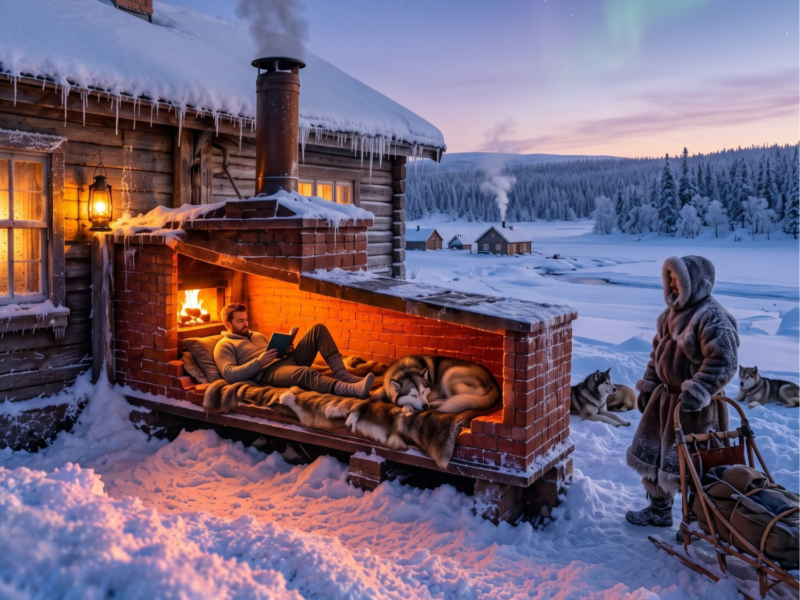
The Station Called His Stove a Brick Coffin — Until He Slept Without a Coat at 47 Below
THE SECOND TOWER
The following morning, during breakfast in the main mess hall, Balashov stood up before his assembled crew.
“Men,” the station chief announced clearly, “I owe our meteorologist an apology. That brick structure is no coffin. It is a lifeboat. And I am asking Zoran to show us how to construct one for this house before the cold claims any more of us.”
Kravets looked up from his mug. “There is no brick on this cape.”
“The remaining half of the municipal bread oven is still standing at the southern trading post,” Mikhail interjected.
Yafim Lapander, the Nenets dog-driver, stepped forward. “Between the blizzards, we have a window of two days. The dogs can make the run.”
On February 6th, three dog-sled teams launched southward into a brutal landscape at thirty-nine below zero. They returned thirty-six hours later laden with salvaged firebricks, having lost a single lead dog that slipped its harness in a whiteout.
Building a masonry heater in the dead of polar winter was an exercise in extreme engineering. Mikhail thawed frozen clay buckets by setting them directly against his own operating stove. They mixed mortar indoors and sprinted across the compound with steaming buckets to prevent the clay from freezing solid before placement.
Balashov laid the bricks himself under Mikhail’s rigorous supervision, receiving strict instructions: “That joint is half a millimeter too thick. Tear it out and relay it.”
Kravets fabricated a custom firebox door and heavy iron damper from an empty fuel drum and scrap sheet iron. Costa, fully recovered, held the inspection lantern deep inside the smoke channels.
The second stove—a slightly more compact version scaling just over a single ton—was completed in mid-February.
On February 20th, it was fired for the first time. The entire station population gathered in the common room, watching the masonry with bated breath. Three hours later, as the exterior walls radiated steady thermal energy, Kravets pressed both hands against the bricks and grinned. “It works like the devil.”
The next morning, the indoor temperature in the main communal house registered a comfortable plus-six degrees Celsius while outdoor readings hovered at thirty-five below.
That evening, old Fodor Ilyich baked a celebratory meat pie using the last reserves of station flour. Setting the tray on the dining table, the cook crossed himself and remarked, “The old bread oven is feeding us after all.”
EPILOGUE: THE BRICK TOWER ON THE ROCK
The supply steamer finally broke through the pack ice on August 14th, 1938.
Station Chief Balashov was the first man to scramble up the rope ladder onto the deck. The ship’s captain leaned over the bridge railing and shouted down, “How did you manage the winter, Artyom? Any casualties?”
“Everyone is alive,” Balashov bellowed back proudly. “Thanks to brick.”
The captain blinked, uncomprehending. Balashov dragged him ashore and insisted he touch the masonry heater inside the main quarters. The captain pressed his palm against the warm clay, felt the steady, life-giving radiation, and stood in respectful silence.
In his official seasonal report to the Northern Sea Route Administration, Balashov dedicated an entire chapter to Mikhail Zoran’s masonry heating system, attaching the comparative meteorological tables from the meteorologist’s notebook. He formally recommended that heavy masonry heaters be mandated for all polar outposts and requested a substantial financial bonus for Zoran.
Mikhail flatly refused the monetary bonus. Instead, he requested a single item for the following navigation season: five tons of industrial firebrick.
“What do you need five tons of brick for?” the administrative clerk in Moscow wired back.
“Not for me,” Mikhail replied via telegraph. “For the other stations.”
Following that winter, Costa Lenov traveled south to Kargopol to apprentice under traditional master stove builders, eventually becoming one of the Soviet Union’s foremost thermodynamic heating engineers. Balashov retired to a dacha near Leningrad in 1946; local legend maintained that the very first project he executed upon purchasing the property was demolishing the iron stove and building a heavy brick hearth.
Mikhail Zoran remained in the Arctic for eleven more winters, leaving behind functional masonry heaters across multiple polar outposts. Vera stayed faithfully by his side through four decades of marriage.
Today, heavy masonry heaters—or heat-storage stoves—are standard architectural elements in sustainable architecture across Scandinavia, Canada, and Siberia. Yet on that nameless cape along the Kara Sea, the station itself was permanently decommissioned in the 1960s, its wooden buildings salvaged for firewood.
They left the brick tower behind because it was simply too heavy to move.
To this day, travelers sailing past the cape report spotting a lonely, roofless brick chimney standing defiant against the Arctic sky—a solitary monument pointing toward the clouds, testifying to the day a Norwegian widow’s ancestral wisdom and a meteorologist’s stubbornness proved that winter can be conquered if you build deep enough into the earth.









