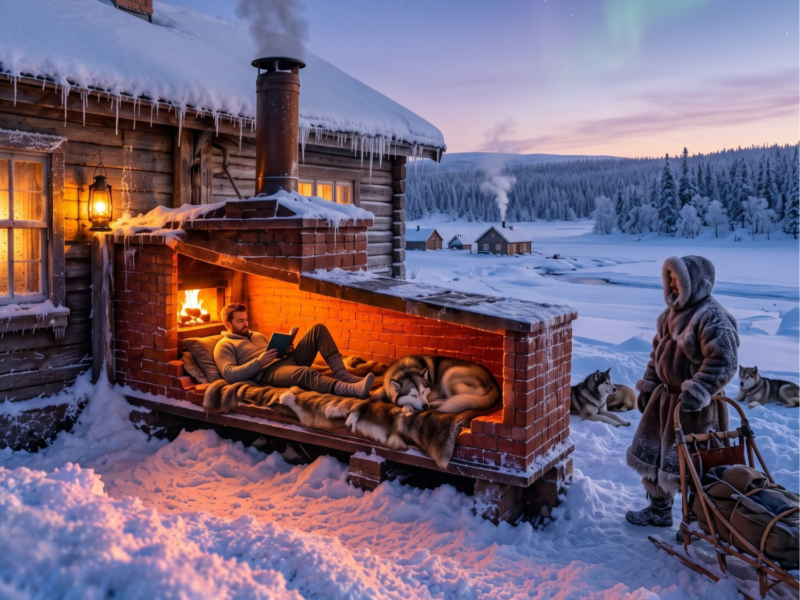
The Station Called His Stove a Brick Coffin — Until He Slept Without a Coat at 47 Below
LAYING THE FOUNDATION
Mikhail began construction on September 3rd.
First, he pulled up the floorboards in the corner of their cabin, clearing away gravel and damp moss down to the bare, solid bedrock. He laid a sturdy foundation using flat beach stones locked together with heavy clay mortar, building upward until it matched the level of the surrounding floor.
Locating suitable clay required a week of searching. Mikhail finally discovered a rich, thawed seam beside a frozen stream bed, sandwiched between layers of sand and glacial ice. He tested the clay using his father’s traditional method: rolling a sample into a thin sausage, bending it into a ring, and checking for fractures. It was pure, high-plasticity clay.
The salvaged bricks were a mixture of standard red construction clay and yellow firebricks salvaged from the mouth of the trading post’s bakery oven. Mikhail segregated the yellow firebricks, reserving them specifically to line the high-stress interior walls of the firebox where temperatures soared.
Working every evening after completing his meteorological observations, Mikhail laid four or five rows of bricks at a time. Vera handed him materials, mixed mortar, and held the oil lamp steady.
Every single brick was thoroughly saturated in water before placement so it wouldn’t prematurely suck moisture from the clay mortar. Mikhail kept the mortar joints exceptionally thin—no wider than a finger. “A thick joint,” his father had taught him, “is the first place the frost will tear apart.”
On Sundays, young Costa Lenov, the station’s twenty-two-year-old radio operator from Minsk, wandered over to watch.
“Why must you lay it so slowly?” Costa asked one afternoon.
“Because,” Mikhail replied without looking up, “you cannot rebuild it in the middle of January.”
Costa pondered that statement for a long time. Within a week, he began showing up every evening after his radio shift, mixing mud, hauling stones, and holding torches.
By September 26th, the masonry tower stood complete, reaching all the way to the timber ceiling. Following strict safety protocols, Mikhail refrained from firing it immediately. For two full weeks, he cured the damp masonry by burning small handfuls of dry wood chips for precisely one hour a day.
“If you rush it,” Mikhail explained to Vera, “the trapped water in the clay will boil, expand instantly, and tear the brickwork apart from the inside out. You have to bake it slowly, like rising bread.”
The first full firing took place on October 8th. Mikhail shoveled a bucket of coal into the firebox and lit it. For an hour, he watched the masonry with intense concentration. Within three hours, the exterior brick walls grew comfortably warm to the touch.
That very evening, Mikhail carried the government-issued cast-iron box stove out into the snow-swept entryway, leaving it exposed to the elements.









