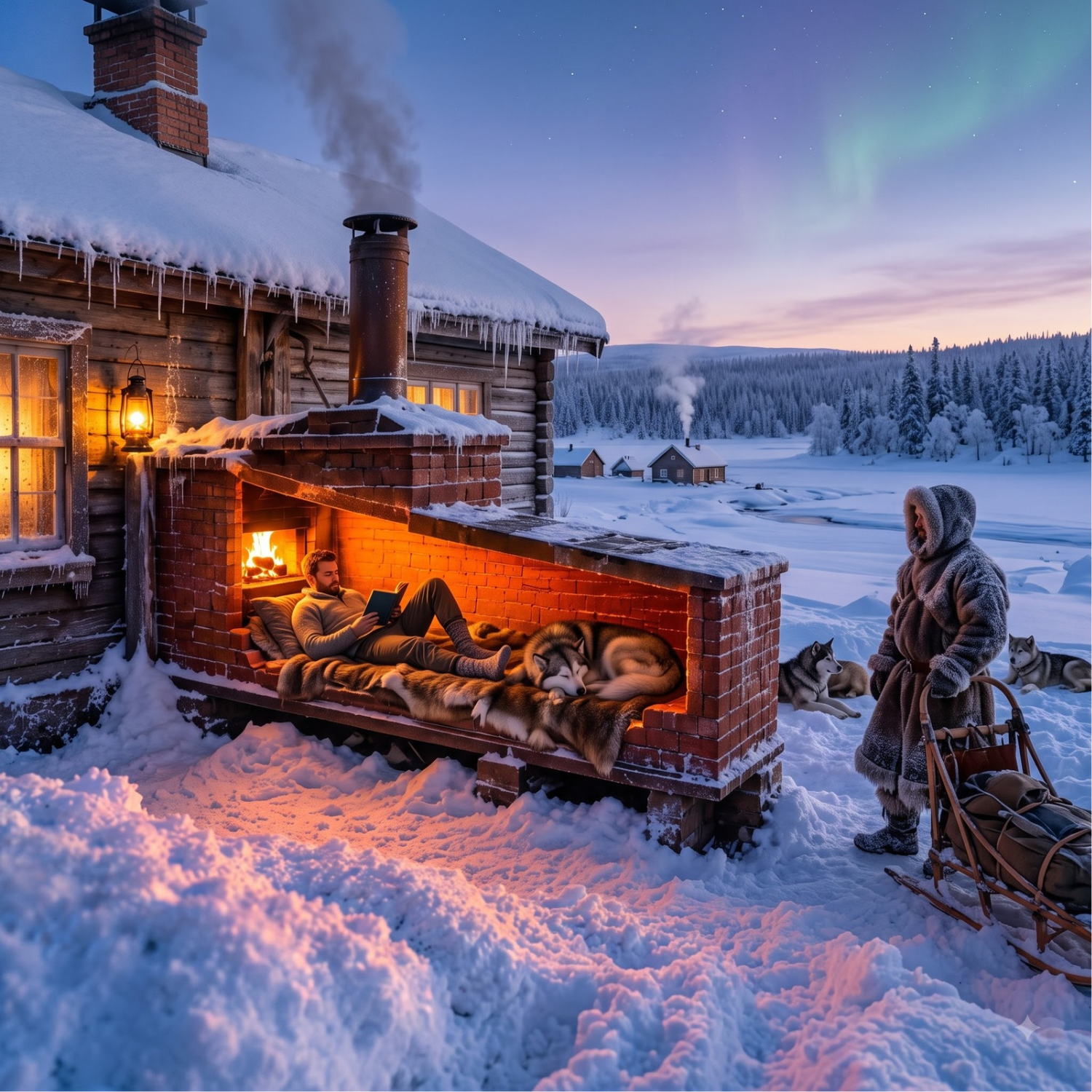
The Station Called His Stove a Brick Coffin — Until He Slept Without a Coat at 47 Below
THE LESSON OF THE STOVE
Mikhail Zoran had not learned about heat from university lectures in Leningrad. He had learned it in the dust and clay of Kargopol, working beside his father until his sixteenth birthday.
His father, Ivan Zoran, was a master stove builder whose reputation stretched across three districts. People said that in January, Ivan’s stoves needed to be lit only once a day, and the pleasant warmth would linger until the following morning. Ivan had taught his son a single, absolute rule of thermodynamics long before Mikhail knew what the word meant:
“Iron warms you only while there is fire burning inside it. Brick warms you long after the fire has gone out.”
Little Misha had tested that maxim every winter of his youth. In the evening, he would press his small palm against his father’s massive masonry stove; it felt like leaning against a sun-warmed boulder. In the morning, when the house was silent and the hearth was dark, the brick was still warm. Only the iron door handle was ice cold.
Yet Mikhail never became a stove builder. He pursued a degree in meteorology in Leningrad, and in 1933, he was assigned to his first Arctic winter on Novaya Zemlya.
He arrived at that initial station with a single suitcase and his father’s wisdom—which at the time seemed to him like little more than stubborn village superstition. The station was equipped with standard government iron box stoves.
During blizzards, those iron boxes glowed cherry-red. Under the ceiling, the air was as stifling as a public bathhouse, hovering near twenty-eight degrees Celsius. But down on the floor, the water in a tin mug froze solid into a block of ice.
Mikhail, keeping meticulous weather logs, began recording indoor temperatures at various heights: plus twenty-eight at the ceiling, minus three at the floor. If the iron stove burned out during the night, within an hour the house dropped to the temperature of the icy entryway.
The crew was forced to maintain a grueling watch rotation, feeding the stove like firemen on a steam locomotive. The man on duty stayed awake all night, went out to take meteorological readings with red, exhausted eyes, and frequently mixed up his numbers in a haze of sleep deprivation. By March, the station ran entirely out of coal. For the final two weeks, they burned empty food crates and ripped floorboards out of the bunks just to stay alive.
Mikhail returned to the mainland with a frostbitten earlobe and a leather notebook filled with columns of indoor temperature gradients. His father read through the notebook in a single evening, took off his spectacles, and offered a quiet verdict:
“Where coal arrives only once a year, iron only warms the man who keeps feeding it.”
That very spring, Ivan showed his son how to lay out smoke channels within a two-ton mass of brick. Mikhail copied the precise cross-section diagrams into the back pages of his weather notebook. Before letting him leave for the Far North, Ivan made his son build a small masonry stove in a neighbor’s bathhouse from the ground up, entirely with his own hands, laying every brick through the long summer evenings.