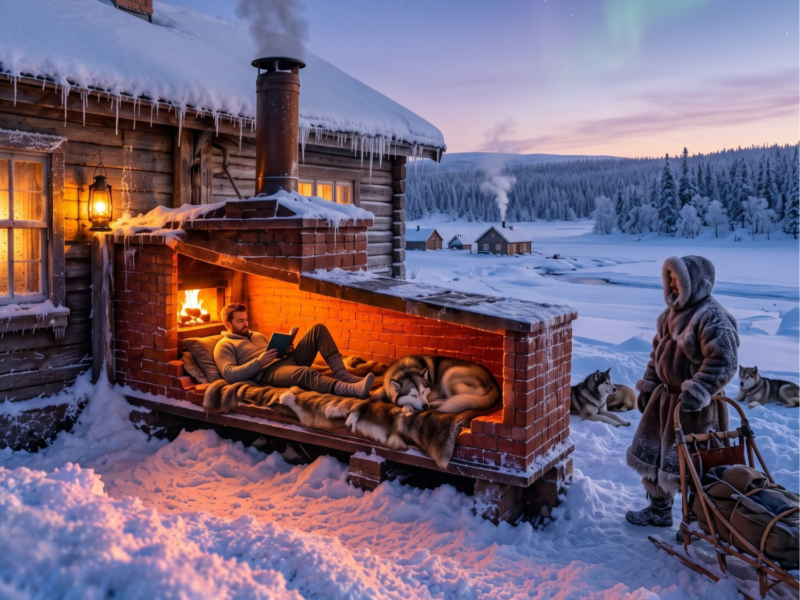
The Station Called His Stove a Brick Coffin — Until He Slept Without a Coat at 47 Below
THE RED PILE BY THE PORCH
The station consisted of three small wooden houses constructed from imported timber: the main living quarters, the radio hut, and a tiny detached cabin intended for the newlyweds, situated slightly apart near the meteorological instrument field.
Each house had already been provided with a standard cast-iron stove and a stack of coal sacks, allocated strictly according to the bureaucratic mandates of the Northern Sea Route Administration. Station Chief Artyom Balashov personally demonstrated how to operate them: A little coal at a time. Never open the door wide. Clean the soot out once a week. Everything by the book. Everything perfectly standard.
There was, of course, no brick on the station.
However, local maps indicated an abandoned trading post twelve kilometers to the south. According to Yafim Lapander, a Nenets dog-driver who delivered mail along the coast, an old municipal bread oven was still standing partially intact among the ruins.
“You’re going to bake bread?” Yafim asked, squinting at Mikhail through tobacco smoke.
“I’m going to live in it,” Mikhail replied.
Yafim considered this for a moment. “With the dogs and good sleds, we can haul half of it back in three days if we don’t spare the animals.”
For three consecutive days, Mikhail and Yafim drove the sled teams down the coast. Mikhail broke the old bread oven apart with a heavy crowbar while Yafim carefully loaded the heavy yellow and red blocks. On the return journey, a sledge tipped over on an icy slope, spilling fifty bricks across jagged rocks. They labored until dark by the flickering light of a kerosene lantern to recover every single one.
Station Chief Balashov watched the red pile grow beside the newlyweds’ porch with mounting irritation. He was a veteran icebreaker captain of twenty years who had seen men lose their minds from isolation and cabin fever during long polar winters. To Balashov, any unauthorized, obsessive project was an ominous precursor to a psychiatric breakdown.
Stepping out onto the porch with his hands on his hips, Balashov looked down at the stack. “Zoran, you already have a government stove. A perfectly good one.”
“It warms only while it burns,” Mikhail replied calmly.
“Every stove warms while it burns! There is coal allocated for everyone.”
“For everyone—if the steamer actually manages to break through the ice next August.”
Balashov laughed, a harsh, dismissive sound. “The steamer will come the way it always does. You’ll break your back this autumn building a monument, and spend the winter lying inside your brick coffin.”
The station mechanic, Stanislav Kravッツ, overheard the exchange and repeated the phrase brick coffin at the dinner table that very evening. By sunrise, the nickname had spread across the entire station—all nine personnel, including the cook.
That evening, Vera looked at her husband across their cramped quarters. “They’re laughing at you, Misha. And at me, too.”
“Let them,” Mikhail said. “Winter will decide.”
She didn’t reply. But the following morning, she donned her heavy quilted parka, walked out to the sledges, and helped her husband clean mortar off the salvaged bricks, stacking them neatly by size.









