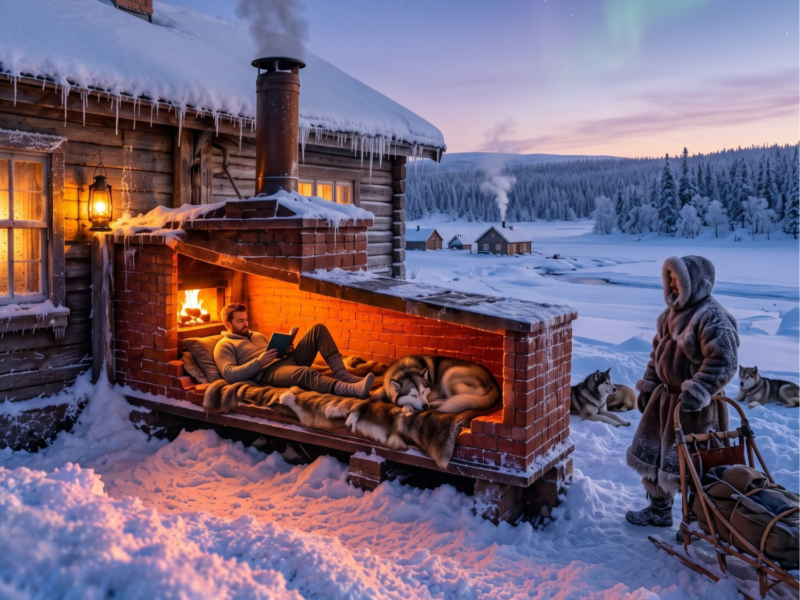
The Station Called His Stove a Brick Coffin — Until He Slept Without a Coat at 47 Below
THE PHYSICS OF THE MASS
To understand why two tons of brick and a cast-iron box on the same windy cape produce two entirely different realities, one must look at how thermal energy behaves.
In an iron stove, coal combusts inside a thin metal housing. The iron heats up instantly, glowing cherry-red, and the surrounding air warms within minutes. Because hot air is lighter than cold air, it surges straight to the ceiling, leaving the floor freezing. This explains the extreme temperature gradient: plus twenty-eight at the ceiling, minus three at the floor.
Worse yet, the gaseous combustion products rush up the metal chimney while still scorching hot. With them, the vast majority of the heat purchased with backbreaking labor flies straight out into the arctic atmosphere. When the coal burns out, the thin iron cools as rapidly as it heated. Within sixty minutes, the stove is stone cold; within two hours, the room matches the outside entryway.
Brick behaves entirely differently.
Clay and masonry conduct heat dozens of times slower than cast iron. Consequently, brick absorbs thermal energy sluggishly and releases it back into the environment with equal reluctance. Furthermore, a kilogram of brick stores nearly twice as much heat energy as a kilogram of cast iron heated to the same temperature.
Mikhail’s stove incorporated two tons of this thermal battery.
The secret weapon lay inside the masonry core: a complex labyrinth of internal smoke channels. Rather than escaping straight up the flue, hot combustion gases were forced to travel upward, downward, and upward again through narrow vertical chambers. At every turn, the superheated gases surrendered their energy directly into the bricks. By the time the smoke finally reached the chimney exit, it was barely warm.
Firing such a stove required a specific discipline: you loaded it quickly, burned the coal intensely for an hour to charge the masonry battery, and then slammed the iron damper shut only after all blue flames vanished to prevent carbon monoxide poisoning.
Once sealed, the brick mass cooled gradually over twelve to twenty-four hours, radiating gentle, infrared warmth in every direction. It warmed the walls, the floor, and the furniture directly—eliminating the vertical stratification of air. In a home anchored by a masonry heater, the temperature difference between floor and ceiling was mere degrees.









