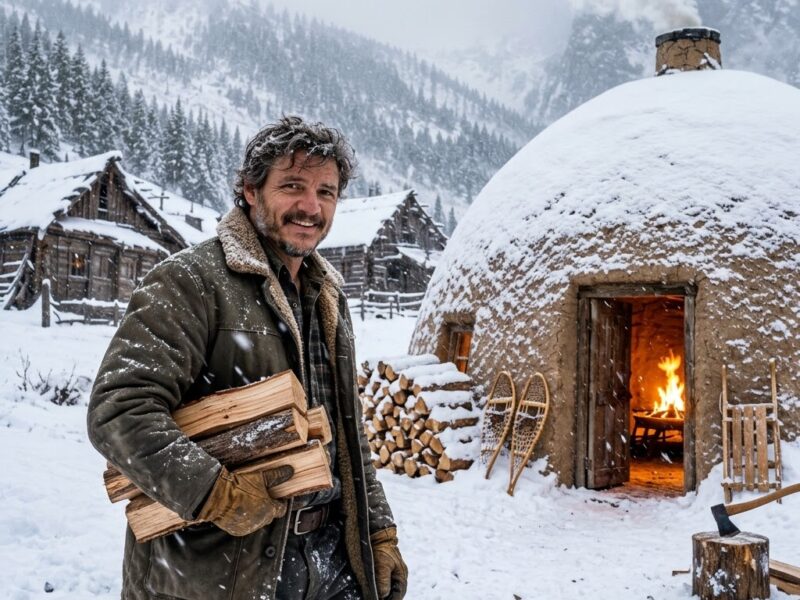
They Called His Clay House a Grave—Then It Survived the Worst Kansas Blizzard
The Ovens of Saratov
Friedrich Vagand was no carpenter, and he had never claimed to be. His grandfather had built bread ovens in the German colonies along the Volga River in the Russian province of Saratov. Every household baked in a heavy clay oven, and Friedrich’s grandfather was the man the village sent for whenever an oven cracked.
Friedrich had carried clay for him since he could walk, the exact way Willie carried straw now. He could still hear the old man’s rule set over every oven he ever built: The fire only visits. The walls are what keep the heat.
A good clay oven, the old man said, did not need a fire all day. You burned straw in it hard for an hour until the clay itself was hot right through. Then you raked out the ashes and baked in the lingering heat the walls gave back—bread in the morning, beans at noon, and still warm enough to dry damp mittens at night. All from one single armful of straw.
And there was a second thing the old man taught him from the far side of the river, out on the open steppe where the Kalmyk herders drove their flocks. The wind blew as hard there as any wind in Kansas, and the herders lived all winter in round felt tents—not square, but round.
“Look how the wind goes around it,” the old man had said, tracing a finger in the dust. “A wind is like a hand. A hand needs a corner to take hold of.”
Friedrich had carried both of those rules across an ocean, and for his first winters in Kansas, he had used neither one.
Willie’s mother lay in a churchyard back in the Saratov Province, and Friedrich had brought the boy over alone. Like most new men on the railroad lands, he had done what the lumber dealer told him. He bought pine boards from Plimpmpton’s yard and built a standard claim shack, twelve feet by fourteen, with a thin sheet-iron stove right in the middle.
Last winter had taught him what a board house truly was.
The iron nails went first. On the coldest mornings, the heads of the nails inside the walls grew white fur because each nail acted as a little iron highway carrying the sub-zero cold straight through the board. Then the water pail split, freezing into a solid disc of ice with the staves sprung apart like petals.
Then the stovepipe collar cracked where it met the roof from heating red and freezing again, and thick gray smoke began leaking back into the room. And finally, Willie started to cough—a small, dry cough at first, then a deep, rattling one that did not leave until April.
Friedrich had sat up with him many nights that winter, listening to the wind find the seams. He could hear the cold air pouring in—a thin, reedy whistle at each corner of the room where the boards met and never quite closed.
In the spring, when the cough was finally gone, Friedrich walked out onto the new claim with a spade and dug down through the grass to see what lay beneath. It was clay—yellow, brown, sticky, wonderful oven clay—just a foot below his boots.
That night, he told Willie they were going to build a house the way the old man built bread ovens.
Willie asked if it would be warm.
Friedrich said it would be warmer than bread.









