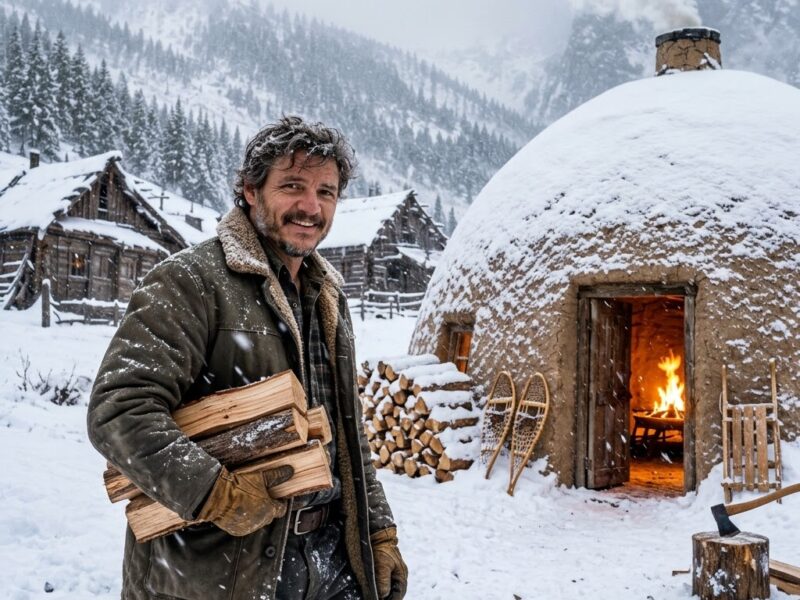
They Called His Clay House a Grave—Then It Survived the Worst Kansas Blizzard
The Thermal Battery
You might wonder how anybody could trust a house of mud against a Kansas winter. Here is how the dome kept its heat, and why it kept it—grounded in the exact same three principles that defeated the board shacks.
1. The Shape. Take a standard shack measuring twelve by fourteen feet. Its four walls run fifty-two feet around. Now take a round floor with exactly the same square footage inside it. The wall around that circle is only about forty-six feet long. The round house has roughly an eighth less exterior wall to lose heat through for the exact same amount of living space.
A dome does even better because it has no separate roof structure. A box has four walls and a flat lid, and warm air rises, pushing its heat out through the lid as fast as through the sides. Put that same floor under a dome, and the whole outer skin—roof and walls together—comes to roughly a third less surface area than a box. Less skin means less heat lost every hour from the exact same fire.
2. The Seams. A dome of clay laid wet has zero structural seams. There is no place where one board stops and the next begins, and no corner where three edges fail to meet tight. The straw ties every single course to the next. When the clay dries, it dries as one single, continuous piece, the way a baked ceramic pot does. The wind has nowhere to push cold air in, and the warm air inside has nowhere to leak out.
A board shack in a gale lost its warm air over and over again every hour. Friedrich’s dome, with its door shut and the clay stove drawing, kept nearly the exact same warm air all night with no draft whispering across the floor. And when the wind struck the dome, it didn’t pile up against a flat face; it slid smoothly around the curve over the top and away. There were no cold corners because there were no corners at all.
3. Thermal Mass. This is the part people most often misunderstand, because clay is not actually a good insulation material. Inch for inch, a clay wall lets heat pass through it faster than dry wood does. Anyone who tells you mud keeps out the cold like a wool blanket is mistaken.
What clay does is store heat. That is thermal mass. Two feet of wet-laid clay and straw in that dome weighed as much as a small herd of cattle. When Friedrich burned twisted hay in the long clay stove morning and evening, the fire roared for an hour, and the heat did not rush out through the roof. It soaked deep into the heavy clay bench and the inner layer of the dome, staying there.
Then all night, as the fire went cold, the warm clay gave that heat back to the air slowly and steadily—the exact way the old ovens on the Volga gave back heat for baking bread.
A board shack with an iron stove is hot only while the stove burns and goes freezing soon after. A clay dome stays warm long after the fire is completely out.
That was what Friedrich had promised Willie: the dome would sit comfortably above fifty degrees inside every morning on just two small fires of hay a day, no matter what the weather did outside the door.









