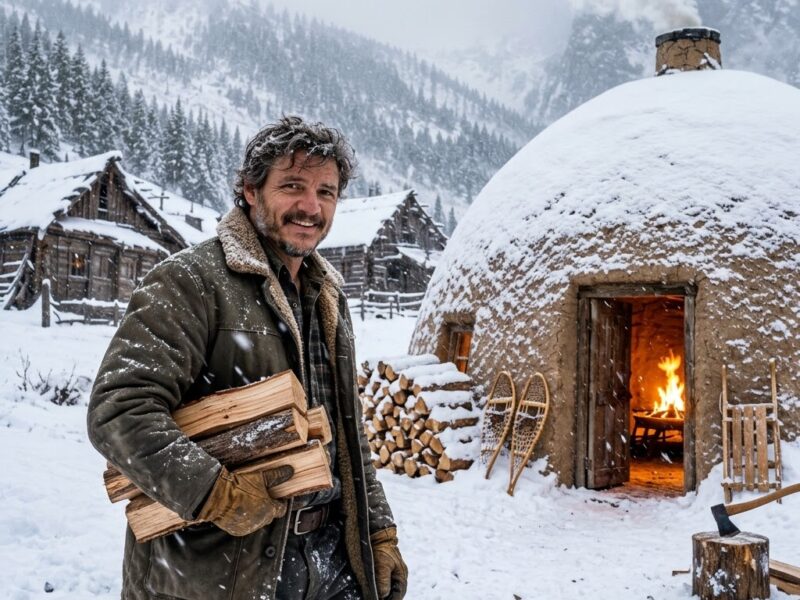
They Called His Clay House a Grave—Then It Survived the Worst Kansas Blizzard
The New Year's Gale
By Christmas, the dome had been tested twice by hard freezes. On both mornings, Plimpmpton’s tin thermometer by the door read well below zero, and inside, the water in the pail by the bench had no skin of ice at all. Brink came over once, stood in the warm doorway with his hands tucked into his armpits, and muttered that a December cold snap was not a true Kansas winter.
He was right about that. The true winter was waiting.
On New Year’s Day, 1886, the sky in the northwest went dark by noon, and the first true blizzard came down the smoky hill country like a falling wall. For three days, nobody on that prairie could see the ground. The wind drove the snow flat along the grass, so thick that a man standing at his own woodpile could not see his own back door.
Then, after the briefest lull, a second storm came howling in behind it, significantly colder than the first.
Willie had a job in the storm, and they had rehearsed it all December. Before the first flakes fell, he and Friedrich ran a thick hemp rope from the doorpost straight out to the ox shed in the haystack. They knotted it at every step, hanging a glowing lantern on a hook just inside the door so its light would shine through the tiny, deep-set window.
Every trip out for hay went hand over hand along that rope. Friedrich went first, and Willie followed behind him, holding his coat closed with a bundle of hay tucked under each arm while blowing snow packed into every fold of their heavy clothes.
Inside, Willie twisted the hay. That was his other crucial job. He took a long handful of slough grass, twisted it tight, doubled it over, and twisted it again until it was hard as a stick of wood. Loose hay flared up and vanished in seconds, but twisted hay burned hot and long. He twisted hay by lantern light, sitting on the warm clay bench in his shirtsleeves, while Friedrich fed the stove twice a day exactly as he had promised, and no more.
On the third morning of the second storm, Friedrich opened the door a hand’s width and read Plimpmpton’s thermometer on the post outside: twenty below.
He shut the door, walked to the bench, and held the lantern up to the little drugstore thermometer he had kept on a nail above the bench all autumn. It read fifty-six degrees.
Across the draw, it was a profoundly different winter.
Rand Brink had a good, heavy iron stove, and on the first night of the storm, he fed it until its top glowed cherry-red. It didn’t matter. The sub-zero air poured through the walls at every warped seam, and on the north side, the gale tore a strip of tar paper loose and flapped it until the iron nails pulled free. Snow sifted in through the cracks, lying on the floor in long, bitter white lines that refused to melt.
By the second morning, the fuel Brink had stacked beside his door was entirely gone. He burned his bench, then his table, then the wooden lid of his wife’s cedar trunk. The water in the kettle froze solid on the stove the moment the fire dipped, and inside his shack, his own thermometer stood at four below zero.
It was worse elsewhere, down toward Victoria. A herder was frozen stiff just a few hundred yards from his own front door in the spring. Cattle drifted blindly before the howling wind until they piled up against boundary fences and froze standing upright. Freight trains sat completely buried in deep cuts along the railroad tracks for days.
Mr. Ewing, sitting in his drafty office in Hays, burned the railroad’s own letterhead paper in his small stove just to stay warm. And Arastus Plimpmpton, the lumber dealer who had kicked a crack into a clay wall, was caught out in the whiteout.
He had driven his buggy out to a claim east of the wagon tracks on the morning of the second storm to collect on a load of pine boards, certain he could beat the weather home. He couldn’t. The snow fell so thick he lost the beaten road within a mile. His horse floundered deep into a hidden drift and snapped the shaft of the buggy, leaving Plimpmpton stranded on foot in a blinding white hell, the freezing wind stealing his breath before he could use it.
He walked blindly for most of an hour, losing all sense of direction. His hands stopped hurting—which frightened him far more than the burning pain had.
Then, low and orange through the swirling snow, he saw a light flicker, vanish, and appear again. It was the lantern shining through the deep little window of the dome.
He stumbled toward it blindly until his shin struck something taut. It was a rope, stretched tight and knotted at intervals. He grabbed it with stiffened gloves and followed it hand over hand the way Willie had followed it a hundred times, until his shoulder struck a solid wall.
The wall was curved. He felt his way along it, round and round, and immediately the howling wind let go of him, because on that protected side of the dome there was barely any wind at all. His fumbling hand found a heavy plank door.
It opened before he could even knock. Willie stood inside in his shirtsleeves.
Plimpmpton fell through the low arched door onto the smooth clay floor, snow sliding off his heavy wool overcoat, unable to stand. Friedrich pulled him to the heavy bench, sat him down with his back against the warm, radiating clay, and pulled off his frozen leather gloves.
Willie brought a pan of clean snow to rub the white, dead-looking fingers, just as Friedrich instructed, followed by a steaming cup of barley broth from the pot at the back of the stove.
For a long time, nobody spoke. The only sound was the wind outside, rushing round and round the smooth dome, finding absolutely nothing to take hold of.
Plimpmpton’s hands came back first—slowly, with a fierce, burning pain—and then his feet began to tingle. Finally, he noticed his back. He shifted uncomfortably on the bench, pressed his bare palm flat against the clay wall behind him, and left it there.
“It’s warm,” he whispered. “The wall… it’s warm.”
“It is warm all night,” Friedrich said quietly. “The fire only visits.”
Plimpmpton looked across at Willie, who was back on the floor by the lantern, sleeves rolled up, methodically twisting more hay. Then he looked up at the thermometer on the nail above the bench: fifty-six degrees. Outside the heavy door, it was twenty below. He knew well enough what the board shacks along the wagon road would read this morning.
“I sold boards to every claim between here and the river,” Plimpmpton said at last, his voice thick. “I told every one of them it was the only way a sensible man could live out here. And I was wrong, Vagand. Not one of those houses is as warm as your mudpot tonight.”
Friedrich did not answer that with gloating. He simply filled the tin cup again, pushed it into Plimpmpton’s hands, and let him drink in peace.
Act V: The Legacy of the Dome
Chapter 11: The Changing Horizon
The great storm blew itself out two days later.
When the dome’s heavy door swung open for good, the open prairie was a brilliant, blinding white sea. Snowdrifts reached the eaves of the flimsy claim shacks; fence posts were entirely gone; the tar paper on Brink’s north wall flapped in miserable tatters in the pale sun.
Yet, around Friedrich’s dome, the snow lay in a clean, smooth, aerodynamic skirt—curved precisely as the wall was curved—because the wind had slid harmlessly over the top and set the snow down gently in its lee instead of banking it against a flat facade.
The door was clear. The clay chimney puffed a steady plume of white smoke.
Rand Brink came across the draw that afternoon, thin, gray-faced, with his silent wife walking behind him. He stood in the warm doorway, looked at the cozy bench, looked at Willie, looked at the thermometer, and did not say a single word about graves.
Friedrich brought them into the heat and fed them hot soup. By the time the wagon roads finally opened, the whole township knew who had spent the storm warm and who had burned their furniture down to the floorboards.
Plimpmpton told the story himself. He told it at the rail depot in front of everyone: twenty below outside, and a boy in shirtsleeves inside a mudpot. He held up his still-bandaged fingers so they could see the proof. He told it in his own lumberyard.
He unhooked the tin-cased thermometer from the dome’s doorpost—the one he had nailed there in mockery—and hung it proudly on the interior wall of his lumber office. And when men asked him why, he told them the truth.
Mr. Ewing, the railroad land agent, drove out in March. He got down from his buggy, went inside the dome, and stood a long while with his palm resting flat against the warm clay wall, the way everyone did on their first visit. Then he reached into his coat, pulled out the formal order he had left there back in December, folded it once more, and slipped it back into his pocket.
The railroad never mentioned tearing down the mudpot again.
By the next autumn, four separate families on the claims surrounding the wagon tracks had built with clay and straw. Brink was the first among them. He did not build a full dome; instead, he built thick, curved clay walls around his existing board shack—a skin of the same yellow ground packed wet and rounded off gracefully at every sharp corner.
And he told anyone who asked that a round wall gives the wind no hand to hold. That winter, he burned precisely half the fuel he had burned the winter before, and his water pail never once split.
Two more households built complete clay walls and long, double-flue clay stoves. A family from the Volga, following the lead of the wagons, raised a proper dome of their own on the next section over to the southeast.
Even Plimpmpton’s lumberyard—which had never sold anything in its history except pine boards—began to routinely stock and sell pressed bales of clean prairie straw.









