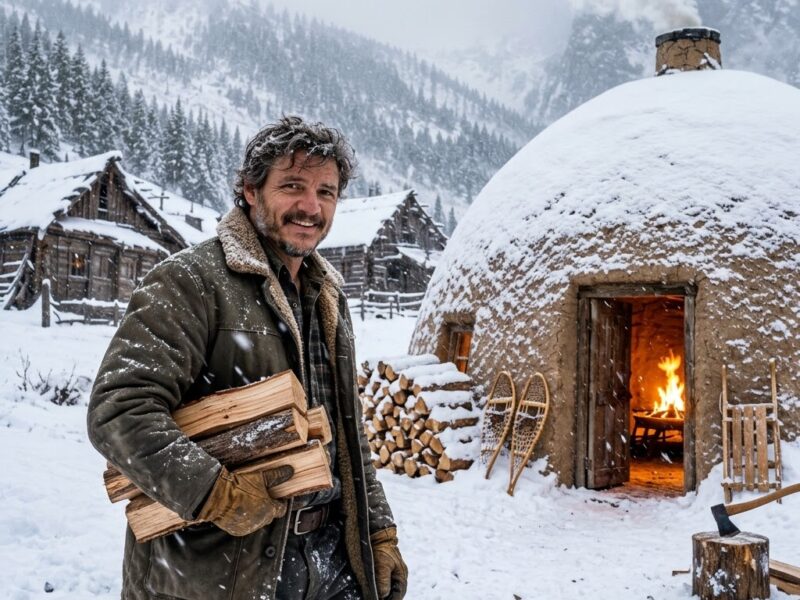
They Called His Clay House a Grave—Then It Survived the Worst Kansas Blizzard
The Physics of the Curve
To understand why Friedrich’s plan worked, you have to understand what was fundamentally wrong with every board shack between Hays and the river.
It was not the stove. Most of those iron stoves could turn their stovepipes red. The trouble was that a board house could not hold onto the heat the stove made, and it lost that heat in three distinct ways at once.
First through the wall itself. A pine board, an inch thick, is a very thin coat for a house. Heat passes through it quickly, and the board has almost no mass—nothing in it to store any warmth. The moment the fire burns low, the room is only as warm as the air still trapped in it, and that air goes cold in minutes.
Second through the air. A board house is a box of seams. Every board touches the next along a crack, and every corner is a place where three edges meet and never quite close tight. When the wind blows on a board shack, it pushes cold air in through every crack on one side and pulls warm air out through every crack on the other. Men on the plains said a board shack in a gale breathed like a tired horse. Brink’s shack across the draw changed its entire volume of air from floor to rafters several times every hour on a windy night. His stove heated the air, but the wind carried the warm air away and brought in freezing drafts.
Third through the corners. Wind does not like corners. When it strikes the flat side of a box, it piles up against it, pressing hard. When it whips around a sharp edge, it tears away and leaves a low-pressure suction behind. The flat wall is pushed; the corner is sucked. The seam at the corner gets both forces at once, and that is where the chinking fails first, where the draft blows hardest, and where the frost grows thickest.
Every settler knew which corner of his shack was the cold one. Nobody had ever asked why.
A round house of clay answered all three.









