They Laughed at His Farm With No Barn Until Winter Revealed What He Built Below
THE INHERITANCE OF THE ALPS
Yost Miller was not a common dirt farmer learning his craft by trial and error. He was a master carpenter schooled in the rigorous, old-order traditions of the Pennsylvania Dutch, a lineage of builders whose hands knew four things instinctively: the precise weight and balance of a broadax, the intricate cut of a heavy timber mortise, the unyielding grip of a white oak peg driven home by a mallet, and the way dense limestone field rubble behaves when it anchors something massive into the living earth.
That knowledge had not originated in Ohio. It had crossed an ocean, forged in the crucible of the Swiss Alps.
In the high cantons of Switzerland, the cold came down like an executioner’s blade. The growing season was brutally short, and the margin for survival was razor-thin. Up there, generations of mountain farmers had been taught the same uncompromising lesson by the frost: Work with the earth, or freeze.
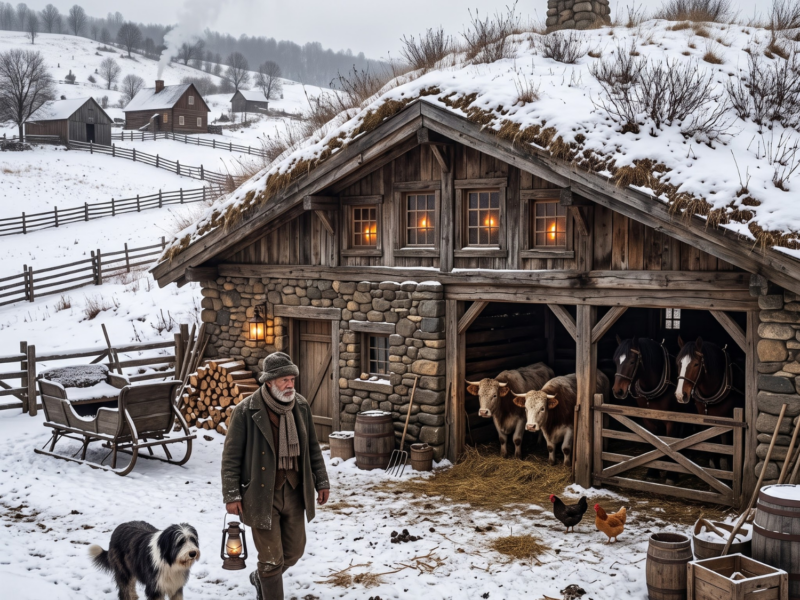
They stopped treating topography as an obstacle to be conquered. To the Alpine builder, the hill, the timber frame, the livestock, and the human family were not separate problems to be solved independently; they were parts of a single, interconnected thermodynamic system. The Schweitzer Bank barn—half-dug into the slope, pairing the living warmth of cattle with the shelter of the earth—was a masterpiece of survival technology.
Miller had carried that genetic and technical inheritance west, seeking a new life for his wife, Rebecca, and their two young children, Samuel and Miriam.
They had arrived in Holmes County just a year prior, stepping directly into an Ohio winter that nearly extinguished the family. Their first season was spent in a standard frontier cabin, thrown up fast and light like every other homestead along the road. That winter wrote its suffering into their bones in a language of ice that never faded.
The cold was not merely weather; it was a physical force that systematically dismantled every illusion of shelter.
The first proof of its terrifying power came from a neighbor’s well, where the heavy iron pump handle snapped clean at the wrist on the very first pull, the metal rendered as brittle as dry glass by the depth of the freeze. Then the cold breached the schoolhouse. By the time the morning bell rang, the ink had frozen solid in the master’s inkwell, turning from liquid to ice before a single letter could be formed on the slate.
Finally, it reached their parlor. Rebecca’s heavy wool coat hung on a wooden peg by the door overnight. When she lifted it down the next morning, it cracked straight down the back like dry bark in her hands; the ambient moisture trapped in the room had penetrated the fibers and frozen solid inside the fabric.
Miller was done with that kind of house. The conventional frontier approach to winter survival was fundamentally flawed, and he refused to test it a second time. Whatever he built next would not stand exposed and alone on flat ground.