They Laughed at His Farm With No Barn Until Winter Revealed What He Built Below
THE UNIFIED ENVELOPE
Yost Miller did not try to improve the traditional frontier farmstead; he systematically erased it.
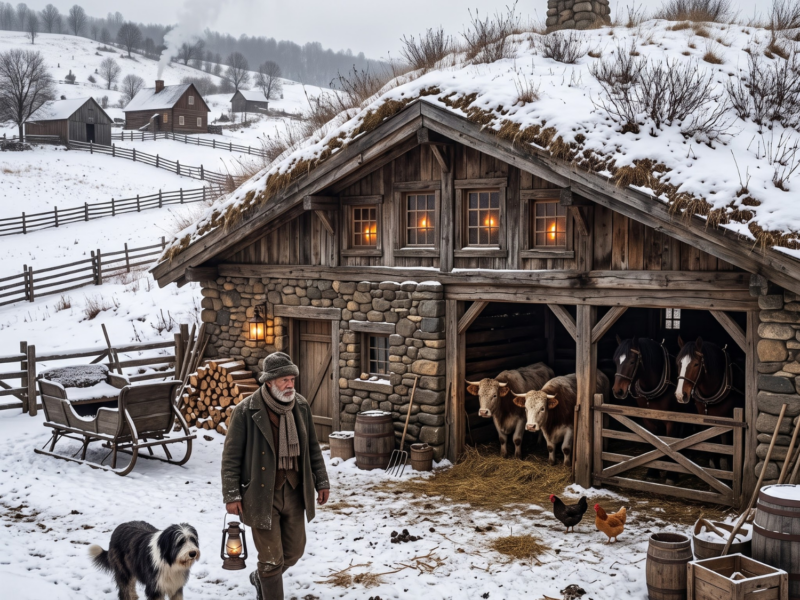
He replaced the two isolated buildings and the deadly gap between them with a single, massive structure driven straight into the south-facing slope of the hill: forty by sixty feet, two primary levels under one unified roof.
The lower level came out of the ground entirely on its southern elevation, carved into the hillside by horse and scraper. Massive limestone foundation walls, nearly two feet thick, rose up within the cut. Three of the four elevations—north, east, and west—were completely buried beneath thousands of tons of living earth. Only the south face stood exposed to the open air, dominated by heavily glazed windows positioned to catch every possible degree of the low winter sun.
Inside, the buried floor was cleanly divided into two distinct worlds by a formidable partition: a wall one foot thick, constructed from dense local limestone set in rich lime mortar.
The eastern half of the lower level was the human domain—kitchen, parlor, and sleeping quarters. The western half was the burer, the stable where the dairy herd and draft horses were housed.
Above them rode the upper story, framed with heavy oak timbers: a vast, open threshing floor designed for grain storage, equipment repair, and a towering loft for dry hay. Above the hay rested the roof—not vulnerable wooden shingles or tin that could bleed heat, but a thick, insulated sod roof pitched to shed water and store mass.
The layering of that roof was a masterclass in passive design: waterproof birch bark laid directly over heavy roof decking, six inches of mineral soil over the bark, and a dense, living mat of deep-rooting pasture grasses that bound the entire assembly into a living shield.
The distance the farmer no longer had to cross in a blizzard was the exact same distance the heat no longer had to travel. Miller had eliminated the enemy of distance with a slope, a scraper, and twelve inches of solid stone.









