They Laughed at His Farm With No Barn Until Winter Revealed What He Built Below
THE WARS OF THE PLAIN
To understand why Miller was tearing apart a hillside, one had to look at the geometry of failure that defined every other farmstead in Holmes County.
A traditional farmstead was a war fought on two separate fronts. There was the house for the people, and there was the barn for the animals, separated by fifty to ninety yards of freezing, open ground. The winter wind attacked both structures simultaneously, and because they were isolated, neither could defend the other.
The conventional house was a machine designed for exporting heat. Built using balloon framing—thin wooden siding stretched over narrow studs with virtually no insulation and zero thermal mass—it offered the howling north wind a massive, receptive surface.
When the wind struck the windward face of the house, it created high pressure against the siding. On the opposite, leeward wall, the pressure dropped. Because air invariably moves from high pressure to low, that pressure differential acted like a giant invisible hand, sucking the warmed air straight out of the living space through thousands of tiny, microscopic cracks, joints, and nail holes in the frame.
Every seam was an exhaust vent. The family’s iron cook stove burned wood all day long, yet the house gained almost nothing back.
The arithmetic of that waste was staggering: eight to ten cords of wood per winter. Cutting, hauling, splitting, and stacking that much timber consumed weeks of brutal labor from every adult in the household. Yet the labor itself burned human calories that the family could ill afford to lose. It was a vicious, inescapable circle: they burned precious calories to cut firewood, and they burned firewood to replace the calories lost to the cold, leaving nothing over at the end of the season.
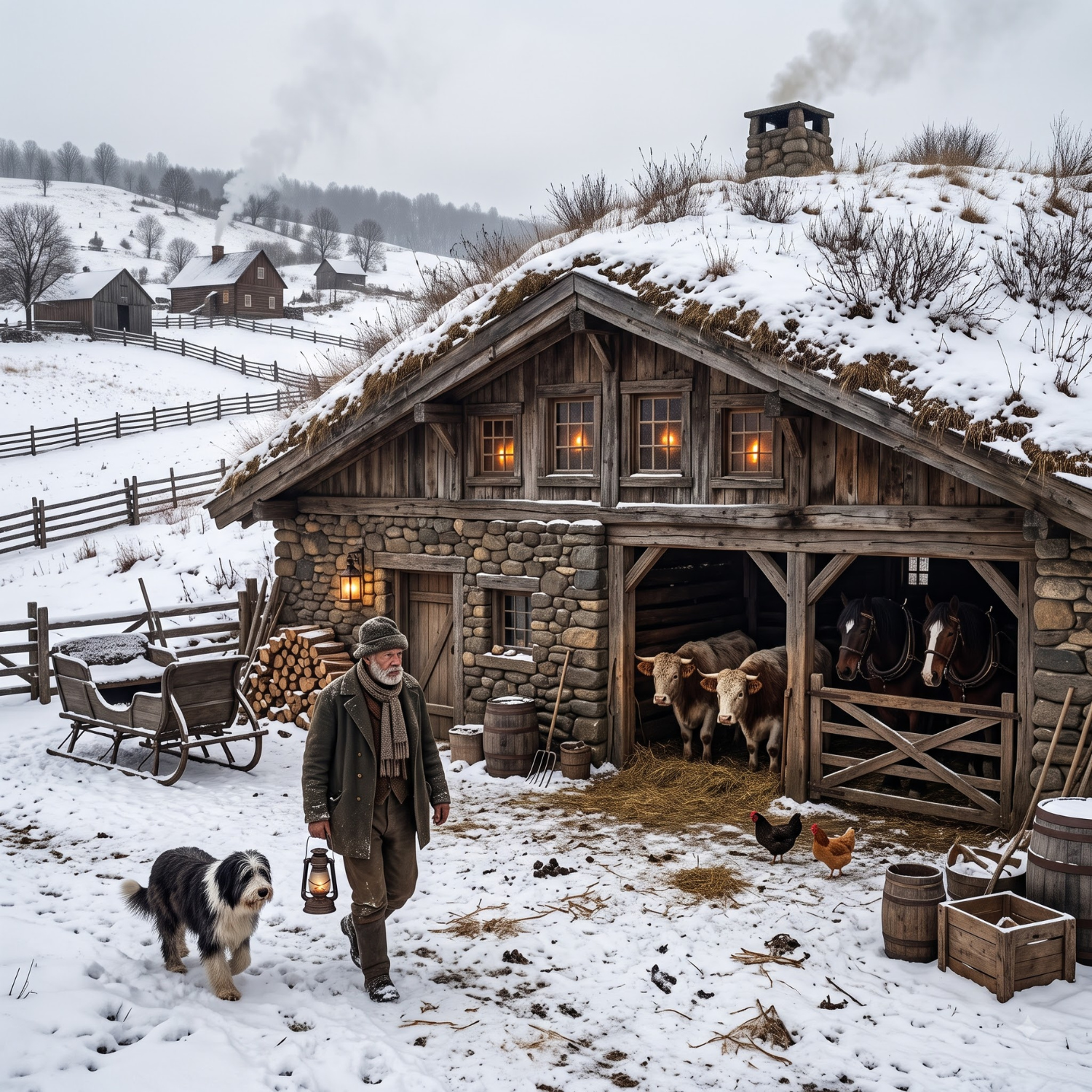
The livestock fared no better. They stood shivering in drafty, isolated barns fifty yards from the dwelling. Cattle are living heat engines; a mature dairy cow weighs over a thousand pounds and continuously radiates significant thermal energy through internal metabolic fermentation.
In the right structure, that heat is free energy. But in a drafty, uninsulated timber barn, it poured straight up through the roofboards and out the gaps in the siding. The animals burned their own feed intake simply to stay alive against the draft. Milk production plummeted; muscle mass withered.
Twice a day, through blinding snow and biting gales, the farmer had to make the perilous trek out to the barn before dawn and after dark to milk and feed. Every trip exposed him to the worst of the weather, pulling more calories from a body already running a deficit. And when he reached the barn, the animals were shivering just as hard as he was.
Two structures. Two separate losses. A system of constant, exhausting attrition against an enemy that never slept.