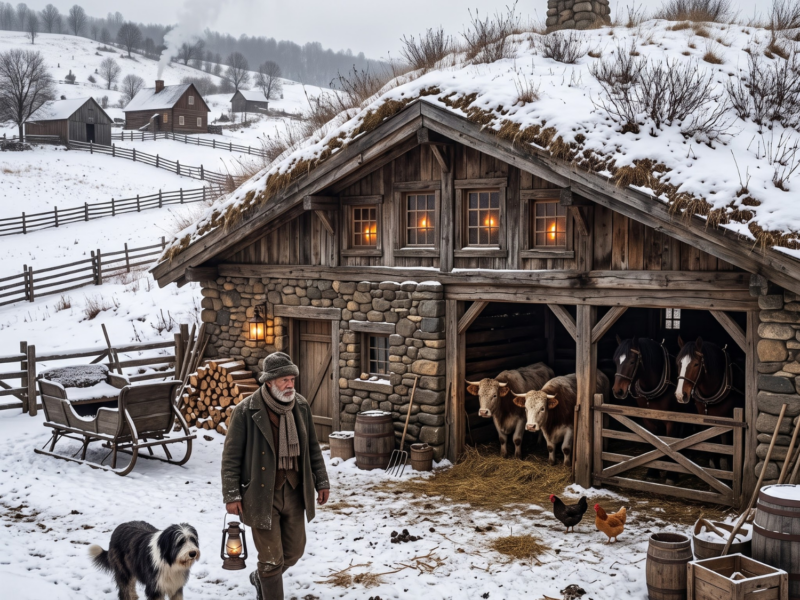
They Laughed at His Farm With No Barn Until Winter Revealed What He Built Below
THE PHYSICS OF THE HILL
The law had gotten its fine, but the real test of Miller’s building was never a statute book. It was written in physics, and the thermometer that would judge it was already gathering over the Great Lakes.
The hill did the vast majority of the work. While a conventional farmhouse stood exposed in the open, fighting winter air head-on—air that could plummet to minus thirty degrees—the earth beneath the frost line never moved. It held a steady, reliable baseline of forty-eight to fifty degrees Fahrenheit year-round.
Furthermore, a buried wall never faces moving air. Wind cannot strip thermal energy from a surface it cannot touch. Consequently, the lower level of Miller’s homestead sat cocooned in a thermal comfort zone that winter had no mechanical way to reach.
The sod roof closed the upper gap. In 1900, Miller’s layered roof rated roughly around R-15—nearly ten times the thermal insulation value of a standard wood-shingle roof of that era. Heat naturally rises, and in an ordinary cabin, it poured straight up through the ceiling boards and vanished into the sky. Miller’s roof caught that rising energy and trapped it within the building envelope.
Then came the livestock.
A mature dairy cow is an unceasing metabolic engine. Through the continuous, internal work of enteric fermentation—digesting heavy roughage in the rumen around the clock—eight mature dairy cattle and four heavy draft horses generated roughly 3.2 kilowatts of thermal energy every single hour.
In a drafty, isolated barn, that heat vanished instantly, stripped away by the wind while the animals shivered. But inside Miller’s earth-sheltered burer, the heat had nowhere to escape. The temperature in the animal quarters climbed to a comfortable sixty degrees Fahrenheit, allowing the herd to convert feed into milk and muscle rather than pure survival calories.
And then that heat met the twelve-inch limestone partition.
Limestone is an exceptional thermal conductor and a massive thermal battery. The western face of the wall absorbed the steady 3.2 kilowatts radiating from the livestock. Slowly and continuously, the stone carried that energy through its mass via conduction, radiating it outward from its eastern face directly into the family’s living quarters.
That interior wall was no longer acting merely as a partition; it was functioning as an unpowered, continuous heating system. Roughly 1.3 kilowatts made that subterranean crossing every hour.
No wood chopped. No stove stoked. No fire tended.
The family’s iron cook stove only had to top off the ambient temperature. The floor, the walls, and the air were already warmed by the earth beneath and the livestock beside them. The Millers ultimately burned a mere one-fifth of the firewood their neighbors consumed—saving over eight grueling cords of timber in a single winter.









