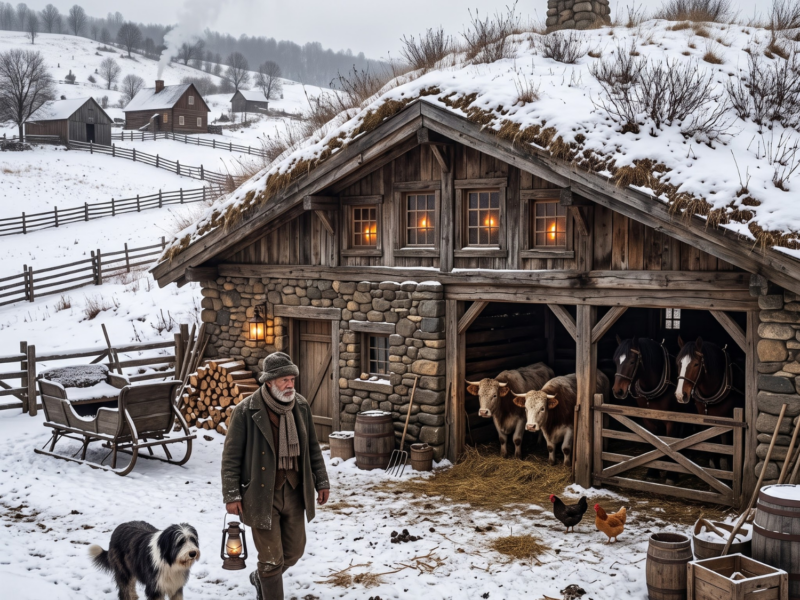
They Laughed at His Farm With No Barn Until Winter Revealed What He Built Below
THE CITATION IN THE MUD
Nothing had tested the design yet. No winter gale had leaned against that sod roof, and no sub-zero night had pressed its weight against the buried limestone walls. Whether the building would hold its heat when the true test arrived remained an open question.
So did the question of whether the township would allow it to stand.
In 1897, the state of Ohio had passed a sweeping farm hygiene code that made Yost Miller’s architectural philosophy strictly illegal before he had even laid his first course of stone. Crafted by urban legislators and progressive agriculturalists who were terrified of cholera, miasma, and tuberculosis sweeping through crowded tenements, the lawmakers had reached a single absolute conclusion: People and animals belong apart.
They wrote that separation into rigid statute: forty feet. That was the minimum legal distance Ohio now required between any livestock housing and a human dwelling.
Cyrus Whitmore carried that number in his pocket like a moral compass. As the Holmes County Township Assessor, the statute was never mere paperwork to him; it was a sacred trust of public health.
So in April, while the heavy oak framing of Miller’s upper story was still open to the spring sky, Whitmore drove his buggy out to the hillside. He walked across the open floorboards, pulled his leather-bound ledger from his coat, and read the statute aloud.
“Section Four,” Whitmore announced, looking down at Miller through wire-rimmed glasses. “You have placed livestock and human beings under the same roof, separated only by a masonry partition. Sharing a roof with beasts is a sanitation violation, a direct hazard to public health, and a primitive regression this township will not endorse.”
Whitmore was not a malicious man. In 1900, the physical proximity of animals was universally accepted by science as the primary vector for disease. He believed in his citation the way a man believes in gravity. To a progressive mind, living under the same roof as cattle was a relic of medieval peasantry—something people did only when they had no other choice. Distance was the only defense anyone trusted. Distance against disease, distance against stench, measured precisely in forty feet of open air.
Miller took the paper from the assessor’s hand. He folded it carefully along its creases and tucked it away into his canvas work apron. He would pay the fine without argument—a modest administrative tax on survival. Then he would go back to work.
Before Whitmore turned to leave, Miller pointed a calloused finger at the thick stone partition, then back at the assessor.
“The wall is sealed,” Miller said quietly. “The air does not mix. But the heat does not know your law.”









