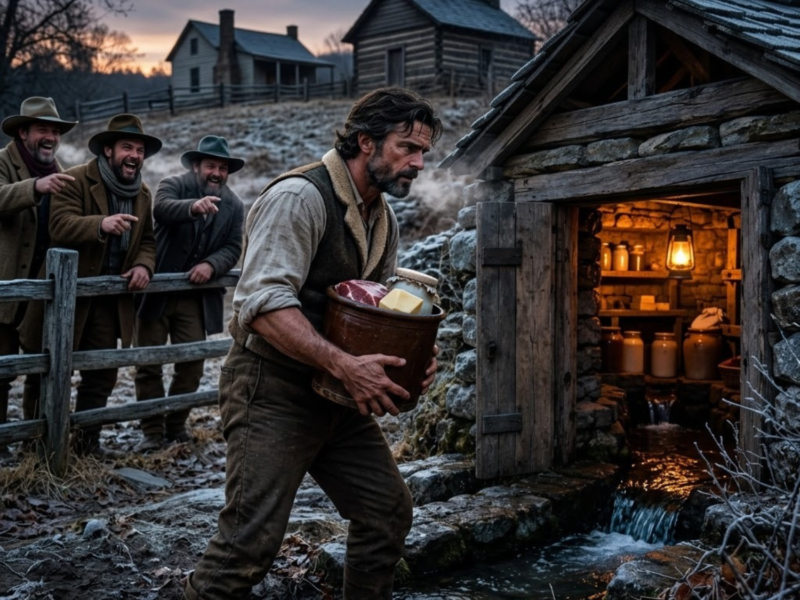
They Laughed at the Tiny House He Built Over a Spring — Then the Heat Ruined Everyone’s Food
They Laughed at the Tiny House He Built Over a Spr…
They Laughed at the Tiny House He Built Over a Spring — Then the Heat Ruined Everyone’s Food
The August heat in the Tennessee foothills did not merely arrive; it settled over the land like a damp, suffocating wool blanket, pressing down on the cornstalks and turning the midday air into a shimmering mirage. Down in the valley, Martin Hail wiped a grimy forearm across his forehead, squinting through the glare toward his neighbor’s property. He had spent the last three weeks calling Isaac Rowan’s latest project a complete and utter waste of time—a foolish, damp folly born of too much idle thinking.
By the time Martin finally understood what Isaac had built, he was standing ankle-deep in cold spring water, gently lowering his family’s last good crock of butter into a low stone room he had mocked all summer. Outside, the relentless sun was baking the earth and ruining stored food by the hour. But inside that little stone structure, the water running across the floor was still cold enough to make a grown man’s hands ache.
The strange part of it all was that Isaac Rowan had never meant to build anything important there.
In the spring of 1846, the place was nothing more than a wet, muddy patch at the bottom of his steep hillside. Clear, sweet water emerged naturally between two deep shelves of limestone, filled a shallow, mossy hollow, and then disappeared through the tall grass on its way toward a distant creek. The spring served a modest purpose: it watered two milking cows, filled the family’s drinking buckets on hot afternoons, and offered a cool, muddy spot where Isaac could kneel and wash the dust from his hands after a long day of repairing wagon wheels. That was all.
Isaac was forty-one years old—a farmer when the stubborn fields demanded it, and a wheelwright whenever a neighbor broke a wagon axle or a tool handle. He lived with his wife, Sarah, and their two young children on a modest, rocky homestead in the Appalachian foothills. They grew corn, beans, and potatoes; they kept a few hogs for winter meat; and they tended a small orchard of apple and pear trees.
Yet, it was the two milk cows that provided the family with their only reliable lifeline to the outside world. Milk became cream, cream became churned butter, and butter could be packed into crocs, carried into town, and traded for the vital necessities the farm could not produce: iron, salt, lamp oil, nails, and occasionally a few precious coins of hard cash.
The system worked well enough until the summer heat set in.
A cow did not stop producing milk simply because the thermometer climbed toward the nineties, but the relentless heat drastically shortened the window of time the family had to process it. Morning milk went into heavy earthenware crocs. Cream had to be separated meticulously. Butter had to be churned before the heat spoiled the texture. Anything that sat too long in the farmhouse kitchen began to warm with the room, turning rancid almost overnight.
The Rowans possessed a cellar, of course. It helped take the sharp edge off the weather. The deep earth surrounding it stayed cooler than the sun-baked house above, but the cellar was never truly cold. By midsummer, it simply became the least warm place available. Sarah planned her entire daily existence around that harsh fact: milk came first, butter came next, and everything else had to wait in line.
Then, one bright June morning, a wooden cream churn split cleanly along one of its aged staves.
Isaac could fix wagon wheels, chair legs, and heavy tool handles with his eyes closed, but a leaking churn could not be rushed. Sarah had already collected a full batch of rich cream. If the cream grew too warm before Isaac finished the delicate repair, they would lose a significant portion of what should have become that week’s market butter.
Faced with disaster, Isaac carried the heavy, covered cream crock outside into the blazing sunlight. He needed somewhere—anywhere—cooler to put it. The cellar felt entirely too warm. The deep shade beneath the front porch felt even warmer.
Then, he looked downhill at the spring.
He walked down the slope and set the crock directly into the shallow, flowing water, wedging small stones around its base so the current wouldn’t tip it over. Then, without looking back, he returned to his split churn staves.
Several hours later, Isaac returned to the spring. The afternoon sun had grown so intensely hot that sweat ran in stinging streams down his back before he even reached the bottom of the hill. But when he lifted the heavy earthenware crock out of the water, the clay felt astonishingly cold against his calloused palms. Not merely cool—cold.
He stood there by the water’s edge longer than necessary, staring at the crock. The hillside around him was radiating heat. The stones exposed to the blazing sunlight were hot to the touch. Yet the water bubbling up from beneath the earth was crisp and chilled.
Isaac carried the crock back up to the house and placed it on the kitchen table beside another identical vessel that had been sitting in the cellar since dawn. He touched one, then the other.
Sarah noticed the difference immediately. The cream from the spring had remained far cooler, its texture smooth and completely unaffected by the furnace-like air of the kitchen.
Related Articles

They Mocked the Widow’s Dirt Cellar—Then the Freeze Left Every Cabin Cold but Hers Warm
They Mocked the Widow’s Dirt Cellar—Then the Freeze Left Every Cabin Cold but Hers Warm…

A Homeless Veteran and His German Shepherd Inherited a Ridge No One Wanted — 35 Feet In, They Found
Chapter 1 / 7 A Homeless Veteran and His German Shepherd Inherit… A Homeless Veteran…

Neighbors Laughed When He Built A Cabin Inside An Old Barn—Until It Kept His Home 35 Degrees Warmer
Chapter 1 / 8 Neighbors Laughed When He Built A Cabin Inside An… Neighbors Laughed…

His Sod House Had No Woodpile in January – Until the Trains Stopped and the Town Came Begging
Chapter 1 / 10 His Sod House Had No Woodpile in January – Until t……

She Built Her Cabin Over the Woodshed and Never Burned Wet Wood Again
Chapter 1 / 8 She Built Her Cabin Over the Woodshed and Never Bu… She…

The Duke Abandoned Her on Their Wedding Day—Years Later, He Discovered What He Had Lost
Chapter 1 / 7 The Duke Abandoned Her on Their Wedding Day—Years… The Duke Abandoned…

He Wedged a Tiny A Frame Into a Crevice Before Winter and His Family Slept at 75°F While Town Hit
Chapter 1 / 7 He Wedged a Tiny A Frame Into a Crevice Before Win……

He Was Too Old to Ride—So He Bought the Ruined Ranch and Found the Room Behind the Fireplac
Chapter 1 / 5 He Was Too Old to Ride—So He Bought the Ruined Ran……

Settlers Laughed at His Underground Heat Recovery Duct — Until It Kept His Cabin 71°F Warmer
Chapter 1 / 9 Settlers Laughed at His Underground Heat Recovery… Settlers Laughed at His…

A Navy SEAL Built a Home Inside a Mountain—Then His Dog Warned Him Before the Storm
Chapter 1 / 5 A Navy SEAL Built a Home Inside a Mountain—Then Hi… A…