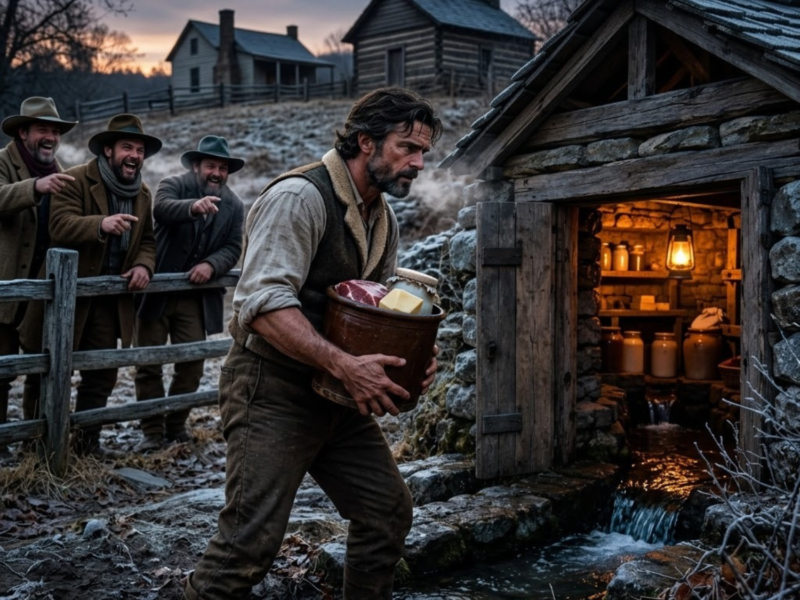
They Laughed at the Tiny House He Built Over a Spring — Then the Heat Ruined Everyone’s Food
The Convert
Three days after Isaac reorganized his storage strategy, Martin Hail walked slowly down the footpath carrying a heavy stoneware butter crock in his arms. There was no mocking grin on his face this time. His wife had churned the butter that very morning, and they desperately needed it to remain firm until it could be safely transported to the market in town.
Martin stopped at the open door of the springhouse, looking down awkwardly. “Isaac… you reckon you’ve got room for one more?”
Isaac stepped to the door and looked inside. Thanks to his strict reorganization, there was just enough space for one more crock right in the path of the fast-moving, freezing current. Barely.
Without a word, Martin stepped down into the stone room. The sudden rush of refrigerated air hit him like a physical blow, and cold spring water immediately covered the soles of his boots as he crouched. He lowered his family’s butter crock carefully between two of Isaac’s, pressing it gently into the gravelly bed so the rushing water embraced the clay.
For several long seconds, Martin said nothing at all. Then, slowly, he reached out and placed his bare hand directly beneath the subterranean inlet.
The spring water was so sharply, breathlessly cold that Martin actually flinched, pulling his fingers back with a sharp gasp.
That was the exact moment the entire structure finally made sense to him. The solid stone walls mattered; the heavy roof mattered; the deep shade mattered. But the beating heart of the whole ingenious mechanism—the part Martin had mocked all summer as foolish and redundant—was the cold, unyielding water running right through the middle of it.
Within a week, another neighbor appeared at the fence asking for spare space. Isaac politely refused the request—not out of selfishness or a desire to hoard the cold, but because the spring had hard physical limits. Overcrowding the channel would slow the current and ruin the delicate balance he had fought so hard to maintain.
Instead, Isaac showed the neighbor the underlying lesson: Find the coldest, most reliable spring on your own property. Do not try to trap or dam the water into a stagnant pond. Give it a clean, unhindered path through deep shade. Keep your most perishable food nearest the incoming flow, and always let the water leave.
That neighbor did not build a carbon-copy of Isaac’s springhouse. His particular spring emerged differently beneath a much steeper earthen bank, so he cleverly built part of his cooling room directly into the side of the hill. Martin’s land, situated on a flat ridge, required yet another architectural arrangement.
The physical shape of the buildings changed from farm to farm, but the core principle remained immutable.
People across early America had, of course, been utilizing that very same natural principle long before Isaac Rowan’s sweaty summer. Traditional springhouses were commonly built directly over or immediately beside reliable springs so that naturally chilled groundwater could pass continuously through stone troughs or damp cooling rooms.
Milk, cream, butter, and cheese were routinely placed in heavy earthenware crocs submerged in the flowing current. At historic sites like Hopewell Furnace in Pennsylvania, surviving springhouses still feature water that naturally maintains a steady, year-round temperature of around fifty-six degrees Fahrenheit—cool enough historically to preserve dairy, fresh meat, fruit, and vegetables through the stifling mid-Atlantic summers.
There was no mechanical compressor, no manufactured ice, no humming electrical grid. The earth’s deep subterranean plumbing supplied the cold, and the simple stone architecture merely kept the destructive sunlight away while making that natural chill useful to human hands.
By September, the oppressive heat finally broke as cool autumn nights swept down from the northern mountains. The farmhouse pantry stopped feeling like a hazard zone; the cellar improved naturally; and the spring recovered its robust seasonal flow. Martin no longer needed spare dairy space in Isaac’s building, having already laid the groundwork for his own stone water-trough across the property line.
Years later, a stranger walking past Isaac Rowan’s homestead might have glanced at the springhouse without giving it a second thought. The family barn had grown much larger over the decades; the farmhouse had been expanded, painted white, and brightened with cheerful glass windows; the wheelwright shop contained finer, more modern tools.
Yet the springhouse remained exactly what it had always been—a damp, dark little stone building tucked modestly against the base of the hill.
Water entered beneath one wall. Water crossed a narrow stone channel. Water left beneath the other.
That was all it had ever done. And that, precisely, was why it worked.









