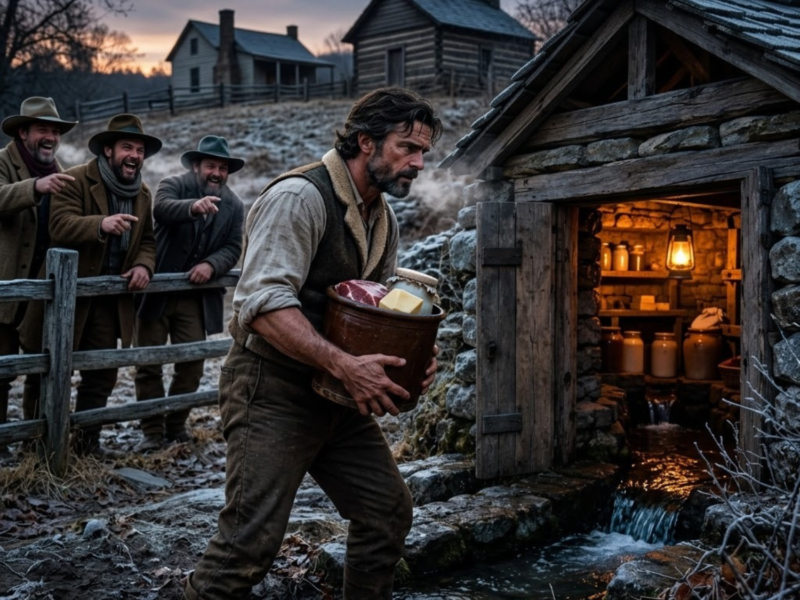
They Laughed at the Tiny House He Built Over a Spring — Then the Heat Ruined Everyone’s Food
The Envy of the Valley
By late July, the environmental contrast between the Rowan farm and every other homestead in the district became impossible to ignore.
Weeks of relentless, cloudless weather had baked the dirt roads until passing wagons raised towering plumes of choking dust. The local creek dwindled to a pathetic trickle of warm puddles. Afternoons grew heavy, windless, and utterly miserable. The Rowans adapted by shifting all heavy field work to the pre-dawn hours, banking their cooking fires during the peak of the day, and sleeping fitfully on sweat-soaked sheets.
The springhouse did not magically make all of that hardship disappear. The cows were still distressed by the heat; the farmhouse kitchen was still stifling; Isaac was still exhausted. But deep beneath the hill, the water remained stubbornly, refreshingly cold, anchoring their livelihood against the furnace of the sky.
Across the property line, however, a quiet disaster was unfolding at Martin Hail’s farm. Food began disappearing from Martin’s table—not because the family lacked provisions, but because they simply couldn’t keep them from spoiling.
One morning’s fresh milk was already sour by the following afternoon. A large crock of precious cream developed a sharp, foul odor and had to be dumped out to the hogs. Butter that should have been sold in town softened so badly in the cellar that it melted into grease.
Their winter vegetables survived down in the dark earth, and their heavy smoked pork held up reasonably well, but fresh dairy had become a daily, stressful gamble.
Martin responded the way most stubborn frontier farmers would: they milked less into storage, consumed what they could immediately, churned at ungodly hours of the morning, and dug deeper pits in their cellar floor. Those frantic measures reduced their losses, but when the summer nights finally turned hot and airless as well, the cellar failed to recover its cool temperature after sunset.
Across the fence line, Sarah Rowan was making fewer and fewer emergency decisions. She still worked from dawn until dusk, but now her milk could go straight from the milk stool to the springhouse while she moved on to other chores. Cream could wait safely in the current; butter remained firm and sweet for days. A small, ingenious manipulation of temperature had translated into a massive advantage in time and peace of mind.
Then, just as the system was proving its absolute worth, a terrifying new threat emerged.
The spring began to fail.
Isaac first noticed it by the subtle change in sound. Normally, the water spilling out of the stone drainage arch made a constant, cheerful trickle over the downhill rocks. One humid morning, that familiar sound was conspicuously quiet.
Inside the springhouse, the stone channel was still full, but the current had slowed to a agonizing crawl. The prolonged drought had finally pierced deep enough into the water table to affect the underground veins he had trusted.
For the first time all summer, Isaac faced the chilling prospect that his miraculous springhouse might soon dry up into nothing more than a damp, useless stone shed.
Without hesitating, he followed the hidden watercourse uphill, searching for a blockage. There was no broken pipe to repair, no mechanical pump to prime; the water simply emerged from natural fractures in the deep limestone and gravel strata just as it always had, but the subterranean source itself was carrying less volume.
Realizing he couldn’t command the earth to produce more water than it possessed, Isaac adapted by ruthlessly managing what he could control.
He waded into the channel and removed every minor obstruction that might slow the current. He lifted the heavy crocs that slightly crowded the narrow inlet, and he cleared away fine silt from the exit arch. He completely abandoned the luxury of cooling everything equally.
From that day forward, only the absolute coldest section closest to the incoming flow was reserved for the most sensitive dairy—milk, cream, and butter. Less delicate provisions were shifted upward onto dry stone ledges. Fresh fruit was moved to the wooden shelves, and heavy vegetables were stored in wicker baskets well away from the wet floor.
When Isaac stopped asking the little building to perform miracles beyond its natural capacity, the springhouse became paradoxically more efficient than ever.









