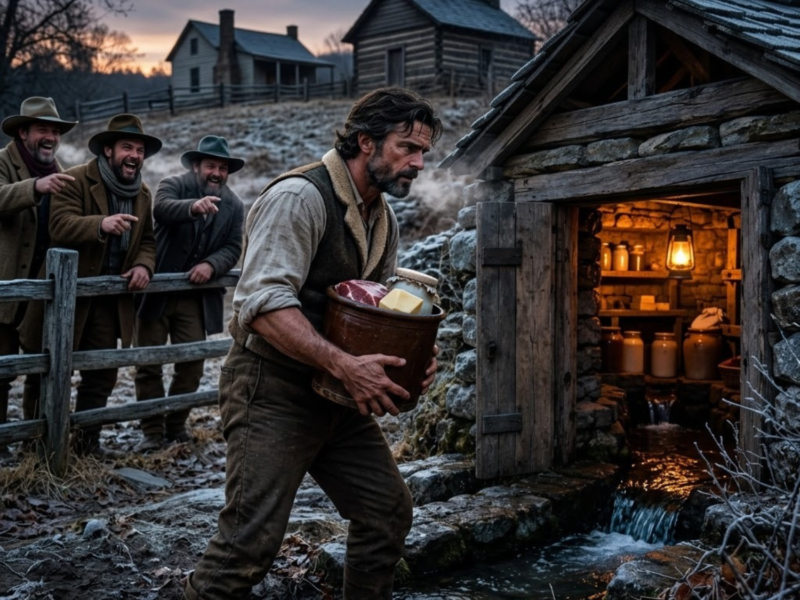
They Laughed at the Tiny House He Built Over a Spring — Then the Heat Ruined Everyone’s Food
The Experiment of the Trough
The first real test of the springhouse came with the evening milk. Sarah filled two identical crocs right after the milking was done. One went into the usual spot in the cellar. The other she carried down to the springhouse, settling it carefully into the fast-moving current so that the lower half was entirely surrounded by flowing water.
That afternoon, she brought both vessels back to the kitchen for comparison. Isaac needed only to touch the outside of the clay crocs to know the truth. The difference was unmistakable: the springhouse cream was icy and thick, while the cellar cream was already beginning to yield to the ambient heat.
Without another word, they moved the entire dairy operation down the hill.
Within a week, Sarah’s grueling daily routine had transformed. She no longer had to organize every chore around the constant, nagging fear that the milk would sour before she could churn it.
Yet, perfection on a pioneer farm was always a moving target. For several weeks, Isaac believed he had solved the riddle of the summer heat. Then, in his desire to make the building even better, he nearly ruined it.
The narrow stone channel worked remarkably well, but it could only hold a few crocs directly in the path of the coldest water. Isaac reasoned that if he widened the channel, there would be more room for storage. If he deepened part of it, larger containers could sit lower, exposing more surface area to the chill.
More water should mean more cooling, he told himself. The logic seemed foolproof.
Isaac took down his masonry tools, removed several strategic stones, and dramatically enlarged the center basin. The narrow, swift little stream suddenly spread out into a broad, lazy pool. Delighted with his extra space, Isaac immediately placed twice as many crocs into the water.
The building looked far more useful and productive.
Two days later, however, Sarah walked up from the springhouse with a troubled look on her face. The butter she had churned that morning felt soft, almost greasy.
Isaac initially assumed she was simply imagining things. The weather had been brutal, after all; of course the butter would soften a trifle. But when he walked down and reached his own hand into the water, he instantly realized something was terribly wrong.
Near the rocky inlet, the water still felt sharply, breathlessly cold. But across the newly widened basin, it felt lukewarm and sluggish.
Isaac watched the surface closely. Before his alteration, the spring water had entered one side of the building and rushed quickly through the narrow raceway. Now, that exact same volume of water was spreading out across a much larger, shallower space. The far end of the pool barely moved at all. Fine silt and floating leaves had already begun settling in the corners.
In trying to create more storage capacity, Isaac had inadvertently destroyed the current. The stiller water lingered too long inside the warm stone room, giving it ample time to absorb ambient heat. His “improvement” had weakened the very mechanism that made the springhouse work in the first place.
That very evening, Isaac hauled his tools back down and painstakingly rebuilt the narrow channel just as it had been. Instead of trying to surround every container with rushing water, he reserved the narrow, freezing section closest to the inlet exclusively for delicate dairy. Everything else—firm vegetables, cured meats, and fruits—would go on the dry stone ledges and upper shelves.
The springhouse did not need the most water possible; it needed water that kept moving.
Martin Hail happened to walk past just as Isaac was finishing repairing what he had just torn apart. To Martin, this endless cycle of building, unbuilding, and rebuilding seemed like definitive proof that the entire enterprise was becoming an unhealthy obsession.
“Seems to me you spend half your life hauling rocks around in the mud, Isaac,” Martin called out, leaning against the fence. “There’s easier ways to keep butter firm.”
Isaac wiped his brow, leaving a streak of wet clay across his forehead. “Where’s your butter right now, Martin?”
“Down in the cellar, softening up like lard,” Martin admitted with a grimace.
Isaac simply smiled faintly and went back to work.









