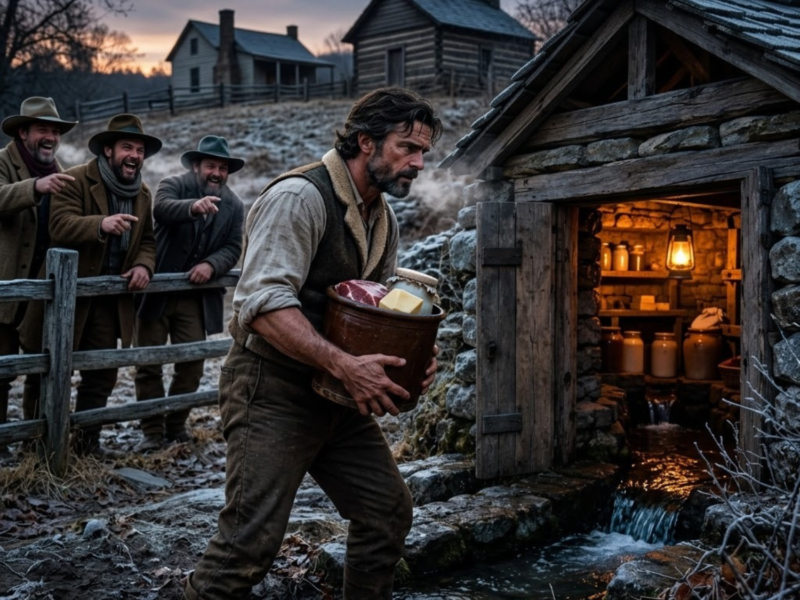
They Laughed at the Tiny House He Built Over a Spring — Then the Heat Ruined Everyone’s Food
The Foolish Architecture
There was nothing mystical about what had happened. The spring water had spent its long journey deep underground, completely insulated from the direct, punishing heat of the sun. But what truly caught Isaac’s attention was not simply that the water was cold; it was that it kept coming.
The little natural basin never held stagnant water for long. Fresh, chilled water bubbled up continuously from beneath the hill, while older, warmed water spilled away into the grass.
The next morning, Isaac carried an empty crock back down the slope, then another. He placed them at different points within the spring to test the currents. One sat directly over the fissure where the water emerged. Another stood in the shallow pool. A third remained on dry stone in the shade.
By afternoon, the difference was obvious even without a thermometer: the crock nearest the moving water was the coldest by far.
That simple observation gave Isaac an idea. Unfortunately, the first version of that idea looked completely ridiculous to everyone who saw it.
He mentioned his plan to Martin Hail, telling him that he intended to build a small, permanent house directly over the spring. Martin lived on the neighboring farm and had known Isaac for nearly twelve years. At first, Martin assumed Isaac was talking about putting up a simple wooden shed near the water to store tools.
Isaac quickly corrected him. Not near it—over it.
Martin stared down the hill, shaking his head. Water and buildings were two things sensible frontier men normally tried to keep strictly apart. Wet foundations shifted and settled into mud. Timbers rotted in the constant dampness. If Isaac needed another storage shed, Martin reminded him, there was plenty of dry, level ground everywhere else on the farm.
Isaac agreed completely. That was precisely why dry ground was entirely useless to him.
Within three days, Isaac had begun moving heavy stones. He did not bury or choke the spring; instead, he built around its natural flow. The first courses of dry-stacked limestone formed two low, sturdy walls running parallel on either side of the water. Then, Isaac carefully channeled the stream through a narrow, stone-lined trench down the middle.
Clean water entered beneath the uphill wall, flowed steadily across the stone floor, and escaped through an arched opening on the downhill side.
As Martin watched the work develop day by day, he became less amused and more concerned. He occasionally used the runoff from Isaac’s spring whenever one of his own livestock troughs ran dry during the dry spells. If Isaac blocked or diverted the natural flow, Martin would feel it downstream.
To reassure him, Isaac showed him the channel design: every single drop of water entering the building would leave it again, completely unhindered. The house was not meant to trap the spring; it was meant to borrow it.
That explanation sounded clever in theory, but the unfinished building still looked utterly foolish to passing travelers. Its lower walls were rugged stone, while its upper section was framed in rough, unpainted timber with a steep, plain roof. There was one small wooden door, no chimney, no proper glass windows, and a visible ribbon of water running right through the middle of the floor.
Travelers on the nearby dirt road often paused to stare at the tiny building tucked below Isaac’s house. Some assumed it covered a hidden well; others guessed it was an unusually small wash house. One neighbor bluntly asked whether Isaac had finally built a home small enough for the chickens.
Isaac ignored them all and kept working.
Inside, he constructed solid stone ledges just a few inches above the flowing water channel. He shaped several flat slabs of slate so that heavy dairy crocs could rest partly submerged in the moving current without tipping over. Above those wet ledges went simple, sturdy wooden shelves for dry storage.
The heavy roof kept direct sunlight completely away from the interior. The stone walls remained permanently damp and cool. The air inside smelled rich and clean—a potent mixture of wet limestone, damp earth, and fresh, mineral-heavy water.
When it was finished, the little springhouse was barely large enough for three adults to stand inside without bumping elbows. But size didn’t matter. No one was ever supposed to live there.









