They laughed At Them For Building Underground Homes – Until Brutal Winter Came
THE STRIPPED LAYERS
Strip away the thick blankets of grass, sod, and earth from the exterior of a Mandan or Hidatsa earth lodge, and the true mastery of its architecture revealed itself.
Beneath the earthen camouflage lay a heavy, meticulously engineered timber frame that put the settlers’ square cabins to absolute shame. Four massive, fork-topped center posts—often massive cottonwood trunks chosen for their density and strength—stood anchored deep into the permafrost line, carrying the primary dead load of the roof structure. Radiating outward from this central square were dozens of smaller pine and willow timbers, interlocking and bracing one another in a self-supporting web of raw mechanical genius.
The builders had not avoided wood. They used plenty of it. They simply chose to hide it deep inside the house, sandwiching it between layers of woven willow matting, prairie grass, and heavy turf.
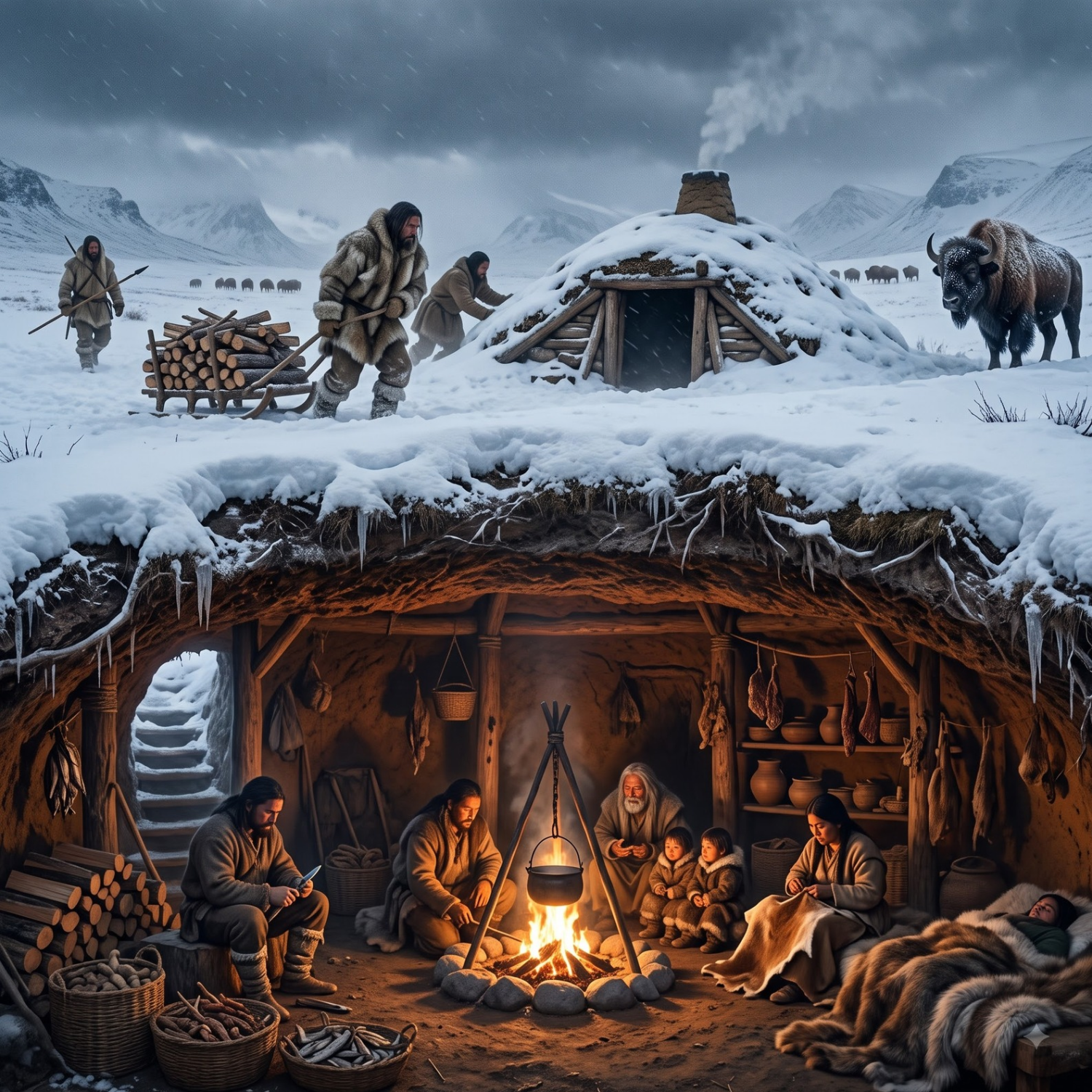
And the design went far deeper than the roof. Before a single log of the superstructure was raised, the floor itself was deliberately excavated two to three feet below the surrounding prairie grade. That single, brilliant stroke of engineering placed a significant portion of the home’s living space beneath the freezing level of the exposed ground.
What looked from a distance like a simple mound of dirt was actually a deeply calculated thermal vessel, shaped to work with the earth rather than fight it.
On the very first night of the great December blizzard, the stark difference between the two architectural philosophies manifested with brutal clarity.
Inside the settlers’ pine cabin, a massive stone fireplace roared with crackling split oak. Close to the hearth, the air was almost uncomfortably hot, drying the skin and scorching wool trousers hung too near the flames. But the moment the gale outside strengthened, the structural flaws of the above-ground box exposed themselves.
Cold air slipped mercilessly through the microscopic shrinkage gaps between the logs. Drafts crawled across the floorboards like icy serpents, wrapping around ankles and pulling the ambient heat right out of the room. The settlers’ fire had to be fed constantly, monotonously. Every hour demanded another armload of heavy logs just to keep the interior from sliding toward the freezing point.
Across the river, in the earth lodge, a fire burned as well—but it burned low and quiet in a central hearth pit scooped directly out of the earthen floor.
The flames did not need to roar. As the smoke and hot air rose, they gathered beneath the heavy, insulated dome of the timber-and-earth roof, trapped and circulating within the rounded interior. The wind passed smoothly over the exterior dome, sliding harmlessly across the curved sod without finding a sharp corner to grip or a flat surface to batter.
For the first few hours of the storm, the contrast seemed almost subtle to an outside observer. But by midnight, the true nature of the two systems revealed itself.
Seen from the side, the earth lodge almost completely followed the natural line of the ground. Only the low, rounded smoke-hole collar and the covered entrance tunnel rose clearly above the wind-swept prairie.
The lodge did not need to become hot in an instant. Its entire purpose was much more sophisticated: It needed to lose heat slowly.
The surrounding earth acted as a massive, geological blanket, slowing the thermal exchange to a glacial crawl. The central fire burned down to a bed of glowing coals, yet the warmth did not evaporate into the night sky the moment the flames faded. The heavy timber, the packed sod, and the surrounding permafrost held the energy, radiating it back inward with a gentle, persistent stubbornness.
No single feature defeated the cold. That was the hidden trick of it. There was no silver bullet, no magic timber. It was an entire system of mass, geometry, and depth working in concert.
Over a single cold night, that difference was simply useful. Over the course of a brutal, unending northern winter, it became the margin between life and death.