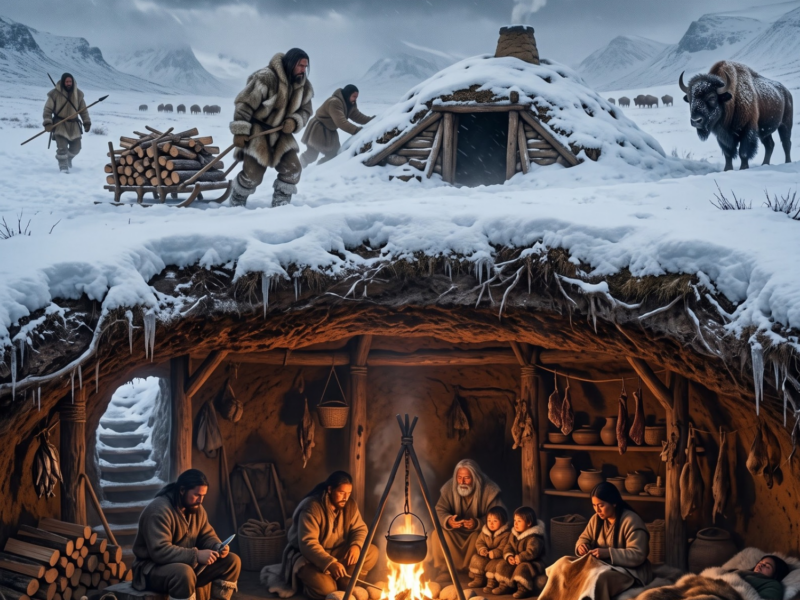
They laughed At Them For Building Underground Homes – Until Brutal Winter Came
THE EXPEDITION MEETS THE VILLAGE
In the late autumn of 1804, a strange, heavily armed party of explorers arrived near these very Mandan and Hidatsa villages just as winter was aggressively closing its icy fist around the northern plains.
Meriwether Lewis and William Clark, leading their Corps of Discovery toward the Pacific Ocean, recognized the desperate need to halt their journey and build a secure encampment before the Missouri River froze solid beneath their keels.
A mile downstream from the native settlements, Lewis and Clark’s men set to work constructing Fort Mandan.
From a distance, the American fort looked undeniably solid. High wooden stockade walls of hewn cottonwood logs stood twelve feet tall, forming a sharp triangle with defensive blockhouses at the corners. Smoke rose steadily above the flat-roofed quarters inside, signaling warmth and industry.
Yet, by the time December unspooled its sub-zero fury, the men of the Corps of Discovery discovered the severe limitations of their imported architecture.
Every single morning, soldiers returned through the heavy wooden gates with pale, waxy patches of frostbite whitening their fingers and toes. Inside the log quarters, the men huddled around brick fireplaces, their journal pages freezing to the touch as they attempted to record the day’s events.
At times, the mercury plunged toward forty degrees below zero. The cold was so absolute that standard ink thickened in its wells like molasses, forcing the scribes to constantly mix water and alcohol just to keep their pens flowing.
Outside, Fort Mandan stood stark and fully exposed against the open, brutal sweep of the Dakota winter. And beyond its wooden walls, sitting low, unassuming, and intimately curved into the earth, smoke continued to rise peacefully from the soil-covered domes of the Mandan and Hidatsa lodges.
By mid-winter, the soldiers at Fort Mandan had learned a humbling lesson that their rigid, vertical wooden walls simply could not teach them.
They desperately needed the people living beyond their stockade.
The Mandan and Hidatsa families regularly traded surplus flint corn, dried squash, and fat-rich pemmican to the freezing, underfed soldiers in exchange for iron trade axes, fishhooks, and glass beads. Local native hunters knew precisely where to track elk, deer, and bison herds when the entire prairie was buried beneath four feet of blinding snow.
While the American soldiers struggled daily with unfamiliar conditions, frost-cracked tools, and dwindling rations, life in the nearby earth lodge villages flowed with a calm, orderly resilience. Food was prepared in massive clay pots over quiet fires; goods and news were exchanged through the swirling snow; and families carried out their daily domestic work insulated from the howling fury of the plains.
Lewis and Clark had arrived in the wilderness equipped with modern iron tools, firearms, and the unshakeable cultural confidence that their civilized ways could conquer any environment. But surviving the brutal reality of an Upper Missouri winter meant learning profound humility—and taking instruction from a people who had successfully inhabited these harsh conditions for centuries.
And their subterranean-adapted earth lodges were merely the most visible physical manifestation of that deep, ancestral knowledge.
That knowledge did not begin when the first snowflake fell from the autumn sky. It began long before the first fire was ever struck in the hearth.









