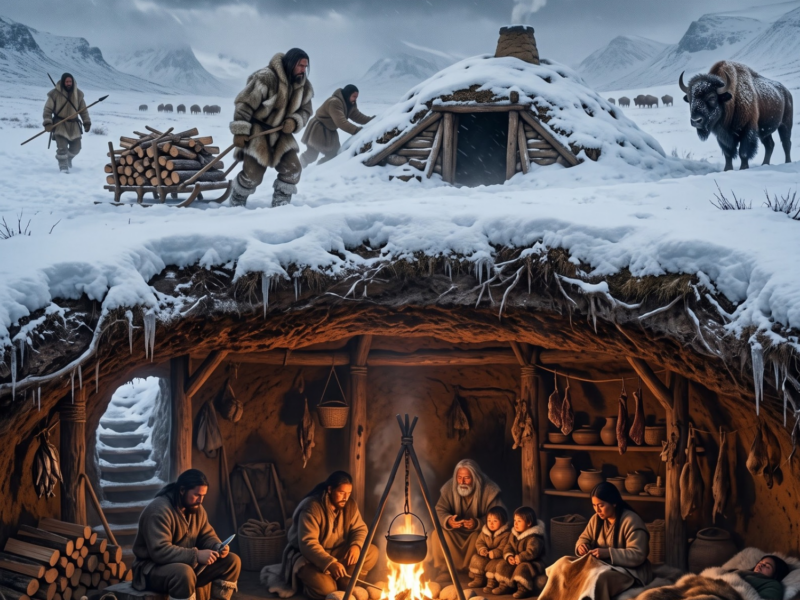
They laughed At Them For Building Underground Homes – Until Brutal Winter Came
THE KEEPERS OF THE BLUEPRINTS
Among the Hidatsa, building a home was never a task left to raw masculine muscle alone. While men certainly chopped down the massive cottonwood pillars and dragged the heavy roof logs across the frozen or muddy flats, the women carried the actual blueprint of the lodge in their minds.
An experienced, respected elder woman directed the entire construction process from staking the perimeter to laying the final sod.
She walked the chosen ground, reading the drainage, the slope, and the wind direction with the eye of a master engineer. She showed the young men precisely where the four massive center posts had to stand to distribute the immense weight of the roof. She inspected the spacing, checked the angle of the lean-to poles, and guided the precise way the roof frame came together layer by layer before a single basket of earth was hoisted upward.
Younger women worked side-by-side with her, their hands moving with practiced efficiency. They watched how the woven willow mats were fitted between the rafters, how the thick prairie grass was stuffed into every potential cold-air leak, and how the heavy blankets of turf and dirt were spread evenly across the dome to prevent uneven settling.
The essential knowledge of the lodge was passed down entirely through the physical act of building itself—not from a written engineering manual or a blueprint drawn on paper, but directly from one generation of women to the next through muscle memory, observation, and shared labor.
And once an earth lodge was finished, it belonged entirely to the woman.
In Hidatsa society, real estate was matrilineal. When a young man married, he packed his belongings and moved into his wife’s household, joining her family circle. Consequently, the women were not merely the daily occupants and domestic managers of these homes; they were the unchallenged keepers of the architectural knowledge that sustained the tribe.
What looked simple, rough, and primitive from the outside was actually a physical manifestation of centuries of accumulated ecological science.
By the time the brutal winter finally broke its grip and the ice began to groan on the Missouri River, the American settlers had seen enough to fundamentally change their worldview. They finally understood that the low, earth-covered homes scattered along the riverbanks were not crude, desperate shelters born of poverty.
The houses they had once arrogantly mocked were built upon a sophisticated architecture of survival—an engineering marvel they had been completely blind to from the outside.
And by then, the difference between the two approaches was vastly larger than the mere height of their walls.
The Earth Lodge worked so flawlessly because it was never just a building. The house, the subterranean food storage pits, the river-bottom winter camp, and the surrounding prairie had all been planned and maintained by generations of inhabitants as one unified, breathing ecological system.
A newcomer from the East could easily copy the external shape of the thing. He could cut down living spruce, stack logs in a circle, and cover a timber frame with a mound of dirt, making something that looked superficially similar from a distance.
But the physical shape alone was never the true knowledge.
That knowledge had been forged through centuries of human beings living, suffering, observing, and dying in the exact same unforgiving climate, passing their hard-won lessons down through the long, dark nights.
By the time the spring thaws turned the frozen plains into a sea of mud, the contrast could be seen clearly from miles away across the prairie.
One style of house stood tall, proud, and rigid against the open landscape, fighting the weather head-on until its timbers warped and its fuel ran dry.
The other rested low and humble beside the river, tucked safely into the contours of the earth, shaped entirely by the ground around it.
Both houses were built from wood. But only one had been built from generations of winter.









