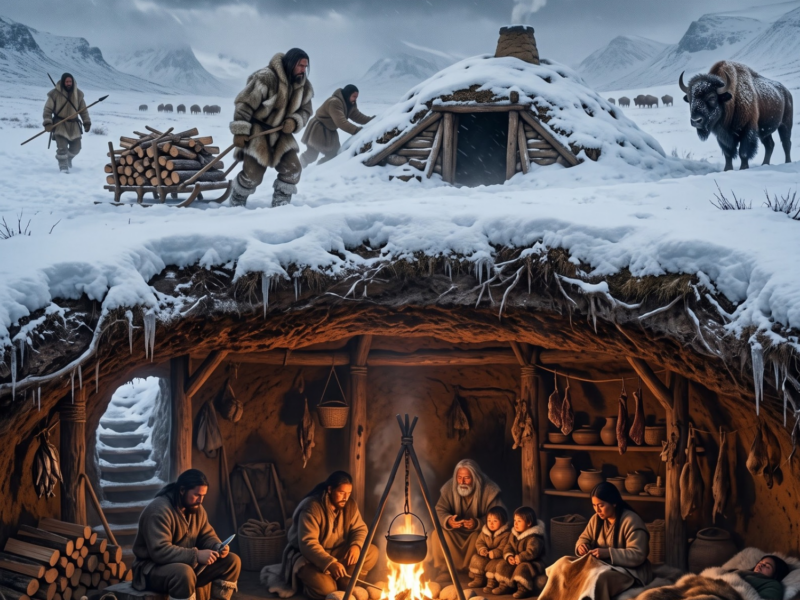
They laughed At Them For Building Underground Homes – Until Brutal Winter Came
THE HIDDEN RESERVE
As January ground on with unrelenting ferocity, the settlers’ cabin began to reveal its unsustainable arithmetic.
The fire demanded more and more wood to combat the relentless thermal bleed. The woodpile behind their cabin, which had looked formidable in November, dwindled with terrifying speed. Every single night meant another miserable trip out into the howling dark, slogging through waist-deep drifts to drag back heavy logs.
Soon, keeping the room above freezing meant a man had to interrupt his sleep every two hours, pulling on frozen boots, stepping out into a gale that stripped the breath from his lungs, and carrying raw timber back through the cabin door while letting great gouts of precious heat escape into the night.
The Mandan and Hidatsa families, by contrast, had systematically engineered a way around this endless cycle of exhaustion long before the first snowflake ever drifted out of the autumn sky.
During the harsh winter months, these indigenous bands traditionally broke camp and moved their primary habitation into smaller, permanent settlements nestled deep within the sheltered river bottomlands. There, towering stands of ancient cottonwood grew shoulder-to-shoulder with the earth lodges, providing a vast, immediate pantry of deadfall and standing timber. A fresh load of firewood could be harvested directly from the nearby river bottom with minimal effort, eliminating the deadly, energy-sapping hauls across open, windswept prairies.
But firewood was only one component of the survival strategy they had carefully placed within arm’s reach.
The most vital reserve was hidden entirely out of sight—beneath the very floorboards of the lodge.
Outside the home, scattered across the village compound, were several large storage pits dug deep into the dry earth. From the surface, only a narrow, circular opening sealed with a tight wooden lid and covered with sod was visible. But beneath that narrow neck, the pit widened out into a massive, bell-shaped underground chamber, meticulously lined with woven willow matting and thick layers of dry prairie grass to keep the moisture at bay.
Inside these subterranean vaults went the agricultural wealth gathered over months of relentless summer labor: yellow, red, and blue flint corn, climbing beans, squash, dried sunflower seeds, and wild prairie turnips. Once filled to capacity, the opening was sealed, insulated with earth, and cunningly concealed so that neither drifting snow nor passing enemies could easily detect its presence.
Decades later, a Hidatsa woman named Buffalo Bird Woman, whose vivid memories of traditional village life were meticulously recorded by ethnographers, described the quiet rhythm of these subterranean caches. When winter storms locked the world in ice and travel became impossible, families simply lifted the heavy sod lid outside their door and reached down into the earth.
A blizzard could shut down the trails for weeks, burying the landscape in white, but it could not cut a family off from its food supply. The shelter was built above them; the life-sustaining reserve was buried safely below them.
And as the weeks of deep freeze stretched into months—as the wind returned, more snow fell, and the thermometer dropped past the limits of human patience—those hidden stores transformed from a mere convenience into the ultimate insurance policy against the white death.
One cold night proved very little about a house. The true test of a home was whether it could stand its ground when the cold refused to leave.









