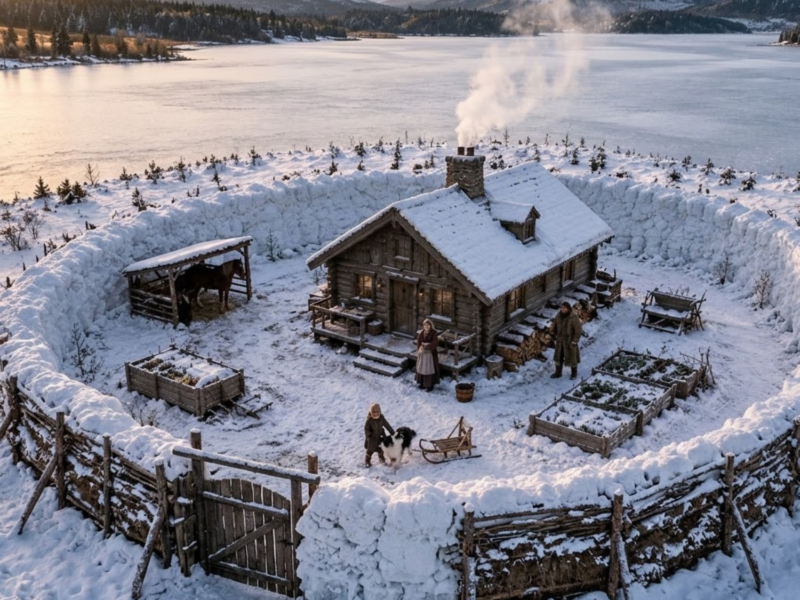
They Mocked Him for BURYING His Cabin in Snow — Until the Coldest Night Came
The Norwegian's Legacy
Jonas Halberg came to northern Minnesota in the autumn of 1879 with his wife, Elise, and their eight-year-old daughter, Anna. He was thirty-eight years old—broad-shouldered, quiet, deliberate in his movements, and already intimately accustomed to the temper of a harsh winter.
Jonas had grown up on a small, rugged farm in the high valleys of Norway, where snow was never treated as a single, uniform thing. To Jonas and his people, snow possessed a vocabulary of its own: fresh snow, wet snow, wind-packed snow, crusted snow, sugary snow. Each behaved differently under pressure, temperature, and wind. And his father had drilled into him a foundational lesson that Jonas never forgot:
“A wall does not need to be warm. It only needs to slow the escape of warmth long enough for the fire inside to replace what is lost.”
Their new Minnesota cabin was a modest affair—solid pine logs, a fieldstone chimney, one reliable iron stove, and two narrow, multi-pane windows. It had felt wonderfully sturdy and picturesque during the mild days of October.
Winter, however, exposed every hidden flaw in the construction.
The cabin’s foundation sat slightly elevated on dry-laid fieldstones, allowing a sharp, freezing draft to whistle beneath sections of the puncheon floor. The clay-and-moss chinking wedged between some of the logs had shrunk and cracked in the dry autumn air. On particularly windy nights, Jonas could hold a candle near the north wall and watch the flame bend sideways, choked by drafts he couldn’t see.
Elise did what she could, stuffing scraps of old wool and linen into the worst of the interior cracks. Jonas followed behind with fresh batches of mixed clay and dried grass. It helped, but the relentless Minnesota cold still found its way through the porous wood.
Their nearest neighbor, Martin Keller, had the conventional answer to the problem: more firewood.
Martin spent most of October swinging an axe until his palms turned to leather. By November, the towering stack of split oak and maple beside his cabin was almost as long as the house itself. Whenever Jonas crossed paths with him, Martin would joke that Jonas should stop staring at his drafty walls and start putting some muscle into his woodpile.
Jonas did cut wood, of course—just not nearly as much as Martin. He knew the arithmetic of finite labor; chopping wood until your back broke was a fool’s game if the heat escaped just as fast as you generated it.
Instead, following the first heavy snowstorm of the season, Jonas took a wide wooden shovel, stepped out into the knee-deep drifts, and began pushing snow directly against the outside walls of his cabin.









