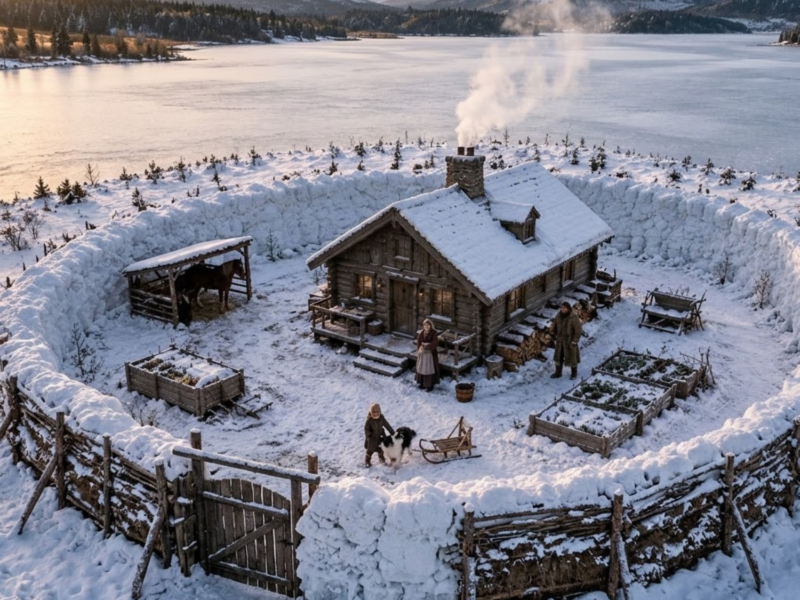
They Mocked Him for BURYING His Cabin in Snow — Until the Coldest Night Came
The First Flaw
The first attempt was far from perfect. Three days after Jonas finished sculpting the western wall, an unseasonal, unexpected warm snap settled over the region.
Temperatures crept above freezing for a few afternoon hours, and bright, direct sunlight struck the snowbank along the southern edge of the western wall. The outer surface of the snow softened, turning slushy. Then, as the sun dipped below the horizon, the temperature plummeted back into the teens.
By morning, the outer layer of the snowbank had frozen into a rigid, glassy shell of hard-packed crust.
Alarmed, Jonas hurried outside and broke the crust open with his shovel. Inside, the snow was still relatively loose, but meltwater from the afternoon sun had trickled down, collecting in a damp pool right against one section of the lower foundation logs.
Elise hurried out behind him, stepping into the cold, and saw the grim expression on her husband’s face. She knew what the neighbors had warned them about. If water sat against the pine logs repeatedly through alternating freeze-thaw cycles, the warnings about rot would inevitably come true.
Jonas didn’t panic; he adapted.
First, he dug a shallow, sloping drainage channel away from the cabin’s base so that any future spring meltwater would be directed safely outward. Next, before rebuilding the snowbank, he gathered armloads of prickly, resinous spruce branches and laid them in a tight thatch directly against the lowest timbers.
The branches created a narrow, breathing separation—not enough to let the freezing wind circulate, but more than enough to keep wet, heavy snow from pressing directly against every square inch of wood.
Finally, he changed his packing technique. He stopped compressing the snow quite so tightly. He wanted trapped, stagnant air, not a solid igloo of ice.
Martin Keller passed by again while Jonas was tearing down and rebuilding the entire western section. This time, Martin didn’t even bother to pull his horse to a halt. He simply shouted a sarcastic remark from the road, asking if Jonas was busy repairing his marvelous snow house. Jonas didn’t look up; he just kept shoveling.
Then, another, more insidious problem manifested.
A few nights later, little Anna woke up crying, clutching her blanket to her face and complaining that her bedroom smelled faintly of woodsmoke.
Jonas was out of bed in a heartbeat, lantern in hand. He rushed to the stove; the iron pipe was clear and drawing properly. He checked the stone chimney; the draft was strong. But when he ventured outside into the bitter dark, he found that the swirling wind had drifted loose snow upward, partially sealing one of the small, grated ventilation openings cut near the foundation to let the cabin breathe.
Jonas cleared the packed snow away with his bare hands instantly. The next morning, he constructed a simple, angled wooden shield—a tiny protective awning—above the ventilation opening so that snow could accumulate freely around the cabin without ever sealing the vital airflow shut.
That near-miss changed the way Jonas viewed the entire experiment. Warmth, he realized, was not the sole metric of survival. A house still needed to breathe; starve a fire or a home of oxygen, and you invited a silent, suffocating disaster.
From that day forward, every single morning began with a strict ritual. Jonas stepped out into the frost to execute his inspection walk: check the chimney stack, check the clearing around the doorway, check the ventilation shields, and finally, inspect the integrity of the snowbanks.
Elise, meanwhile, took over the bookkeeping of their survival.
Every evening, she marked down how many pieces of split oak went into the iron stove before bedtime. She recorded the indoor temperature on the wall thermometer before blowing out the tallow candle, and then checked it again just before sunrise.
At first, the daily temperature shifts were marginal. But as December deepened and the northern nights became lethally cold, the numbers on Elise’s slate began to diverge sharply from what they had experienced a month prior.
Jonas was burning noticeably less wood than he had in November. Yet, remarkably, the cabin was noticeably warmer.
The floorboards near the north wall no longer felt like sheets of river ice. The candle flame in Jonas’s hand stopped shuddering when held near the lower logs. On calm, freezing nights, the difference was pleasant; on howling, windy nights, the difference was nothing short of miraculous.
Still, outside the tight circle of the Halberg family, nobody in the settlement took the experiment seriously. They viewed it as the eccentric hobby of a Norwegian who missed the glaciers.
Until Samuel Bearskin arrived.









