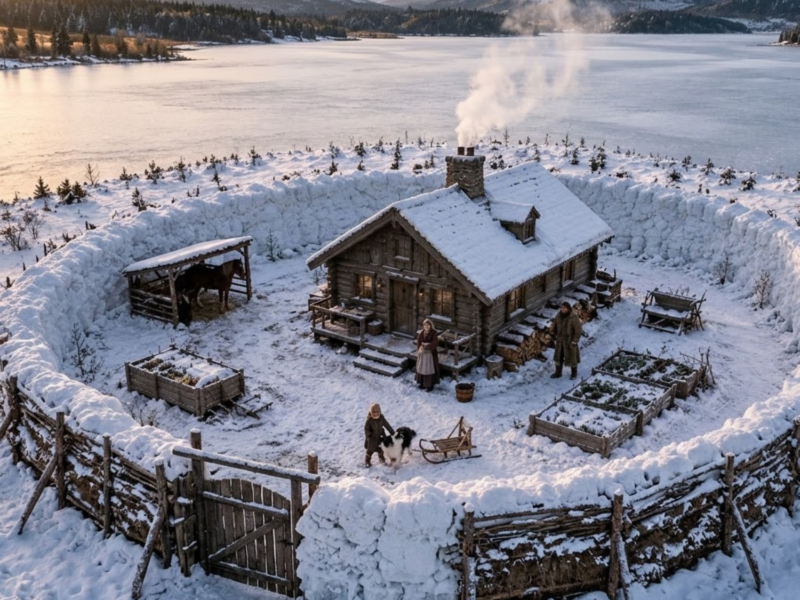
They Mocked Him for BURYING His Cabin in Snow — Until the Coldest Night Came
The Cold Coat
At first, nobody noticed. A man clearing a path from his door naturally piled snow to the sides. But Jonas kept going, systematically expanding the mounds.
He packed snow densely against the fieldstone foundation, then worked it halfway up the first course of pine logs, and then higher still. He worked methodically around three sides of the house—the north, east, and west exposures—while intentionally leaving the south-facing wall exposed to catch whatever weak winter sunlight managed to break through the gray clouds.
Little Anna followed close behind him with a child-sized shovel, eagerly filling minor gaps around the foundation stones with loose powder. Elise kept the doorway and the immediate stove area meticulously clear of buildup. Within a few days, the cabin looked as though it were slowly, inexorably sinking into the earth, swallowed by the very elements it was meant to defy.
Martin Keller stopped his horse and wagon in the road one afternoon, staring dumbfounded at the scene. Jonas was standing waist-deep in white drifts beside the north wall, carefully shaping the contour of the snowbank with the back of his shovel.
“Jonas!” Martin called out, reigning in his team. “What happened? Did the roof slide?”
Jonas paused, leaning on his shovel handle. “Nothing happened, Martin. I’m insulating the house.”
Martin looked at the snow, then at Jonas’s deadpan expression, then back at the snow. “With snow?”
Jonas nodded calmly. “With snow.”
Martin threw his head back and laughed aloud, the sound sharp in the freezing air. Snow was the enemy—the white tyrant everyone in Minnesota spent the winter fighting. It buried roads, blocked doors, collapsed poorly built sheds, and trapped livestock. Yet here was Jonas Halberg, deliberately welding it to his own home.
Within a week, local wags had begun calling the place “the buried cabin.” But Jonas knew something his neighbors didn’t.
Snow was not a solid, frozen block of ice, nor was it a conductor of cold. Fresh, fallen snow is actually composed of roughly ninety percent trapped air and only ten percent ice crystals. Millions of microscopic air pockets exist between the delicate ice branches. And when that snow is packed gently against a wall without being crushed into hard, solid ice, those countless tiny pockets of air remain trapped inside.
Air, when held completely still, is a remarkably poor conductor of heat. It transfers thermal energy at a sluggish pace. It was the exact same physical principle that made a woolen sweater warm, or a fox’s winter fur effective against a gale. Jonas was weaving a temporary, living coat of trapped air around the coldest perimeter of his house.
Furthermore, he was solving a secondary, deadlier problem: the wind.
A log wall on a calm, freezing night might lose heat at a steady, manageable rate. But that exact same wall, blasted by a bitter prairie wind, shed its internal warmth exponentially faster. Every shrinking chink became an entry point; every gap beneath the floor became a convective highway.
Jonas’s snowbank neutralized the wind entirely. The howling gale struck the outer barrier of packed snow and spent its kinetic fury there. By the time the air pressure reached the logs beneath, much of its biting force was already broken.
That was the theory, at least. Practice, as always, demanded a few hard lessons.









