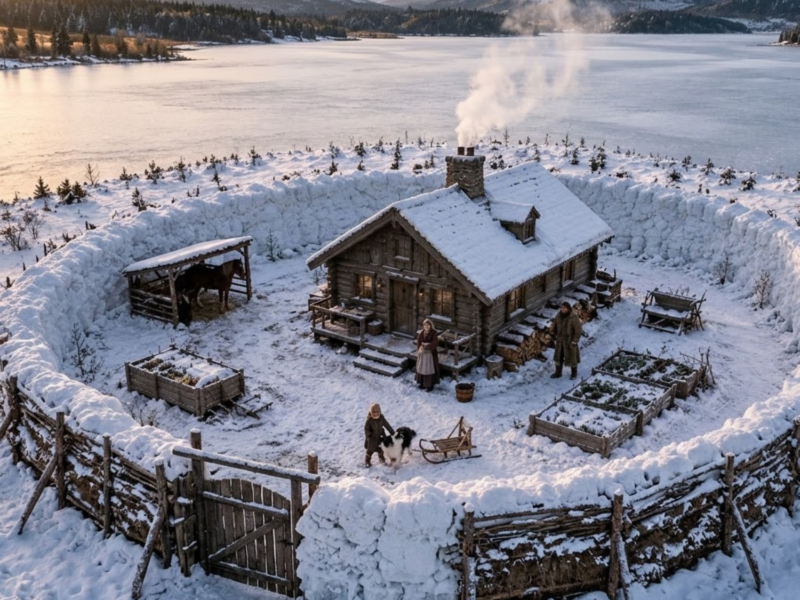
They Mocked Him for BURYING His Cabin in Snow — Until the Coldest Night Came
The Night of the Deep Freeze
January arrived with a brutal, unapologetic fist. For the first few days of the new year, the temperature remained low but manageable—the kind of cold people bundled up against and cursed under their breaths.
Then, the wind shifted.
It swung sharply out of the northwest, blowing down from the Arctic barrens. At first, it came in gentle, deceptive gusts, but by the afternoon of January 18th, a fine, biting dust of snow was streaming across the frozen fields like white smoke.
By mid-afternoon, the sky cleared completely—a terrifying, brilliant azure.
That, to anyone with experience on the plains, was the most dangerous sign of all. There were no clouds, no insulation in the upper atmosphere, and no new snowfall to trap whatever lingering warmth radiated from the earth. The sky was a clear, open drain, funneling the heat of the land straight up into the void.
By sunset, the thermometer attached to the general store’s porch was plunging downward at an alarming rate.
Jonas walked around the cabin one last time as dusk swallowed the horizon. The packed snowbanks had settled and frozen into a stable, three-foot-thick armor around the house. He shoveled a light layer of fresh, powdery snow over two thin spots near the western corner, cleared the air vent one last time, and stepped inside, sliding the heavy pine door shut.
By midnight, a deep, glacial freeze had clamped down over the entire Minnesota settlement.
At the Keller cabin, Martin’s home had thick log walls and a top-tier cast-iron stove. But it also had exposed fieldstone foundations and a north wall that faced directly into the teeth of the howling northwest gale.
Martin fed the stove split oak; when the fire dimmed, he fed it again. By one in the morning, the iron sides of the stove were glowing a dull, angry red at the seams, radiating intense heat into the center of the room.
Yet, despite the roaring fire, his wife had to hang heavy woolen blankets over the windows to stop the glass from frosting over entirely. Their two young sons had to drag their mattresses into the main kitchen area because the back sleeping room had become uninhabitable—a literal icebox.
Restless and freezing, Martin got up and pressed his palm against the inside of the north log wall. It felt like a slab of tombstone. Down along the lowest logs, treacherous white needles of frost had begun forming around several chinking joints.
Frustrated, Martin shoved more wood into the hungry stove. The room immediately grew stiflingly hot near the hearth. But the moment the fire dipped even slightly, the howling wind outside pulled the warmth away through a hundred invisible leaks.
At the Halberg cabin, less than a mile away, the exact same northwest wind battered the north side. But it didn’t hit the logs.
It hit three feet of packed, insulating snow.
The air trapped inside the intricate matrix of the snowbank barely moved. The wind could strip thermal energy from the exposed outer crust of the snow, but it had to fight its way through layer after microscopic layer of trapped, dead air before it could ever hope to steal heat from the pine wall beneath.
Inside, Jonas’s iron stove burned steadily—not fiercely, not dangerously roaring, just maintaining a reliable, even baseline.
Elise checked the mercury thermometer hanging near the center room. The indoor temperature had fallen merely a few degrees since evening. Little Anna slept soundly in her own bed under a single heavy quilt. The floor beside the north wall was cool to the touch, certainly, but it wasn’t freezing, and there wasn’t a single crystal of frost to be found.
At two in the morning, Jonas woke and pulled on his heavy boots and coat to step outside.
The moment he opened the door, the cold struck his face so violently that his eyes instantly watered, freezing his eyelashes together. He checked the chimney stack: clear, roaring a steady column of heat into the dark. He checked the vent: clear.
The outer crust of the snowbank had frozen hard in the sub-zero air, but when Jonas pushed his mittened finger deep into a sheltered pocket beneath the deep eaves, the snow underneath was still wonderfully soft, dry, and airy.
He went back indoors, tossed two modest logs onto the embers, and went back to sleep.









