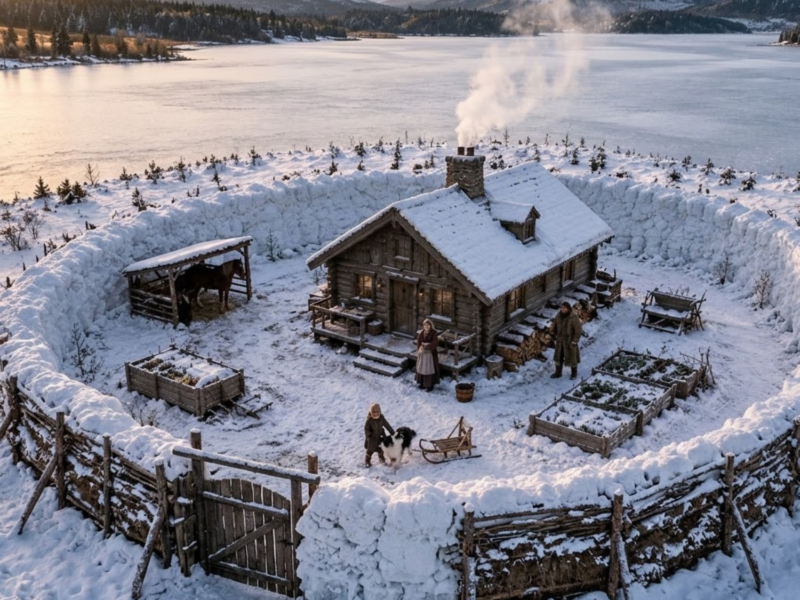
They Mocked Him for BURYING His Cabin in Snow — Until the Coldest Night Came
The Turning of the Tide
By that very afternoon, Martin Keller was standing outside his own freezing cabin with a wide wooden shovel in his hands. He started methodically with the north foundation, piling the white drifts high against the logs.
Within a week, three more families in the settlement had low, clumsy snowbanks built around their coldest, most vulnerable walls.
Nobody buried their buildings quite as deeply as Jonas had—most didn’t need to go to such extremes. A foot of snow packed around the foundation helped marginally; two feet helped significantly. People quickly learned the nuances of the craft: they learned to leave the ventilation shafts open and protected; they learned not to pack the snow into solid, suffocating ice; and they learned to carve smart drainage channels so that when spring finally arrived, the meltwater would run away from the timber rather than pool against it.
By the following winter, nobody in the district used the phrase “the buried cabin” as a joke anymore.
The name had lost its irony. It had become something much closer to a respected seasonal routine across the northern frontier. First the snow fell; then the paths were shoveled; then the roofs were cleared; and finally, a portion of that cold, white nuisance was shoveled deliberately against the place where people lived.
Jonas Halberg had not invented snow insulation, of course. For generations unknown, indigenous peoples across the freezing expanses of the Arctic had used snow blocks to build igloos that stayed comfortable inside while blizzards raged outside. Scandinavian farmers, Russian peasants, and trappers had all understood the thermal properties of snow long before the Halbergs ever set foot in Minnesota.
What made Jonas unusual was simply that he had trusted the fundamental physics of nature when everyone around him was blindly fighting it.
His neighbors looked at snow and saw only bitter cold. Jonas looked at snow and saw trapped, motionless air. They saw an adversary that needed to be endlessly shoveled away and cast out; he saw a vital building material that winter delivered straight to his doorstep entirely for free.
And on the coldest night of that brutal Minnesota winter, while other families exhausted themselves feeding their fires hour after hour in a futile, desperate attempt to overpower the weather, the Halbergs did something much simpler, much wiser, and infinitely more enduring.
They made the cold fight its way through the snow.









