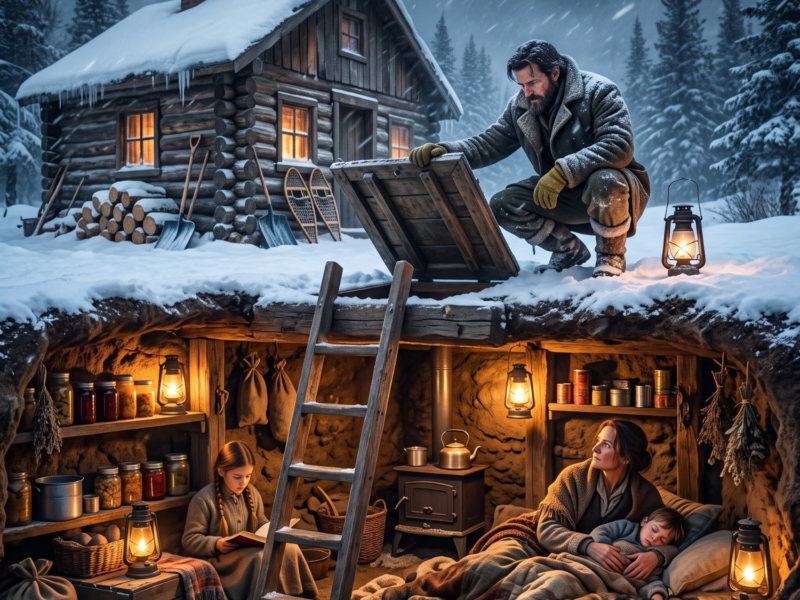
Turned Away With Two Kids, She Built a Hidden Shelter Under the Cabin — Then the Worst Blizzard Hit
The Bottom of the Sky
Nola Furth filed a proper, legal homestead claim on a quarter section of land just east of the tree line the following April, as the spring thaw turned the foothills to mud. She paid the filing fee with money earned by breaking sod with a borrowed team of horses.
Caspian Gale did not move on. He stayed through the summer, bringing his tools and his quiet strength. He helped Nola frame a proper, sturdy log cabin that would eventually replace the sagging old trapper’s shack. He proved to be a far more capable builder than the menial labor he had been assigned in the coal camps, and the growing settlement quickly found permanent uses for his skills.
Neither Caspian nor Nola spoke much about that first winter. They did not speak of it the way people speak about heroic events they want to be remembered for. To them, the shelter had simply been necessary. They had identified a problem, they had built a solution, and the solution had worked. That felt like the complete shape of the story.
Theo grew through the following three seasons robust and healthy. The hollowed, haunted look around his eyes that had terrified Nola since the autumn completely vanished. The deep, rattling cough never returned.
Ingrid, the girl who had sat in the dark and held the lamp steady on all those freezing nights without ever having to be asked twice, grew into a formidable young woman. She developed a reputation in the territory for measuring massive problems by their smaller, solvable parts rather than being overwhelmed by their apparent size. People who met her later in life often noted this unique quality, never quite able to name where she had learned it.
What Caspian Gale had understood beneath the floorboards of that cabin was not a secret. It was not a brilliant new industrial invention.
The indigenous peoples of the plains and the boreal north had built semi-subterranean winter dwellings for thousands of years. They were structures that utilized the thermal steadiness of the earth—not as a source of radiating warmth itself, but as an impenetrable shield against the relentless, thieving loss of it.
From the icy coasts of Labrador to the deep Peace River country, across every severe, brutal landscape the Canadian North could offer, people had once understood the exact same essential fact: below the frost line, the wind ran out of reach. And existing outside the reach of the wind was the most important shelter a human being could ever find.
What the settlement of Hollow Birch Flats had temporarily forgotten—the way all modern settlements eventually forget things when “progress” dictates that men must build upward into the sky rather than inward into the earth—was that the oldest, truest protection had never required a taller chimney or a hotter fire.
It had required the humility and the willingness to go below the line, down into the dark, where winter finally exhausted itself.
Gareth Mun lived to build four more underground chambers before the decade ended, right up until his hands became too arthritic to hold a plumb bob. He never stopped refining his pipe angles.
Beatatrix Lund survived fourteen more Alberta winters on her own without once running out of warmth.
And on the absolute coldest, most terrifying nights of every following winter, while the sky screamed and the timber groaned, the people of Hollow Birch Flats, who had learned the value of a spade, understood something the rest of the frozen world above them did not.
The storm was still up there. It was moving hard across the foothills, as indifferent, violent, and enormous as it had always been since the dawn of the world.
But down below the frost line, wrapped in the still, dark, silent earth, the storm could not find them. Some shelters stand defiantly against the cold, daring it to break them. Other shelters simply step out of its way.









