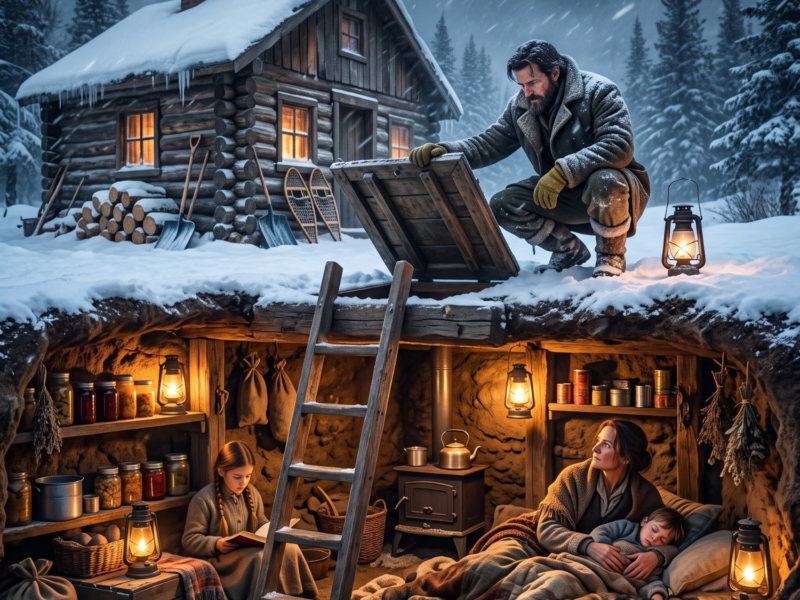
Turned Away With Two Kids, She Built a Hidden Shelter Under the Cabin — Then the Worst Blizzard Hit
The Seven-Day Roar
Outside, the storm waged war on the earth for seven unbroken days.
It was a blizzard of historic, terrifying proportions, the kind that would be spoken of in hushed tones around potbelly stoves for a generation.
Inside the bunker, the concept of time dissolved. Underground, the days organized themselves entirely differently than days lived under the sun. Morning was defined by the moment Ingrid woke from her cot, struck a match, and relit the second oil lamp. Evening arrived when Theo’s eyelids grew heavy and he fell asleep to the sound of Nola humming softly.
Night was the stretch of hours when both children slept deeply, and Caspian and Nola sat awake, leaning against opposite stone walls in the flickering lamplight. They did not always speak. They had arrived at the cabin as bruised, battered strangers in the autumn. But seven days buried alive together in a six-by-eight-foot box had collapsed that emotional distance entirely, the way hard, desperate circumstances often do. It happened without theatrical drama; it was simply a profound, quiet merging of trust.
The most miraculous change, however, occurred within Theo.
By the second night underground, his cough completely disappeared. The heavy, damp, freezing air of the cabin had been replaced by the dry, temperate, fifty-one-degree climate of the earth. His breathing settled into a deep, clear evenness that Nola had not heard from him since the summer before his father died.
Nola sat in the quiet, listening to the steady rise and fall of her son’s chest. She did not tell Caspian or Ingrid. She simply closed her eyes and let herself feel the crushing weight of her maternal terror finally lifting off her shoulders.
But survival required maintenance, and maintenance was terrifying.
Twice each day, Caspian had to leave the sanctuary. He had to climb the ladder, open the trapdoor into the freezing cabin, and go outside to ensure the chimney was not freezing shut and that the drifting snow had not buried the exterior ventilation pipes.
Every time he unbolted the hatch, the storm came plunging down the shaft like a living, enraged beast. The screaming wind, the spray of loose, blinding snow, and a cold so absolute it made the wooden ladder rungs burn right through his thick leather gloves.
Every time he slammed the hatch shut and descended, the underground room instantly returned to its magical, immediate stillness.
Caspian’s beard came back frosted completely white after every trip. His hands would take long, agonizing minutes to stop shaking. On the third day, the wind was so violent he could barely pull the trapdoor shut because his fingers had gone stiff and unresponsive in the mere seconds it took to clear the ice from the chimney flue.
He came down the ladder slowly that day, his breathing ragged. He collapsed against the shale wall, pulling his knees to his chest, and it was a full minute before the violent trembling in his core subsided.
Nola did not fuss over him. She knew a man like Caspian did not want pity. Before his next scheduled climb, she quietly set a tin cup of hot, steaming broth—warmed over the flame of the oil lamp—at the base of the ladder. She didn’t say a word about it. He picked it up, drank it, and gave her a single, grateful nod. He accepted the care the same way it was given: silently, and completely.
Above them, Hollow Birch Flats was suffering the agonies of a frontier settlement that had let winter outpace its preparations.
A chimney fire erupted at the north edge of the settlement before dawn on the fourth night. A terrified family, freezing in their beds, had loaded their stove past its physical capacity. The cast-iron flue glowed cherry red, igniting the roof timbers. Men fought the blaze with buckets of snow in horizontal winds at thirty-eight below zero, losing half the structure to the flames.
Two cabins down the row, a family ran out of firewood by day five. Desperation took hold. They began feeding their kitchen furniture into the stove. They burned the wooden chairs first. Then a broken shelving unit. Then, weeping, the father chopped up the wooden slats of the bed the children were not currently sleeping on.
A grandmother in the center of town wrapped three pairs of thick wool stockings around her feet, huddled inches from her stove, and still lost all feeling in her left toes before morning broke.
Gareth Mun, stubborn and proud, kept his massive stove burning hotter than it had ever burned in his life. By day six, the intense, localized heat radiating downward had melted the frost in his floorboards, causing the heavy iron legs of his stove to sink a quarter of an inch straight into the wood planking. He packed the smoking gaps with wet clay and kept feeding the fire, because there was no other option his mind could comprehend.









