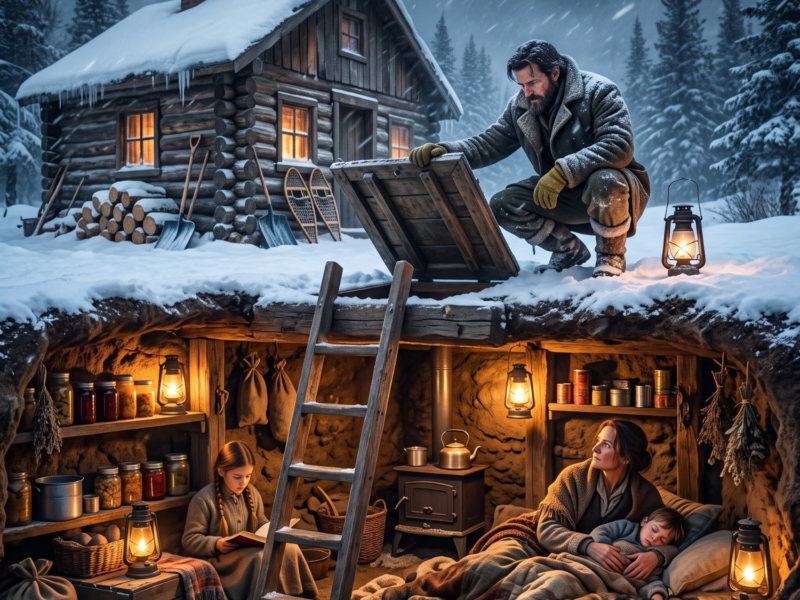
Turned Away With Two Kids, She Built a Hidden Shelter Under the Cabin — Then the Worst Blizzard Hit
The Collapse
By the third week of November, the space beneath the floorboards had grown. It was now a subterranean chamber wide enough for three bedrolls to be laid side by side. Caspian had lined the lower walls with rough river stone and braced the dirt ceiling with bent willow supports where the earth looked treacherous and soft.
It looked like a marvel. It should have been enough.
It was not.
The earth is a living, breathing entity, and it resists being hollowed. Water began collecting first. Thin, icy beads of condensation formed along the dirt ceiling, dripping steadily, rhythmically onto the packed earth floor, turning it into a slick, freezing mud. The air turned heavy, suffocating, and close when the trapdoor was kept shut for too long.
On the ninth night of the expanded dig, Caspian was working alone below. Nola had finally succumbed to exhaustion and was sleeping on her cot. Ingrid sat faithfully at the edge of the hole, the lantern casting long shadows across her face.
Caspian was widening the north wall, striking the clay with a small pickaxe, when the earth sighed.
It happened without the explosive warning of a timber crack. A massive shelf of earth on the north face simply sheared away. It slid inward, a silent, heavy avalanche of freezing dirt, dropping directly across the area designated for the bedding platform. The impact was a low, guttural thud that physically shook the cabin floor overhead.
Dust billowed up in a choking cloud.
Ingrid’s knuckles went white around the handle of the lamp. She did not scream, but she leaned precariously over the edge, her heart in her throat, peering through the settling dust.
Below, Caspian sat frozen in the dirt. He was buried to his waist in the collapse. His lantern had tipped onto its side, spilling oil, but miraculously, the flame had not gone out. He sat very still for several seconds, assessing his body, waiting for the rest of the ceiling to come down and bury him alive.
When the earth held, he began to dig himself out.
He climbed the ladder slowly, his movements heavy and defeated. He emerged into the cabin, covered head to toe in dark, wet loam. He slumped against the cabin wall in the dark, pulling his knees up, resting his forehead on his forearms.
Ingrid set the lamp gently beside him and padded across the room to wake her mother.
Nola came out of the shadows wrapped in a heavy quilt. She looked at the hole, then at Caspian.
“It fell,” Caspian whispered into the dark. He didn’t look up. “Gareth Mun was right about the wall angle. The earth is too wet. It won’t hold the weight of the cabin without timber bracing we don’t have. He wasn’t right about everything… but he was right about that.”
The silence in the cabin was oppressive. It was the sound of defeat.
Nola walked over to him. She did not offer sympathy. Sympathy was useless. She stood over him, a silhouette of fierce, unyielding motherly terror and resolve.
“Then change the angle,” Nola said.
Caspian lifted his head, staring at her in the dim light.
“It fell in,” she repeated, her voice hard as iron. “So rebuild it differently. You know what failed, Caspian. You know exactly where the weak point is. That is more than most people get before the winter kills them.”
He looked at her, seeing the absolute refusal to surrender in her eyes. The fire that had died in him years ago in the flooded mines of Lethbridge flickered, caught, and flared back to life.
They spent the next three nights in a state of manic, desperate engineering.
They tore out the loose, collapsed earth. Caspian redesigned the chamber on the fly. He rebuilt the north wall, extending it four inches deeper, anchoring it into a solid vein of hard shale he had discovered behind the clay. He abandoned the willow supports and built structural arches out of the heaviest river stones he could haul up from the creek.
He attacked the air quality next. Using the stovepipe he had bought from Sutter, he engineered a ventilation system. He changed the pitch of the intake pipe, running it deep so that the freezing outside air entered near the floor of the chamber and was forced to move upward, warming slightly as it rose, rather than settling in a deadly, freezing pool across the sleeping space.
He ran a second, narrower exhaust pipe up behind the cabin’s main chimney stack. The heat of the chimney created a natural updraft, pulling the heavy, stale air out of the bunker.
To combat the dampness, they hauled buckets of dry wood ash from the stove and packed it inches deep beneath the bedding platform, creating a massive desiccant that drew the moisture down and away from the air. Finally, Caspian built sleeping boards that sat elevated on flat stone risers, keeping the beds completely off the earth floor.
Nothing about the chamber looked mathematically engineered. It was a chaotic, organic patchwork of stone, iron, and ash. It looked exactly like what it was: the desperate work of two people who had kept adjusting, failing, and adjusting again until something finally stopped failing.
Slowly, the chamber stabilized.
The dirt ceiling dried to a hard crust. The air, pulled by the draft of the pipes, moved cleanly through the space without feeling trapped or suffocating. The earth settled behind the shale walls and held firm.
One night in early December, the wind above ground was howling a murderous tune. Caspian descended into the chamber alone. He carried an old mercury thermometer, a candle stub, and his silver pocket watch.
He sat cross-legged on the sleeping platform for forty-five minutes. Above him, the temperature outside had plummeted to fifteen below zero.
Down in the earth, the candle flame stood tall and perfectly straight, barely trembling. Caspian held the thermometer up to the candlelight. The red line held rock steady at forty-nine degrees.
He climbed back up the ladder and stepped into the freezing cabin. Nola was standing by the stove, her arms wrapped around herself.
“Forty-nine,” Caspian said. “It’s holding.”
Nola closed her eyes. She stood completely still for a moment, letting out a long, shuddering breath. Then, without saying a word, she turned to the children’s cots. She began folding their thin blankets and woolen clothes into tight, precise bundles, preparing them for the descent.









