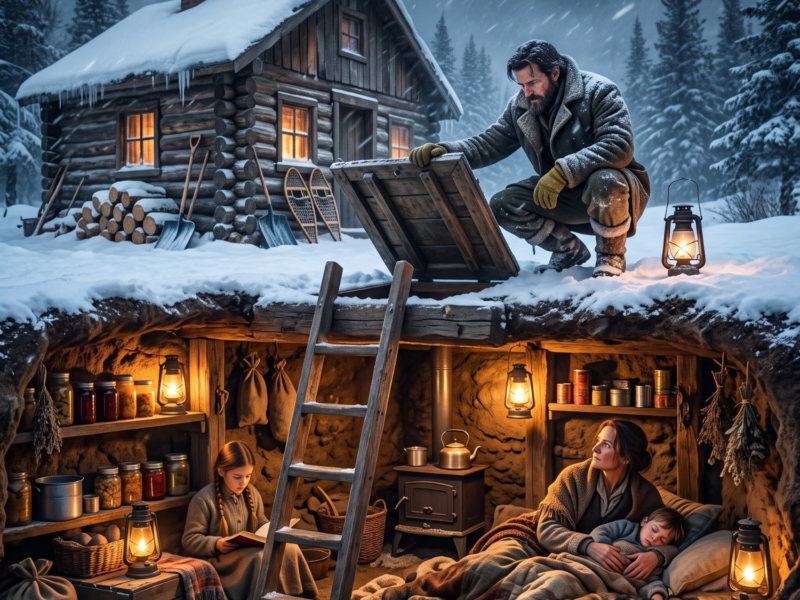
Turned Away With Two Kids, She Built a Hidden Shelter Under the Cabin — Then the Worst Blizzard Hit
Heating the Bottom of the Sky
By mid-November, the stove in the center of the room was burning continuously. Caspian was a machine, feeding the cast-iron belly with split spruce and birch until the metal glowed a dull, angry orange. He had patched the walls. He had climbed the sagging roof and ensured the chimney drew properly.
Yet, the cold inside the cabin refused to yield.
It was a physical impossibility that defied logic. The fire was hot enough to singe eyebrows if one leaned too close, but step three feet away, and the air was brittle as ice. Nola noticed it first, the way a person notices a painting hung slightly off-center. By midnight, her breath hung in thick white plumes above her woolen blankets. By dawn, delicate, fern-like patterns of frost ran in long, pale lines along the cracks in the floorboards.
Theo’s cough worsened. The rattling woke him in the deep hours, leaving him shaking and breathless. Nola would pull him from his cot, sitting him mere inches from the roaring stove, wrapping him in every blanket they owned. It did nothing. The cold was not attacking from the walls.
One night, exhausted and desperate, Nola knelt beside the stove to retrieve a dropped piece of kindling. She placed her bare palm flat against the floorboards.
She gasped, snatching her hand back.
She did it again, pressing her skin against the wood. The realization was horrifying. The cold was rising from below. It wasn’t seeping through the walls; it was bleeding upward from the earth itself, steady, constant, and devouring. It was like standing on a frozen lake.
The next morning, while Ingrid fed Theo watered-down porridge, Nola pulled Caspian aside.
“The floor,” she whispered, her voice tight. “The cold is coming from under us.”
Caspian set down his axe. He walked to the center of the room, near the stove, and crouched. He placed his calloused hand against the planks. For a long moment, he did not move. Then, he pressed a tight fist slowly against the floorboards, leaning his weight into it, the way a man checks the thickness of river ice before trusting his life to it.
He stood up, his face grim. “The crawl space is open underneath,” he said, his voice a low rumble. “Wind crosses beneath the floor all night. We are sitting on top of a wind tunnel.”
He looked at the roaring stove, then at the frost on the floor.
“You can’t heat this room,” Caspian said softly. “You’re heating the bottom of the sky.”
He remained still, staring at the floor for nearly a full minute. Nola waited, her heart hammering against her ribs. Caspian Gale had spent eleven years framing mine shaft supports and bracing underground tunnels in the brutal coal camps south of Lethbridge. When the main shaft at his last camp flooded beyond recovery, the company had dissolved the crews without a penny of severance. He had walked away with sixty dollars, a leather kit of specialized tools, and a profound, intimate knowledge of the earth’s dark interior.
“I’ve worked below the frost line before,” Caspian said finally, turning his gaze to Nola. “In the mines, the earth changes at a certain depth. There is no wind. There is no draft. The air stops moving entirely.” He paused, choosing his words carefully. “The temperature holds steady near fifty degrees. Through January and February both.”
Nola looked at the floor, then back at the tall, quiet man. “You’re talking about digging.”
“Yes.”
She looked at her son, who was coughing into a rag, his small shoulders shaking. She did not say it was impossible. She did not say they lacked the tools, or the time, or the strength. She had run out of room for the word impossible.
“When do we start?” she asked.









