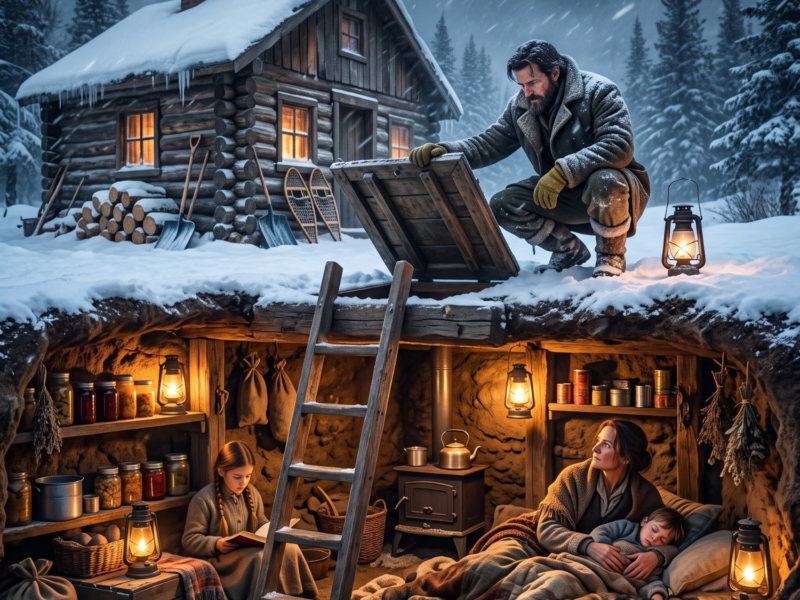
Turned Away With Two Kids, She Built a Hidden Shelter Under the Cabin — Then the Worst Blizzard Hit
The Sky Turns to Iron
The settlement of Hollow Birch Flats had been watching the sky change for ten days before the great storm finally arrived.
It was a creeping dread. The snow blew dry and horizontal across the plains before the temperature had even finished its terrifying plunge. The ancient spruce trees lining the creek seemed to sense it; they held their branches rigid and perfectly still for hours before the first serious wind struck. It was a bad omen, a sign the old-timers in the foothills knew to respect. The forest was bracing for impact.
Livestock grew frantic, pressing their bodies hard against the lee side of fences, refusing their feed, their eyes wide with animal panic. The air grew so profoundly, violently dry in the days preceding the storm that the bark of the pine trees literally cracked in the cold, sounding like split cedar snapping under an axe.
The people of the settlement prepared the only way they knew how. Men swung axes from dawn to dusk, stacking mountains of firewood inside their front rooms. Chimney flues were frantically scrubbed clean. Women spent hours stuffing torn rags, wet clay, and horsehair into the shrinking gaps of their log walls.
Gareth Mun spent two days riding between three neighboring families, helping them add height to their exterior stovepipes. He preached the gospel of fire: a taller pipe meant a stronger draft, a stronger draft meant a hotter fire, and a hotter fire meant survival.
Caspian Gale moved in the exact opposite direction.
While the town looked to the sky and their chimneys, Caspian went deeper into the dirt. He spent those same two days reinforcing the lower shale walls of the bunker with flatter, interlocking stones. He packed the seams of the dirt ceiling with a thick paste of ash and wet clay, sealing it tight. He sawed an inch off a support beam to adjust the angle of the roof, ensuring the underground space was as physically tight as possible to hold body heat efficiently.
Nola worked with a quiet, terrifying efficiency. She carried their entire winter food stores below the floorboards. Strips of salted, dried meat, sacks of hard biscuits, and two heavy clay jugs filled with fresh water were arranged meticulously along a stone shelf Caspian had built into the wall.
Ingrid, understanding the gravity of the moment, organized the spare wicks and the jars of lamp oil, placing them where they could be reached in the pitch black.
Theo, whose cough had returned with the dropping pressure, brought his small cloth bag of hand-carved wooden animals down the ladder. He set them carefully in the corner beside the bedding platform, arranging them as if they, too, needed protection from the wind.
On the morning the storm finally broke across the foothills, Caspian stood outside the cabin door.
He looked up at the sky above Hollow Birch Flats. It had gone the bruised, heavy color of old iron. The wind was already moving sideways through the spruce stand, carrying a fine, powdery, dry snow that felt like crushed glass against bare skin. The roar in the upper atmosphere sounded like a distant, massive waterfall.
He stood there just long enough to fully comprehend the scale of the violence that was coming.
Then, he turned, went back inside, and shut the heavy oak door, dropping the iron latch. He knelt in the center of the room and pressed his palm flat against the floorboards.
The cold beneath the wood was entirely different than it had been the night before. It was no longer a steady, ambient chill. It was active. It felt like it was vibrating. It was moving incredibly fast, the way the ground feels when a severe, killing freeze is driving hard and deep through the topsoil, ruthlessly hunting whatever fragile warmth remains below it.
He looked across the room at Nola. She was already lifting Theo into her arms, wrapping a heavy quilt around his shoulders.
They did not wait for the cabin to fail them. That was the first, most vital lesson Caspian had learned about underground work. You entered the earth before the structure above you became the emergency. If you waited until the roof tore off or the fire died, you were already dead.
“Go,” Caspian said.
Nola descended the ladder first, clutching Theo tightly against her chest, stepping backward into the dark. Ingrid followed, gripping the kerosene lamp, casting dancing shadows against the shale walls.
Caspian came last. He stood in the freezing cabin for one final moment. He walked over to the roaring stove, took the iron poker, and smothered the fire down to a bed of glowing red coals, closing the dampers tight.
He climbed down into the hole. Reaching back up, he grabbed the heavy wooden trapdoor and pulled the hatch shut above him, throwing the iron bolt into place.
Instantly, the storm vanished.
Not the storm itself—above the closed hatch, the blizzard was tearing across Hollow Birch Flats, screaming through the eaves of the cabin, threatening to rip the shingles from the roof.
But below, in the narrow, stone-lined room carved from the permafrost, the auditory assault ceased. With the two oil lamps burning clean and straight, the apocalyptic roar of the wind was reduced to a low, muffled thrumming, like a heartbeat felt through a thick mattress. It sounded distant, impotent, and entirely indifferent.
There was no draft. There was no cutting, razor-wire cold. The candle Ingrid had set on the stone shelf burned with a perfectly still, teardrop-shaped flame.
Theo lay on the platform, pulling his quilt up to his chin. He looked up at the low, clay ceiling for a long moment, listening to the muffled vibrations.
“It’s quiet,” the boy whispered, his eyes wide.
Nola lay down beside him, pulling him close, burying her face in his hair. She did not answer. She was looking across the small space at the mercury thermometer Caspian had hung near the intake pipe.
The red line had settled perfectly at fifty-one degrees.









