What Did Medieval Villagers Do All Winter When the Fields Were Frozen?
The Walls of Mud and Straw
The true winter had begun long before the first snowflake fell. For the peasants of Ashbury, the turning point was Michaelmas, the feast of St. Michael, at the end of September. When the final sheaves of grain were stored and the ground began to harden into iron, the heavy agricultural labor of the fields ceased.
But the people did not stop. They shifted.
Elara’s house was a fortress built of mud, spit, and ingenuity. It stood on a timber frame of oak, the spaces between the beams woven with a tight lattice of hazel sticks—the wattle. Over this, she and her late husband had smeared the daub: a thick, heavy paste of wet clay, river mud, straw, and animal dung. When it dried, it formed a shell that turned away the howling northern winds.
The windows were small, narrow slits. Glass was a luxury reserved for the great cathedrals and the manor houses of the lords. Instead, Elara’s windows were covered with thick, oiled cloth that let in a hazy, amber light, and could be shuttered tight with wood when the blizzards shrieked across the fens.
When the sun rose—usually not until the morning was well advanced, offering only eight or nine hours of anemic daylight—the village erupted into motion.
Thomas was the first out the door. He wrapped himself in multiple layers of dense wool. A linen undertunic to absorb sweat, followed by two heavy woolen tunics, thick hose, and a cowled hood. Fur was for the lords; for the peasantry, wool did the heavy lifting. The raw wool retained its natural oils, shedding the snow and trapping body heat in the tiny pockets of air between the woven threads.
But the weather was growing harsher. The village elders spoke of winters past when the rivers flowed freely all year, but now, in the shadow of a shifting climate, the rivers froze solid. The Little Ice Age was creeping over Europe, shortening the growing seasons and turning winter into an active, aggressive predator.
Thomas’s first task, before he even broke his fast, was the livestock. The animals did not care that the ground was frozen. He hauled water from the partially frozen stream, cracking the ice with the haft of his axe, and carried it back in heavy wooden pails. He checked the sheep, distributed the carefully rationed feed, and inspected the fences.
Fences were the unspoken law of the village. A broken wattle fence could allow a neighbor’s wandering pig to devour the winter cover crops, leading to bitter disputes in the manorial court and fines that could ruin a family.
While Thomas worked outside in the bitter, compressed daylight, Elara managed the true engine of the medieval winter economy: the interior of the home.
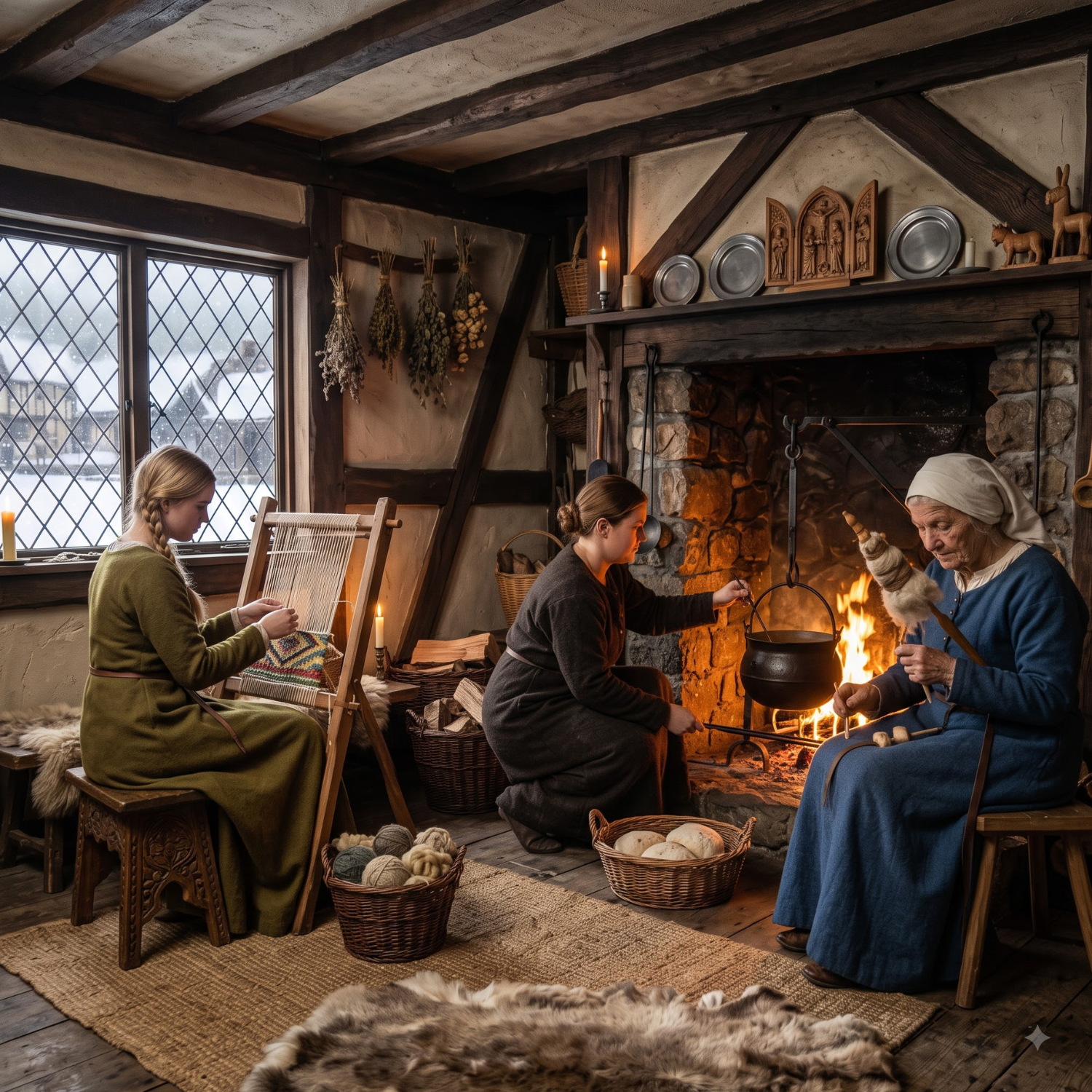
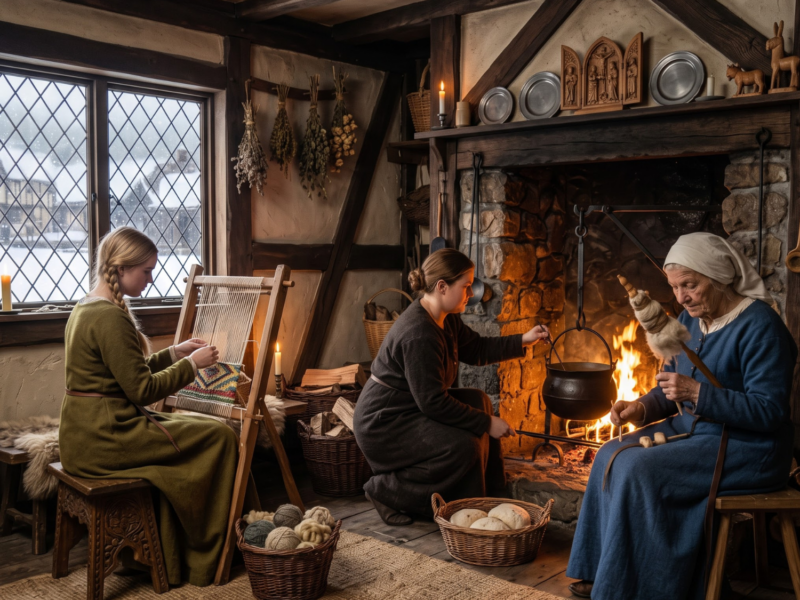
The air inside the cottage was perpetually hazy. Without a chimney, the smoke from the central hearth drifted upward, filtering slowly through the thatch or escaping out of a small hole in the roof. The acrid sting of smoke was a permanent fixture in their lives, settling in their lungs and stinging their eyes. But the alternative was freezing to death.
Every evening, when Thomas returned, his wool garments would be damp with melted snow. Wet wool lost its magic; it leached heat from the bones. And so, a nightly choreography began. The damp cloaks and hose were draped carefully near the fire to dry, filling the room with the smell of wet sheep, adding yet another layer of labor to the evening’s watch.