What Did Medieval Villagers Do All Winter When the Fields Were Frozen?
The Spinster and the Alewife
History would eventually forget the women of the medieval winter, painting them as idle figures huddled by the fire. But Elara knew the truth. When the fields froze, the women kept the world turning.
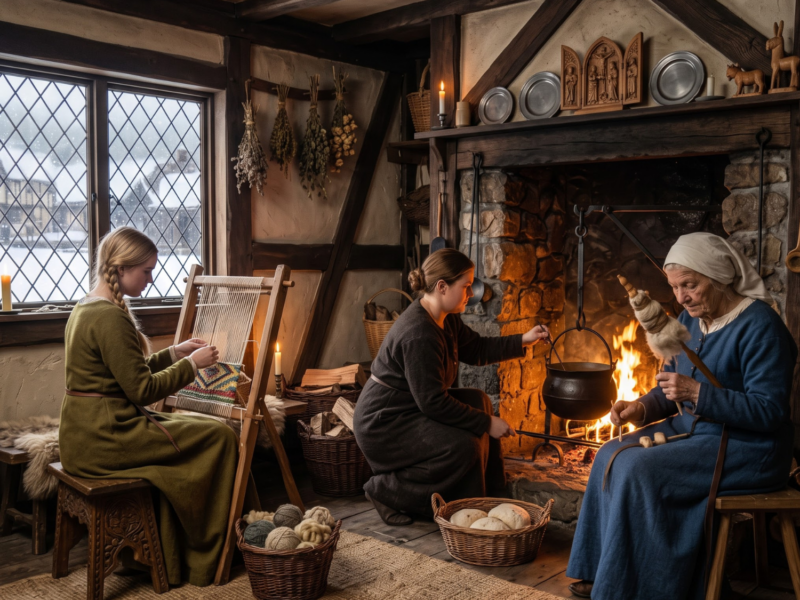
As the brief daylight faded by three in the afternoon, Elara sat by the hearth, her tools of survival in hand. Tucked under one arm was a distaff, bundled with raw, washed fleece. From her other hand dangled a wooden drop spindle.
Hour after hour, with a rhythm so ingrained it felt like breathing, her fingers teased the fibers from the distaff, twisting them into a fine thread, and setting the weighted spindle spinning to pull the yarn tight. This was the backbone of the English economy. The spinning wheel had not yet reached their village; everything was done by hand. It was agonizingly slow, repetitive work, but it was absolutely essential.
She spun not just for her family, but for the merchants. The thread she created would be sold to weavers in the larger towns, turned into the broadcloth that funded kingdoms. Women spun so universally, and relied on it so heavily for their independence, that society would eventually name unmarried women after the trade: spinsters. To Elara, the word was a badge of economic survival.
But spinning was only half her trade. Elara was an alewife.
Above the low door of her cottage hung a bundle of twigs—an ale-wand—signaling to the village of Ashbury that a fresh batch was ready.
Water was dangerous. The rivers and wells harbored invisible sicknesses that could empty a house in a week. But ale was safe. The boiling of the water, the malting of the barley, the fermentation—it killed the foulness in the water. Furthermore, it provided massive, vital calories. A pint of thick, barely fermented medieval ale delivered the energy required to chop wood or mend a roof in freezing temperatures.
Brewing was a relentless cycle. Without hops to preserve it, the ale would sour in five days. Elara’s copper tubs were constantly in use. She steeped the grain, boiled the wort, and watched over the fermentation with the eye of an alchemist.
Men drank it, women drank it, even little Bess drank a weaker “small ale” throughout the day. When the ale was ready, the manor’s official ale-taster would come to inspect the quality, ensuring she sold it at the regulation price. It was a female-dominated industry, run from the smoky, cramped kitchens of peasant women, holding the community together through hydration, calories, and the social warmth of a shared drink on a dark night.









