What Did Medieval Villagers Do All Winter When the Fields Were Frozen?
The Lord of Misrule
If winter was a long, dark tunnel, the Church provided the lanterns to guide the way. The psychological survival of the village was mapped out in festivals and fasts.
December began with Advent, a grueling four weeks of fasting. Meat was forbidden; diets were restricted. While framed as spiritual preparation, it forced the village to ration their food at the exact moment their stores were most vulnerable.
But then, just as the darkness seemed absolute and the cold unbearable, the dam broke.
Christmas arrived.
In the medieval world, Christmas was not a single day; it was a twelve-day explosion of noise, light, and gluttony, running from December 25th to the Epiphany on January 6th. For twelve days, the grinding machinery of feudal labor ceased. No fences were mended. No manorial courts were held.
The entire village shut down to celebrate survival.
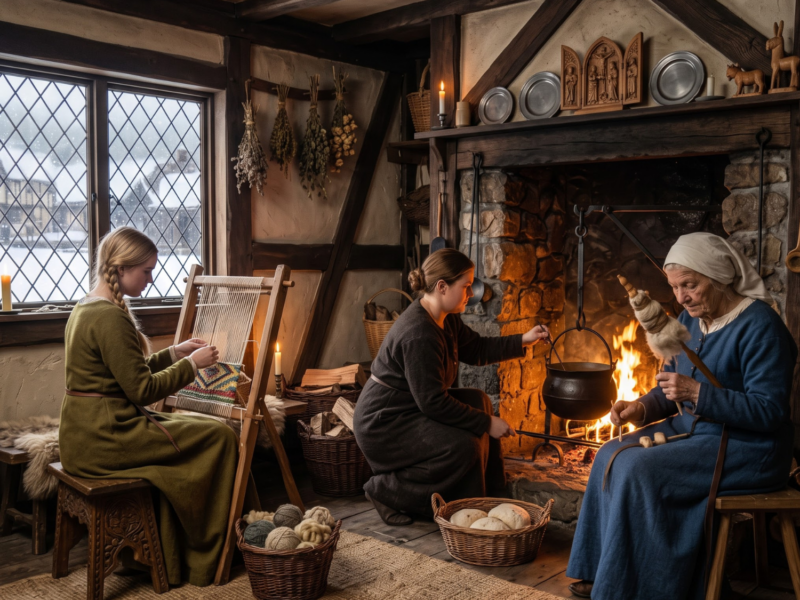
Elara watched as Kaelen hauled a massive section of a felled ash tree into the cottage—the Yule log. It was placed at the back of the hearth and lit on Christmas Eve, intended to smolder and burn for the entire twelve days.
The fasting of Advent gave way to furious feasting. Lord Harrington, bound by ancient manorial custom, opened the great hall of his manor to his tenants. Elara, Thomas, and Bess joined the rest of Ashbury in the sprawling, torch-lit hall. The villagers brought their own small contributions, but the Lord provided the meat. There were roasted oxen, salted venison, and great casks of wine and ale. For the poorest peasants, it was the only time they would taste fresh, roasted meat all year.
But the food was only half the medicine. The rest was rebellion.
During the twelve days, the rigid, suffocating social hierarchy of the medieval world was deliberately flipped on its head. A peasant was chosen—often by finding a dried bean hidden inside a cake—to be the “Lord of Misrule.”
This year, it was old Miller John. Crowned with a wreath of holly, the miller sat at the head of the table, shouting absurd, comedic orders at the knights and bailiffs, who were obligated by tradition to obey. The peasants roared with laughter, drinking deeply of Elara’s strongest ale.
Outside, the snow fell, but the village was alive with mumming. Young men and women dressed in bizarre, terrifying costumes of straw, animal skins, and masks, going from door to door, performing chaotic, comic plays in exchange for food and drink. They sang, they danced, they made a mockery of the darkness.
It was a vital psychological release. It gave the village something to look forward to during the bleakness of November, and the memories provided the spiritual fuel required to endure the punishing starvation months of late January and February.
On Twelfth Night, January 5th, the festival reached a roaring crescendo. The ale flowed like a river, the fires roared, and the village exhausted itself in a final burst of joy. At midnight, the Lord of Misrule stepped down, the masks were put away, and the brutal reality of the feudal hierarchy snapped back into place.









