What Did Medieval Villagers Do All Winter When the Fields Were Frozen?
The Turning of the Light
The first Monday after Epiphany was Plow Monday.
The holiday was over. It was time to look toward the earth again. Thomas joined the other young men of Ashbury, dragging a heavy, decorated plow through the snowy, muddy streets of the village. They knocked on doors, demanding small donations of food or pennies to fund the communal ale-drinking. If a household refused, the young men would playfully—but destructively—plow up the ground in front of the miser’s doorstep. It was a ritual to wake the sleeping earth, a reminder that the time of planting was approaching.
But the true, spiritual end of the winter did not arrive until February 2nd: Candlemas.
On this day, the entire village walked up the hill to the stone church. The wind was still vicious, the snow still deep, but the air felt different. Elara carried a single, precious beeswax candle, a luxury bought with a year’s savings.
Father Thomas stood at the altar, blessing the hundreds of candles held by the congregation. The warm, flickering light illuminated the cold stone walls of the church.
The candles were taken back to the cottages. They would be lit during violent summer thunderstorms, or placed by the beds of the sick and dying. But Candlemas held a deeper, older magic. It sat at the exact midpoint between the winter solstice and the spring equinox. Before it was a Christian feast, it had been the Celtic festival of Imbolc.
The message was identical: The light is coming back. The worst is over.
When Elara returned home, she and Bess meticulously took down the sprigs of holly and ivy that had decorated the house since Christmas. Tradition warned that any decorations left up after Candlemas would become infested with goblins—a superstitious way of enforcing the transition from the season of rest to the season of labor.
The transition to spring was not a sudden, cinematic thaw. February was a month of starvation. The salted meat was gone. The ale grain was running dangerously low. The pottage was watery and thin.
But the psychological shift had occurred.
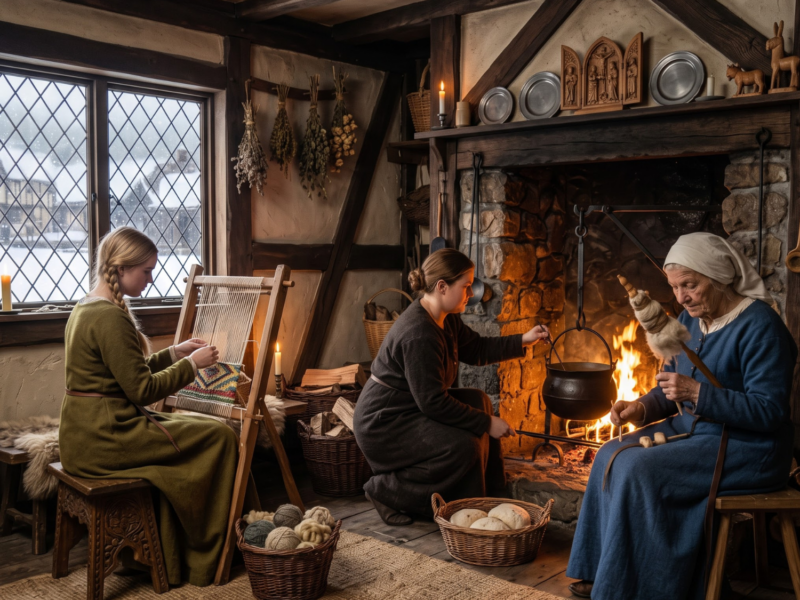
Inside the smoky cottage, the frantic pace of Elara’s spinning slowed. On warmer afternoons, she took her drop spindle outside, leaning against the wattle-and-daub wall, letting the pale sun touch her face.
The animals were led out of the longhouse, their manure shoveled out and spread over the fields to fertilize the coming crops. The air in the house grew colder without their body heat, but it also grew sweeter, cleaner.
Thomas spent hours at the blacksmith’s forge, watching as the iron plowshares, dulled by the autumn work, were heated white-hot and hammered sharp again, sending showers of sparks into the gloom.
And then, one morning in late March, as Elara walked to the edge of the forest to gather kindling, she saw it.
Pushing stubbornly through the frost-hardened mud, beneath the shadow of a thorny hedge, was a cluster of wild nettles and young sorrel. It was the first green life of the year.
She dropped to her knees and gathered them with trembling, eager hands. That night, the bitter, vibrant greens were tossed into the pottage pot. After months of eating brown, salted, and boiled stores, the sharp, fresh taste of the nettles was a revelation. It tasted like survival.
The ground softened. The heavy iron plows bit into the earth. The tightly compressed, claustrophobic world of the winter cottage opened up, spilling the villagers back out into the vast, open fields.
Epilogue: The Echoes of the Hearth
The medieval winter was not a tragedy of helpless peasants freezing in the dark. It was a masterpiece of adaptation.
The biphasic sleep, the midnight Watch, allowed their minds to rest and process the dark. The wattle and daub held the heat. The communal granaries prevented starvation. The women, spinning their wool and brewing their ale, kept the economic and social heart of the village beating when the fields were dead.
They did not merely endure the winter; they built a life inside its constraints.
Centuries later, the world would change. Gas lamps and electric bulbs would banish the shadows, compressing sleep into a single, unbroken block. Chimneys would clear the smoke from the rooms. The supermarket would erase the desperate mathematics of the autumn slaughter and the salt barrel.
But the echoes of Ashbury remained. The word spinster lingered in the language. The tradition of communal charity survived in modern mutual aid. And the deep, human instinct to gather around a source of light and warmth, to share stories when the days grow short and the wind howls at the glass, never truly faded.
In the modern era of perpetual light and endless summer produce, the intentional rhythm of the medieval winter—the collective decision to rest, to repair, to gather close, and to wait for the light—was lost.
But on the coldest nights, when the power fails and the snow piles high against the door, the ghost of the winter watch returns. And in the silence of the dark, the ancient, quiet machinery of survival waits, just as it always has, for the sun to rise again.









